

Turkish, Egyptian and Kurdish migrants in UK could be deported to their home countries

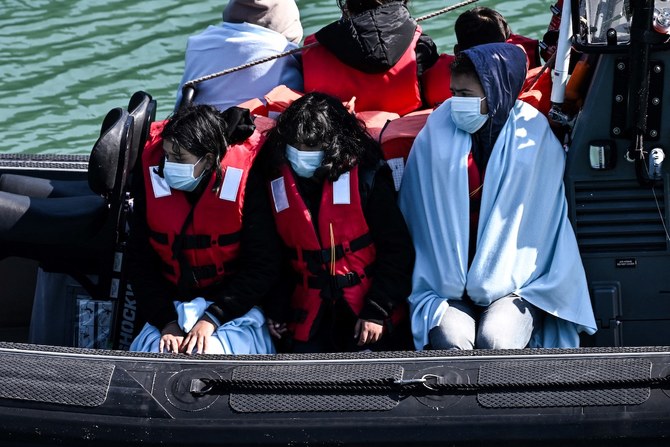
Migrants are seen on the UK Border Force rubber dinghy, after they were picked up at sea while attempting to cross the English Channel. (File/AFP)
Short Url
Updated 12 November 2023
Follow

Turkish, Egyptian and Kurdish migrants in UK could be deported to their home countries

  • Decision comes ahead of the Supreme Court’s ruling next week on the legality of Rwanda deportation scheme

LONDON: Turkish, Egyptian and Kurdish migrants from Iraq who arrive in the UK illegally could be immediately deported to their home countries as the government considers expanding its list of “safe” countries, the Telegraph reported on Sunday.

These nationalities represent a significant portion of the nearly 4,000 migrant arrivals by the end of August. The government believes adding these countries to the existing safe list, which includes the EU, Switzerland and Albania, would streamline the process of denying asylum claims and expedite repatriation.

The decision comes ahead of the Supreme Court’s ruling next week on the legality of the government’s Rwanda deportation scheme, which was delayed after being blocked by the European Court of Human Rights in 2022.

If deemed lawful, deportations to Rwanda might start in January, but if found illegal, there could be calls for the UK to leave the ECHR.

In the eight months to the end of August, Turkiye accounted for 2,121 Channel migrants, while Egypt accounted for 679, and Iraq accounted for 1,774. Turkiye and Egypt are reportedly being actively considered for inclusion on the safe list, the Telegraph reported.

However, the designation of Iraq as a safe country is complicated by continuing sectarian violence, particularly affecting the significant number of Kurdish Iraqi asylum seekers. Immigration Minister Robert Jenrick discussed the issue last week in a meeting with the foreign secretary of the Kurdish regional government, the Telegraph reported.

Expanding the safe list would facilitate deportations directly to migrants’ home countries, potentially reducing the need to relocate migrants to Rwanda. However, Enver Solomon, chief executive of the Refugee Council, told the Telegraph that the government “should be focusing on operating an orderly, humane and fair asylum system, treating people with humanity and dignity, as well as expanding safe routes to the UK.”


Only 4% women on ballot as Bangladesh prepares for post-Hasina vote

Updated 5 sec ago
Follow

Only 4% women on ballot as Bangladesh prepares for post-Hasina vote

  • Women PMs have ruled Bangladesh for over half of its independent history
  • For 2026 vote, only 20 out of 51 political parties nominated female candidates

DHAKA: As Bangladesh prepares for the first election since the ouster of its long-serving ex-prime minister Sheikh Hasina, only 4 percent of the registered candidates are women, as more than half of the political parties did not field female candidates.

The vote on Feb. 12 will bring in new leadership after an 18-month rule of the caretaker administration that took control following the student-led uprising that ended 15 years in power of Hasina’s Awami League party.

Nearly 128 million Bangladeshis will head to the polls, but while more than 62 million of them are women, the percentage of female candidates in the race is incomparably lower, despite last year’s consensus reached by political parties to have at least 5 percent women on their lists.

According to the Election Commission, among 1,981 candidates only 81 are women, in a country that in its 54 years of independence had for 32 years been led by women prime ministers — Hasina and her late rival Khaleda Zia.

According to Dr. Rasheda Rawnak Khan from the Department of Anthropology at Dhaka University, women’s political participation was neither reflected by the rule of Hasina nor Zia.

“Bangladesh has had women rulers, not women’s rule,” Khan told Arab News. “The structure of party politics in Bangladesh is deeply patriarchal.”

Only 20 out of 51 political parties nominated female candidates for the 2026 vote. Percentage-wise, the Bangladesh Socialist Party was leading with nine women, or 34 percent of its candidates.

The election’s main contender, the Bangladesh Nationalist Party, whose former leader Zia in 1991 became the second woman prime minister of a predominantly Muslim nation — after Pakistan’s Benazir Bhutto — was the party that last year put forward the 5 percent quota for women.

For the upcoming vote, however, it ended up nominating only 10 women, or 3.5 percent of its 288 candidates.

The second-largest party, Jamaat-e-Islami, has not nominated a single woman.

The 4 percent participation is lower than in the previous election in 2024, when it was slightly above 5 percent, but there was no decreasing trend. In 2019, the rate was 5.9 percent, and 4 percent in 2014.

“We have not seen any independent women’s political movement or institutional activities earlier, from where women could now participate in the election independently,” Khan said.

“Real political participation is different and difficult as well in this patriarchal society, where we need to establish internal party democracy, protection from political violence, ensure direct election, and cultural shifts around female leadership.”

While the 2024 student-led uprising featured a prominent presence of women activists, Election Commission data shows that this has not translated into their political participation, with very few women contesting the upcoming polls.

“In the student movement, women were recruited because they were useful, presentable for rallies and protests both on campus and in the field of political legitimacy. Women were kept at the forefront for exhibiting some sort of ‘inclusive’ images to the media and the people,” Khan said.

“To become a candidate in the general election, one needs to have a powerful mentor, money, muscle power, control over party people, activists, and locals. Within the male-dominated networks, it’s very difficult for women to get all these things.”