


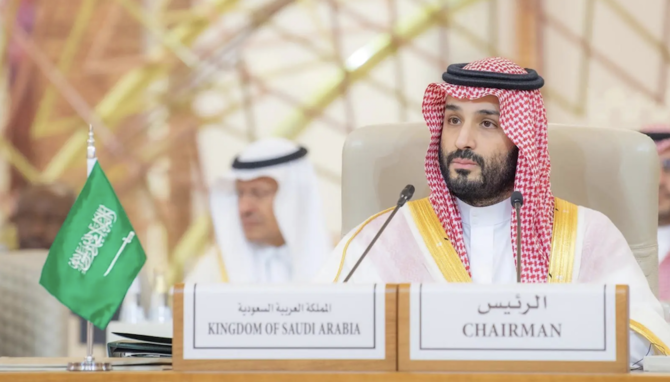
RIYADH: The leaders of 50 nations from across the Middle East and Africa gathered in Riyadh on Friday for the inaugural Saudi-African Summit.
The event, which followed the Saudi-Arab African Economic Summit on Thursday, sought to enhance political coordination between African nations and the Kingdom. It addressed regional security threats, championed economic transformation through new partnerships and research, and boosted local development for new energy solutions and investment cooperation.
At Thursday’s meeting, the Saudi Fund for Development announced it would sign agreements worth 2 billion riyals ($533 million) with African countries.
In his opening remarks on Friday, Crown Prince Mohammed bin Salman reiterated the Kingdom’s “condemnation of the Israeli occupation authorities’ violation of international humanitarian law in Gaza.”
HIGHLIGHTS
• At Thursday’s meeting, the Saudi Fund for Development announced it would sign agreements worth 2 billion riyals with African countries.
• In his opening remarks on Friday, Crown Prince Mohammed bin Salman reiterated the Kingdom’s ‘condemnation of the Israeli occupation authorities’ violation of international humanitarian law in Gaza.’
He continued: “We stress the necessity of stopping this war and forced displacement, and creating the conditions for the return of stability and peace.”
His words were echoed by several African leaders.
Pravind Kumar Jugnauth, the prime minister of Mauritius, said: “We also reaffirm our support for a two-state solution, which is the only way forward to lasting peace in the region.”
Before making his speech, Chad’s President Mahamat Idriss Deby asked for a moment of silence to remember the Palestinian victims of the conflict.
“Despite this summit being held during a troubling time, we must nonetheless seek to buttress the cooperation and enhance our partnerships to face these challenges at a time of human loss,” he said.
“I call upon the Kingdom of Saudi Arabia and African nations to support development for the mutual benefit of all countries and forge partnerships based on mutual interests and respect of all parties in various areas, whether these be political, economic, trade, humanitarian or environmental.”
Other leaders expressed their nations’ desire to see an immediate ceasefire in Gaza that would end the humanitarian suffering and work toward establishing peace.
Deby said also he was “saddened” by the war in Sudan, which he said had “greatly affected the economic and social situation in Chad.”
“I take this opportunity to mention that there are a lot of displaced citizens of Sudan (in Chad) and we have called multiple times to resolve the issue and Chad is providing the necessary support.”
Besides the conflict in Gaza, the Saudi-Africa Summit took place against the backdrop of several global and regional challenges, including climate change, the aftermath of the coronavirus pandemic, the wars in Sudan and Ukraine, inflation, water scarcity and food security.
Several leaders spoke of the partnership and friendship between Saudi Arabia and the African continent, which dates back to a period between the 1950s and 1970s when several African nations gained their independence.
Ethiopian Prime Minister Abiy Ahmed Ali, whose country continues to face unrest a year after the end of the Tigray War, highlighted the importance of Saudi-African relations and the potential for future collaborative endeavors.
He praised the Kingdom’s commitment to investing in Africa, especially in sectors such as renewable energy, infrastructure, agriculture, healthcare and education and expressed Ethiopia’s eagerness to continue fostering economic relations that contribute to the social development of African nations.
Ethiopia is one of the region’s fastest-growing economies but also one of its poorest. Between 1995 and 2021, the value of Saudi exports to Ethiopia grew by about 33 percent to $174 million.
Abiy spoke to the crown prince on the sidelines of the summit.
Nigeria’s President Bola Tinubu, whose reforms in recent decades have been well received overseas, said his country was keen to attract further foreign direct investment to support infrastructure development.
He also noted the potential of an enhanced diplomatic and economic relationship with Saudi Arabia.
On the sidelines of the conference, the Kingdom’s Minister of State for Foreign Affairs Adel Al-Jubeir met President Filipe Nyusi of Mozambique and Burundi’s Minister of Foreign Affairs Albert Chingyor.
The success of the Saudi-African Summit depends on its ability to strengthen the historical and economic ties between the two sides.
Abdel Fattah Al-Burhan, chairman of Sudan’s Transitional Sovereign Council, said: “Sudan will always be a supporter of the Saudi-African partnership, benefiting from its geographical location that links the continent of Africa with the Horn of Arabia, and we are happy for the partnership and look forward to its success.
“We desire to be a bridge between the African continent and the Kingdom of Saudi Arabia.”
At the end of October, Sudan’s warring parties resumed talks in the Kingdom to end a conflict that has raged for more than six months and left thousands dead.


