Qatar’s emir visits Egypt for talks on ending Gaza violence

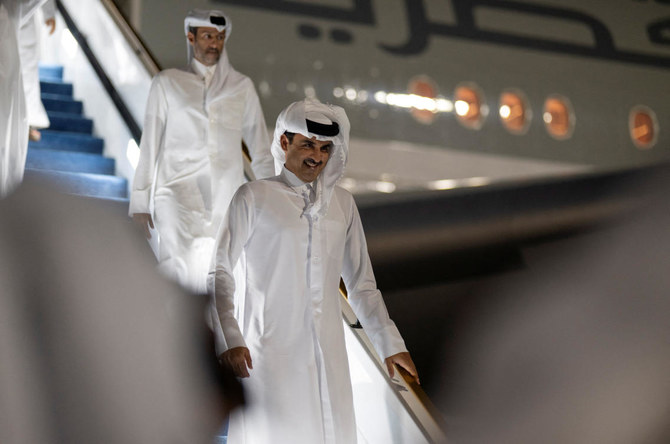
Before landing in Egypt, Qatar's Emir Sheikh Tamim bin Hamad al-Thani was in Abu Dhabi to stress need for immediate ceasefire during talks with his Emirati counterpart Sheikh Mohamed bin Zayed. (File/Reuters)
Short Url
Updated 10 November 2023
Follow

Qatar’s emir visits Egypt for talks on ending Gaza violence

  • Leaders will cover ways to calm the situation in Gaza and provide humanitarian relief
  • Qatari emir’s visit comes a day after Qatar’s prime minister met the chiefs of the US Central Intelligence Agency (CIA) and Israeli spy agency Mossad in Doha

CAIRO: The leaders of Qatar and Egypt met in Cairo on Friday, both hoping to mediate a de-escalation of violence in the Gaza Strip, the provision of humanitarian aid and the release of Israeli hostages.
The talks between Egyptian President Abdel Fattah El-Sisi and Emir Sheikh Tamim bin Hamad Al Thani discussed intensified efforts to achieve a cease-fire in Gaza and the delivery of sufficient quantities of aid for its 2.3 million besieged residents, a statement from El-Sisi’s office said.
Qatar said “joint efforts to stop the aggression against Gaza, reduce escalation and bring in urgent humanitarian aid” were discussed.
The Qatari emir’s visit comes a day after Qatar’s prime minister met the chiefs of the US Central Intelligence Agency (CIA) and Israeli spy agency Mossad in Doha to discuss the parameters of a deal for a hostage release and a pause in fighting between Israel and Hamas.
Qatar, where several Hamas political leaders are based, has been leading mediation between the Palestinian militant group and Israeli officials for the release of more than 240 hostages taken by Hamas militants on Oct. 7, in an attack in which Israel says 1,400 people were killed.
Since then Israel has launched an unrelenting bombardment and an armored invasion of Hamas-ruled Gaza, where more than 10,000 people have been killed, according to Palestinian officials.
Egypt also has contacts with Hamas and Israel and has been involved in negotiations, including for the provision of aid through its Rafah border crossing with Gaza and the evacuation from the territory of foreign passport holders and some Palestinians requiring urgent medical treatment.
Evacuations through Rafah restarted on Thursday following a pause after the Red Cross said one of its convoys escorting evacuees was targeted inside Gaza.
The United Nations said 65 aid trucks entered Gaza from Egypt on Thursday, well below the number needed to address a deepening humanitarian crisis.
The United States said on Thursday that Israel had agreed to daily four-hour pauses in the north of Gaza and the operation of corridors for civilians to move south, though there was no sign of a let-up in the fighting.


‘People are suffering in a way you can’t even imagine’: Al Arabiya journalist recounts Sudan devastation

Updated 9 sec ago
Follow

‘People are suffering in a way you can’t even imagine’: Al Arabiya journalist recounts Sudan devastation

  • Al Arabiya anchor Layal Alekhtiar’s journey through Sudan exposes the brutal reality behind the headlines
  • Millions are displaced, aid deliveries blocked, and camps are filled with traumatized women and children

RIYADH: Al Arabiya anchor Layal Alekhtiar arrived in Sudan expecting to interview the de facto president. What she encountered along the way, over six harrowing days on the ground, reshaped her understanding of violence, survival, and the limits of language itself.

Speaking to Arab News after her return, Alekhtiar described what she witnessed not as collateral damage or the fog of war, but as something far more deliberate and systematic: a “gender-ethnic genocide.”

What she saw was a campaign of targeted killings of men and the mass rape of women that has shattered entire communities and displaced millions. “People are suffering, suffering in a way you cannot imagine,” Alekhtiar told Arab News.

“Firstly, I am speaking about the displaced people in the refugee camps. Fifty percent of the women who had arrived there had been raped. These are the women I encountered in the camps.

“For them (the militias), this is something they have to do to the women before allowing them to exit the war zone that they are in.

“Some of the women are much older, some of them are young girls, very young girls, 13, 14, 15, 16, and they have children who they don’t even know who the father is because they were raped by three or four, multiple masked men.”

Since the conflict erupted in April 2023, the civil war in Sudan — driven by a power struggle between the Sudanese Armed Forces and the Rapid Support Forces — has displaced millions and left a trail of murder and sexual violence in its wake.

Alekhtiar does not believe placing further sanctions on Sudan is necessarily the solution. (Supplied)

Men are killed before reaching aid sites while women and girls are often raped so violently they require surgery. Mothers are found dead, still clutching their children. Pregnancies from gang rape are widespread.

This was not abstract reporting for Alekhtiar. It was what she saw.

She travelled to Port Sudan on Dec. 2 to interview Abdel Fattah Al-Burhan, the head of the Sudanese Armed Forces and Sudan’s de facto president.

However, at the request of his office, the interview was to take place in Khartoum — a city without functioning airport infrastructure and retaken from the RSF only in March.

With a small team — a videographer, producer and driver — Alekhtiar undertook the gruelling 12-hour drive from Port Sudan to the capital.

“Looking from one area to another area, you see the difference, you see the depression, you see it on the faces, you see it on the street, you see it everywhere, and you see the effect of the war,” she said.

The destruction was physical as well as psychological. “We saw so many cars and even RSF trucks that were scorched and burned on the side of the road.”

What unsettled her most was not only the scale of the devastation, but the fact that it was inflicted by Sudanese on Sudanese.

“What I have heard from them, there is no way someone can be a human being and can do that. No way. It’s impossible,” she said.

“And the way the city, the way Khartoum is destroyed, no way a person in their own country would do something like this. It’s crazy.”

Along the journey, Alekhtiar spoke to locals wherever she could, asking what they wanted from a war that had consumed their lives.

“They don’t want war. Definitely, they want peace. All of them want that. But at the same time they will not accept being under the leadership of the RSF. For them, there’s no way. And this is something I have heard from all of the people I have spoken to. I did not hear otherwise.”

From outside Sudan, the conflict is often reduced to brief news alerts. Alekhtiar says those accounts fall far short. When asked whether the coverage reflects reality on the ground, she replied without hesitation: “No, not at all, not at all.”

Nearly everyone she met had lost everything — homes destroyed, savings wiped out when banks were looted and burned. According to UNHCR, nearly 13 million people have been forced from their homes, including 8.6 million internally displaced.

Alekhtiar does not believe placing further sanctions on Sudan is necessarily the solution. (Supplied)

On the road from Port Sudan to Khartoum, the scale of death was impossible to ignore. Alekhtiar recalls seeing clouds of flies everywhere, drawn by bodies buried hastily or not at all along the route.

During her six days in the country, her team stopped in Al-Dabbah, where UNHCR tents shelter displaced civilians. What she saw there still stays with her. “I want to emphasize one thing and it is very alarming,” she said.

“What I was witnessing in the camps was only women and children; there were no men. The only men I saw were very old in age. It’s a genocide. They are killing all men. They cannot go out.

“What we saw in the videos, it was real,” she said, referring to the graphic footage of atrocities circulating on social media. “It’s not true that it was one video and the reality is different than that. No, it was real.

“It’s a gender-ethnic issue. It is really a genocide. I’m not just using the word genocide for the sake of using the word. This is actually a genocide.”

Life in the camps was defined by scarcity. There were no spare clothes, almost no supplies, and most people slept directly on the ground. The UN was scrambling to respond, Alekhtiar said, but had never anticipated displacement on this scale.

She watched buses arrive packed with women, screaming babies in their arms. When she asked why the infants were crying, the answer was devastatingly simple.

“Because they are hungry … they are breastfeeding and we cannot feed them because we have not eaten,” they told her. The women’s bodies, starved and exhausted, could no longer produce milk.

UN staff told Alekhtiar they lacked resources as funding was insufficient. RSF fighters were also blocking the main roads, preventing aid from reaching those who needed it most.

Alekhtiar wished she had more time in the camps because this — bearing witness and amplifying suffering — is the core purpose of journalism, she said.

What the women told her there continues to haunt her. Rape survivors said they were treated as slaves, stripped of humanity by their attackers. “They need help, on a psychological level, human level, all levels,” Alekhtiar said.

“These women, I don’t know how they will live later. Some of them cannot talk. They are sitting and looking at me; they cannot talk. Some of them keep crying all day long. Some of them don’t go out of the tent.

“Some of them have kids with them. They don’t know who these kids are, because they found them on their way, and they took them, because they were children alone.

“One woman told me she took a child from his mother’s arms who was murdered, and the child doesn’t speak, even at his age of 3 years, he stopped being able to speak. So many stories, so many stories.

“The problem is the war is still ongoing, and they will come from other cities in their millions. We are not talking about tens or hundreds of thousands. We are talking about millions.”

Alekhtiar does not believe placing further sanctions on Sudan is necessarily the solution.

Alekhtiar does not believe placing further sanctions on Sudan is necessarily the solution. (Supplied)

“The international community, countries, right now are announcing sanctions on Sudan, but that’s not enough,” she said.

“What people need there is support, humanitarian support, and they need real support from the whole world to stop this war because it’s not a normal war.

“A whole race is being killed. Being killed because they want to change the identity of one region. It’s a genocide.”

International sanctions have targeted individuals accused of mass killings and systematic sexual violence. The UK has sanctioned senior RSF commanders over abuses in El-Fasher.

The US, meanwhile, has sanctioned the Sudanese Armed Forces over the use of chlorine gas, a chemical weapon that can cause fatal respiratory damage.

Asked about her own experience in the field, Alekhtiar said the availability of clean water was among the biggest challenges she faced.

“Showering was not an option,” she said, as most water came out black, contaminated, its contents unknown.

She barely ate, overwhelmed by what she was witnessing.

“I was crying all the time there, to be honest. I was sick for two days when I arrived back,” she said.

“After you leave, you become grateful for what you have when you see the suffering of others. They changed my whole perspective on life. It changed me a lot.”