

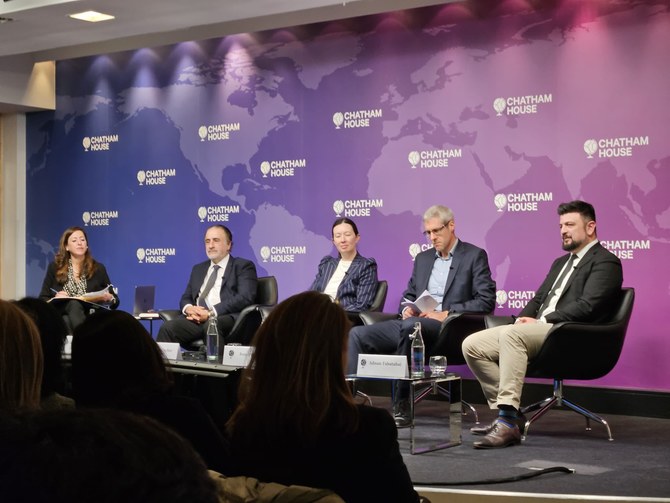

LONDON: Accountability, the fight against corruption, and maintaining stability remain the central focus in Iraq as the country seeks to ensure future peace and prosperity, a panel gathered by Chatham House in London has heard.
The Iraq Initiative brought together speakers from a variety of backgrounds to discuss the Iraqi economy, policies, and the effects of climate change.
Renad Mansour, a senior fellow and director of the Iraq Initiative at Chatham House, said that although the country has benefited from unprecedented stability, how to maintain it remains the question.
“Accountability matters. Iraq’s history has been almost cyclical with the same problems,” he said. “Corruption kills; it is the ultimate impediment for reform.
“If there is no upholding a clean rule of law then you can be sure, for example, that corruption in the medical sector will terminate patients, given the medication and treatments being used are fake.”
He added: “The elite must be held accountable in order for the country to progress.”
Referring to continuing violence between militias in Iraq and the Yazidis’ predicament, Rebar Ahmed, minister of interior in the Kurdistan Regional Government, said: “We need to be humble about the mistakes that continue since 2005. We need to address the fact that there is distrust between ruling parties. It seems every group in the country is fending for itself and being looked after solely by their representatives in government.”
Abbas Al-Ameri, a political adviser in the Iraqi parliament, said that the economic challenges and complexities surrounding the federal budget allocation are influenced by external factors, and Baghdad should not bear the blame alone.
“The fluctuation of the dollar, the changes in the price of oil, and the fact that Washington ultimately does what serves its personal interests all have effects on our economy,” he said, adding that “all (Iraqi) ministers must do their jobs; there are also problems found the in KRG.”
Lahib Higel, a Crisis Group senior analyst, warned that “the country is always at risk of being dragged back into conflict. It witnessed a relative period of peace, but this has changed since the events of Oct. 7 between Hamas and Israel.”
He added: “The ethno-sectarian system has failed; it does not correctly represent any Iraqi.”
In their final remarks, the panel stressed the importance of sparing Iraq another war.
In another panel, Hanaa Edwar, founder of the Iraqi Women’s Network, voiced concerns over the government crackdown on speech, civil society, and women’s rights.
“Lack of accountability remains rampant in our society,” she said, citing the assassination of security adviser Husham Al-Hashimi in 2020, with the perpetrator not yet brought to justice.
She also said that “women do not feel safe in the streets or in their homes.”
The panelists unanimously expressed solidarity with Palestine, saying their upbringing as Iraqis instilled in them a commitment to the Palestinian cause.
However, Yaser Mekki, co-founder and director of Moja, described boycotting brands and companies that support Israel as a “romantic” idea, adding that it was not practical.
Farris Haram, a poet and activist, disagreed, saying: “Boycotting absolutely works. How else was India freed from British colonization? How did Africa end apartheid?”
But he said that “the boycotting of armed groups, political ideologies, and their representatives” also yielded positive outcomes.
Unemployment remains a major issue in Iraq and a leading cause of youth frustration.
Hayder Al-Shakeri, a research fellow at Chatham House, said that Iraqi youth realize how rich their country is and do not wish to leave, but “corruption remains a big problem.”
He added that the private sector continues to be controlled by the country’s elite, and while jobs were created this year, the future depends on oil price stability.
The climate emergency in Iraq has escalated to alarming levels, casting a shadow over the future.
Iraqi environmentalist and academic Shukri Al-Hassan said that Basra, home to the country’s biggest oil reserves, was “suffering.”
He said: “Palm trees have almost disappeared there. While military actions are partly to blame, it is the climate that is the main cause. Water levels are 45 percent lower than what it used to be.”
Panelists agreed that while there are initiatives, both locally and diplomatically, to mitigate the water problem, corruption in government institutions remains a major obstacle.
But Glada Lahn, an environment senior research fellow at Chatham House, believes there is a silver lining.
“There is an opportunity stemming from political will,” she said. “The prime minister (Mohammed Shia Al-Sudani) seems to be giving a lot of attention to this climate change problem,” with “moves of rapprochement toward other countries that will stabilize the problem.”
Panelists warned that without sustained accountability in Iraq, the nation’s issues could spill over regionally and internationally, manifesting as unrest, increased immigration, and diplomatic tensions.


