

Pakistan seeks enhanced regional integration at ECO summit amid shifting Central Asian dynamics

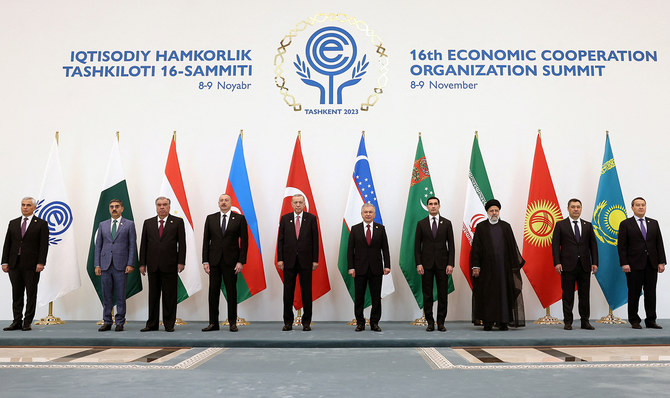
Turkey's President Tayyip Erdogan poses with Pakistan's caretaker Prime Minister Anwaar-ul-Haq Kakar, Tajik President Emomali Rakhmon, Azerbaijani President Ilham Aliyev, Uzbek President Shavkat Mirziyoyev, Turkmen President Serdar Berdymukhamedov, Iranian President Ebrahim Raisi, Kyrgyz President Sadyr Japarov and Kazakh Prime Minister Alikhan Smailov for a group photo during the 16th Economic Cooperation Organization Summit in Tashkent, Uzbekistan November 9, 2023. (Turkish Presidential Press Office/Handout via REUTERS)
Short Url
Updated 09 November 2023
Follow

Pakistan seeks enhanced regional integration at ECO summit amid shifting Central Asian dynamics

  • Anwaar-ul-Haq Kakar says ECO is only contributing two percent to global and eight percent to regional trade
  • He points out that the forum needs to become more competitive and reduce barriers to economic integration

ISLAMABAD: Caretaker Prime Minister Anwaar-ul-Haq Kakar emphasized regional integration while addressing the 16th Economic Cooperation Organization (ECO) Summit in Tashkent on Thursday, saying that the regional forum was only contributing two percent to the overall global trade despite its enormous potential.

The ECO, an intergovernmental organization, was established by Pakistan, Iran and Turkey in 1985 before expanding its membership to include Central Asian states that have traditionally remained under the Russian influence.

These countries are now striving to explore more international partnerships amid Moscow’s weakening hold on the region in the wake of its decision to invade Ukraine. They are also trying to bolster their landlocked economies by trying to access the sea via Pakistani ports located on the Arabian Sea.

The Pakistani prime minister, who arrived in Tashkent a day earlier, thanked the Uzbek authorities for extending a warm welcome ahead of the summit.

“The ECO region is blessed with natural resources, geographical contiguity, enterprising people and a cultural heritage that can serve as a basis to expand trade and economic integration in this area,” he said during his address to the forum. “Nevertheless, despite our enormous potential and infinite resources, we have a share of only two percent in the global trade and eight percent in intra-regional trade.”

The prime minister noted the ECO states’ overall imports within the region were only recorded at $39 billion in 2022 against the total world imports of $577 billion in the same period. Similarly, he added, the bloc’s intra-regional exports stood at $46 billion compared to the total world exports of $459 billion.

“This shows how the region has still not been able to achieve its true potential of increasing exports from the ECO region to the world,” he said.

The prime minister said it was important for ECO member states to figure out how they could increase their share in the global and intra-regional trade, become more competitive and reduce barriers to economic integration.

“Let’s make ECO the organization not just of words but action, not just of commitments but implementation,” he added.

Kakar congratulated Iran for taking over the 2024 ECO presidency while announcing that the organization’s next secretary-general would be from Pakistan.

He has held meetings with Uzbekistan President Shavkat Mirziyoyev along with Azerbaijan President Ilham Aliyev on the sidelines of the event.

The prime minister is also expected to visit the historical city of Samarkand where he will go to the shrine Imam Bukhari, a 9th-century Islamic scholar who played a pivotal role in the compilation of Hadith literature.


Imran Khan not a ‘national security threat,’ ex-PM’s party responds to Pakistan military

Updated 06 December 2025
Follow

Imran Khan not a ‘national security threat,’ ex-PM’s party responds to Pakistan military

  • Pakistan’s military spokesperson on Friday described Khan’s anti-army narrative as a “national security threat”
  • PTI Chairman Gohar Ali Khan says words used by military spokesperson for Khan were “not appropriate”

ISLAMABAD: Former prime minister Imran Khan’s Pakistan Tehreek-e-Insaf (PTI) party on Saturday responded to allegations by Pakistan military spokesperson Lt. Gen. Ahmed Sharif Chaudhry from a day earlier, saying that he was not a “national security threat.”

Chaudhry, who heads the military’s media wing as director general of the Inter-Services Public Relations (ISPR), spoke to journalists on Friday, in which he referred to Khan as a “mentally ill” person several times during the press interaction. Chaudhry described Khan’s anti-army narrative as a “national security threat.”

The military spokesperson was responding to Khan’s social media post this week in which he accused Chief of Defense Forces Field Marshal Asim Munir of being responsible for “the complete collapse of the constitution and rule of law in Pakistan.” 

“The people of Pakistan stand with Imran Khan, they stand with PTI,” the party’s secretary-general, Salman Akram Raja, told reporters during a news conference. 

“Imran Khan is not a national security threat. Imran Khan has kept the people of this country united.”

Raja said there were several narratives in the country, including those that created tensions along ethnic and sectarian lines, but Khan had rejected all of them and stood with one that the people of Pakistan supported. 

PTI Chairman Gohar Ali Khan, flanked by Raja, criticized the military spokesperson as well, saying his press talk on Thursday had “severely disappointed” him. 

“The words that were used [by the military spokesperson] were not appropriate,” Gohar said. “Those words were wrong.”

NATURAL OUTCOME’

Speaking to reporters earlier on Saturday, Pakistan’s Defense Minister Khawaja Asif defended the military spokesperson’s remarks against Khan.

“When this kind of language is used for individuals as well as for institutions, then a reaction is a natural outcome,” he said. 

“The same thing is happening on the Twitter accounts being run in his [Khan’s] name. If the DG ISPR has given any reaction to it, then I believe it was a very measured reaction.”

Khan, who was ousted after a parliamentary vote of confidence in April 2022, blames the country’s powerful military for removing him from power by colluding with his political opponents. Both deny the allegations. 

The former prime minister, who has been in prison since August 2023 on a slew of charges he says are politically motivated, also alleges his party was denied victory by the army and his political rivals in the 2024 general election through rigging. 

The army and the government both deny his allegations.