Pakistan PM to address 16th ECO Summit in Tashkent, discuss regional connectivity

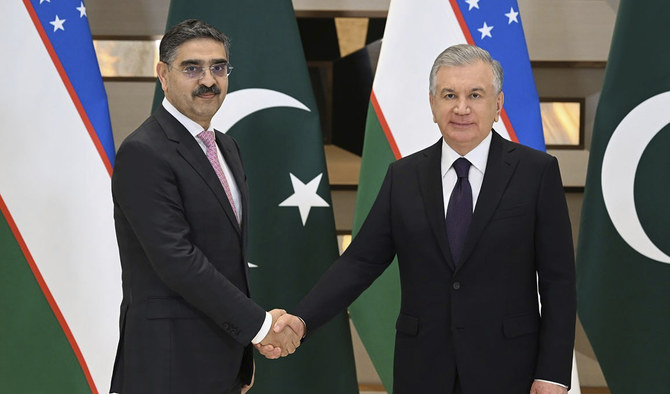
In this photo released by Uzbekistan's President Press Office, Uzbekistan's President Shavkat Mirziyoyev, right, and Pakistan's interim Prime Minister Anwaar-ul-Haq Kakar, left, shake hands in Tashkent, Uzbekistan, Wednesday, Nov. 8, 2023 on the eve of the Summit of the Economic Cooperation Organization (ECO). (Uzbekistan's President Press Office via AP)
Short Url
Updated 09 November 2023
Follow

Pakistan PM to address 16th ECO Summit in Tashkent, discuss regional connectivity

  • PM Kakar has met the Uzbekistan president and will hold a meeting Azerbaijan’s leader Ilham Aliyev
  • The prime minister is expected to visit Samarkand today where he will go to Imam Bukhari’s shrine

ISLAMABAD: Caretaker Prime Minister Anwaar-ul-Haq Kakar is scheduled to address the 16th Economic Cooperation Organization (ECO) Summit in Tashkent on Thursday and attend a reception arranged in the honor of the leaders of participating countries, confirmed his office in Islamabad.
The ECO, an intergovernmental organization, was established by Pakistan, Iran and Turkiye in 1985 and has since expanded its membership to include Afghanistan, Uzbekistan and other Central Asian countries.
Kakar arrived in Uzbekistan on Wednesday to discuss issues related to enhanced trade and regional connectivity.
“The Prime Minister will meet the President of Azerbaijan, Ilham Aliyev,” said the PM Office while sharing his schedule for the day. “Bilateral relations of Azerbaijan and Pakistan, regional and global issues will be discussed in the said meeting.”
“The Prime Minister is also expected to visit the historical city of Samarkand, Uzbekistan, where he will go to the shrine of Hazrat Imam Bukhari,” the statement added.
The Pakistani premier has already held meetings with Uzbekistan President Shavkat Mirziyoyev and ECO Secretary-General Khusrav Noziri since his arrival in the Central Asian country.
The meetings reviewed the recent developments under the purview of ECO, especially in the domain of trade, connectivity and economic cooperation.
The Pakistan PM also expressed satisfaction at the growing level of bilateral cooperation during his meeting with the Uzbekistan president while emphasizing the importance of sustaining the momentum.
The regional forum aims to utilize the economic potential of its member states that collectively form a mammoth market of over 500 million people by creating increased trade and investment opportunities.


Pakistan finance chief calls for change to population-based revenue-sharing formula

Updated 6 sec ago
Follow

Pakistan finance chief calls for change to population-based revenue-sharing formula

  • Muhammad Aurangzeb criticizes current NFC formula, says it is holding back development
  • Minister says Pakistan to repay $1.3 billion debt in April as economic indicators improve

ISLAMABAD: Pakistan’s Finance Minister Muhammad Aurangzeb said on Saturday the country’s revenue-sharing formula between the federal and provincial governments “has to change,” arguing that allocating the bulk of funds on the basis of population was holding back long-term development.

The revenue-sharing is done under the National Finance Commission (NFC) Award that determines how federally collected taxes are divided between the center and the provinces. Under the current formula, much of the distribution weight is based on population, with smaller weightages assigned to factors such as poverty, revenue generation and inverse population density.

“Under the NFC award, 82 percent allocation is done on the basis of population,” Aurangzeb said while addressing the Federation of Pakistan Chambers of Commerce & Industry’s regional office in Lahore. “This has to change. This is one area which is going to hold us back from realizing the full potential of this country.”

Economists and policy analysts have long suggested broadening the NFC criteria to give greater weight to tax effort, human development indicators and environmental risk, though any change would require political consensus among provinces, making reform politically sensitive.

Aurangzeb also highlighted the economic achievements of the country in recent years, saying Pakistan’s import cover had improved from roughly two weeks just a few years ago to about 2.5 months currently, adding that the government had repaid a $500 million Eurobond last year.

“The next repayment is of $1.3 billion in April,” he continued, adding that “we will pay these obligations, which are the obligations of Pakistan, as we go forward.”

The minister also noted that unlike in 2022, when devastating floods forced Pakistan to seek international pledges at a Geneva conference, the government did not issue an international appeal during more recent flooding, arguing that fiscal buffers had strengthened.

“This time, the prime minister and the cabinet decided that we do not need to go for international appeal because we have the means,” he said.

He reiterated the government was pursuing export-led growth to avoid repeating past boom-and-bust cycles driven by import-led expansion that quickly depleted foreign exchange reserves and pushed Pakistan back into International Monetary Fund programs.