ISLAMABAD: The Islamabad High Court (IHC) on Wednesday reserved its judgment on ex-foreign minister Shah Mahmood Qureshi’s bail plea filed in a case in which he is charged with leaking the contents of a secret document.
A special court set up under the Official Secrets Act charged Qureshi and former prime minister Imran Khan with deliberately leaking the contents of a diplomatic cable for political gain last month.
The saga, which has come to be known popularly as the cipher case, pertains to a diplomatic cable that Khan’s party claims contained a threat from the United States to oust the then-prime minister Khan from office. Qureshi, the then-foreign minister, is accused of handing this document to Khan which reportedly went missing from his possession.
While Khan has filed a post-arrest bail plea at the Supreme Court, Qureshi approached the IHC against his indictment. During a hearing of the plea on Wednesday, Federal Investigation Agency (FIA) Special Prosecutor Raja Rizwan Abbasi urged the court not to grant Qureshi bail in the case.
“Shah Mahmood Qureshi has committed a serious crime, and he doesn’t deserve bail in the case,” Abbasi said, adding that Qureshi should have stopped Khan from sharing the contents of the letter.
“He [Qureshi] is equally responsible for the crime, and the bail is granted only when there is no evidence available against the accused,” the prosecutor said.
Zulfikar Abbas Naqvi, another special prosecutor in the case, told the court that the trial could be completed within 15-20 days. However, he accused the defense of trying to use different delaying tactics.
Hearings of the cipher case against Khan and Qureshi are being conducted at the Adiala Jail in Rawalpindi, where both are imprisoned. Khan has been in jail since August when he was convicted in a case relating to the sale of state gifts during his tenure as prime minister.
While the IHC dismissed his conviction subsequently, Khan continues to be in jail on judicial remand in the cipher case.
Qureshi’s counsel, Advocate Ali Bukhari, urged the court to grant bail to his client as he does not have a criminal record.
Bukhari pointed out that it was the job of the prime minister’s principal secretary to set the agenda of the cabinet meeting during which the diplomatic cable was declassified.
However, he said the former premier’s principal secretary was not nominated in the case.
He said the case against Qureshi was registered 17 months after the diplomatic cable arrived, arguing that the ex-foreign minister had not revealed the contents or the document’s origin in any of his public interactions.
“It was my [Qureshi’s] constitutional responsibility to share information [about the cable] with the prime minister,” the former foreign minister told the court.
Qureshi said he would have violated his oath if he had concealed the information from the prime minister.
After hearing arguments from both parties to the case, the court reserved its judgment.
“It is now the court’s discretion to announce the judgment at a suitable time,” Bukhari told Arab News. “We feel this is a simple case and its judgment should be announced as quickly as possible to grant relief to the applicant.”


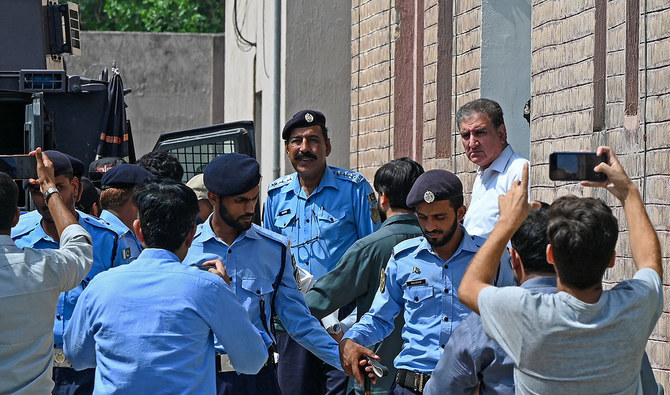
State secrets’ case: Pakistani court reserves verdict on ex-foreign minister’s bail plea
https://arab.news/rs29t
State secrets’ case: Pakistani court reserves verdict on ex-foreign minister’s bail plea

- FIA prosecutor argues against Qureshi’s bail, says he committed a ‘serious crime’
- Qureshi, ex-PM Khan are charged with leaking the contents of a secret document

Pakistan reports current account surplus in Jan. owing to improved trade, remittances
- Pakistan’s exports crossed the $3 billion mark in Jan. as the country received $3.5 billion in remittances
- Last month, IMF urged Pakistan to accelerate pace of structural reforms to strengthen economic growth
ISLAMABAD: Pakistan recorded a current account surplus of more than $120 million in January, the country’s finance adviser said on Tuesday, attributing it to improved trade balance and remittance inflows.
Pakistan’s exports rebounded in January 2026 after five months of weak performance, rising 3.73 percent year on year and surging 34.96 percent month on month, according to data released by the country’s statistics bureau.
Exports crossed the $3 billion mark for the first time in January to reach $3.061 billion, compared to $2.27 billion in Dec. 2025. The country received $3.5 billion in foreign remittances in Jan. 2026.
Khurram Schehzad, an adviser to the finance minister, said Pakistan reported a current account surplus of $121 million in Jan., compared to a current account deficit of $393 million in the same month last year.
“Improved trade balance in January 2026, strong remittance inflows, and sustained momentum in services exports (IT/Tech) continue to reinforce the country’s external account position,” he said on X.
Pakistan has undergone a difficult period of stabilization, marked by inflation, currency depreciation and financing gaps, and international rating agencies have acknowledged improvements after Islamabad began implementing reforms such as privatizing loss-making, state-owned enterprises (SOEs) and ending subsidies as part of a $7 billion International Monetary Fund (IMF) loan program.
Late last month, the IMF urged Pakistan to accelerate the pace of these structural reforms to strengthen economic growth.
Responding to questions from Arab News at a virtual media roundtable on emerging markets’ resilience, IMF’s director of the Middle East and Central Asia Jihad Azour said Islamabad’s implementation of the IMF requirements had been “strong” despite devastating floods that killed more than 1,000 people and devastated farmland, forcing the government to revise its 4.2 percent growth target to 3.9 percent.
“What is important going forward in order to strengthen growth and to maintain the level of macroeconomic stability is to accelerate the structural reforms,” he said at the meeting.
Azour underlined Pakistan’s plans to privatize some of the SOEs and improve financial management of important public entities, particularly power companies, as an important way for the country to boost its capacity to cater to the economy for additional exports.
“This comes in addition to the effort that the authorities have made in order to reform their tariffs, which will allow the private sector of Pakistan to become more competitive,” the IMF official said.


