

Pakistani PM calls for engaging Western capitals, introspection by Muslim nations amid Gaza war

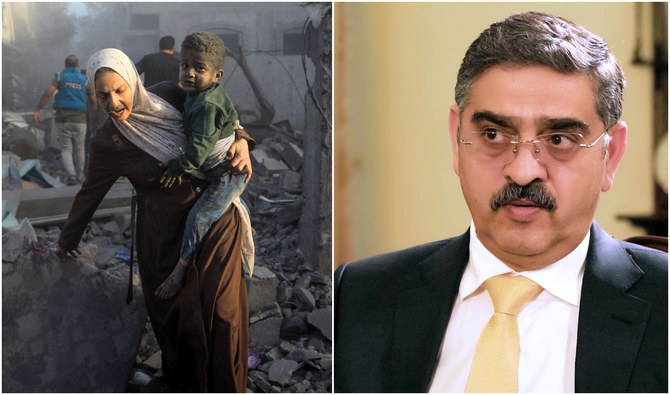
The combination of photos show people running following Israeli air strikes on a neighborhood in central Gaza Strip on November 6, 2023., left, and Pakistan's Prime Minister Anwaar-ul-Haq Kakar during an interview with Arab News on November 8, 2023. (AFP and AN photo)
Short Url
Updated 08 November 2023
Follow

Pakistani PM calls for engaging Western capitals, introspection by Muslim nations amid Gaza war

  • In interview to Arab News, PM says London, Washington must convince Israel Gaza war could have “spillover effect” beyond Middle East
  • PM Kakar says Saudi Arabia to host special OIC session on Nov. 12 to deliberate how to bring situation back to “so-called normalcy”

ISLAMABAD: Prime Minister Anwaar-ul-Haq Kakar has said Pakistan needs to engage with Western governments, particularly in the United States and Britain, to convince Israel the war in Gaza could have a “spillover effect” beyond the Middle East, but also called for introspection by Muslim countries.

The ongoing war is the bloodiest in the generations-old Israeli-Palestinian conflict and broke out on Oct. 7 when Hamas fighters burst into Gaza and killed 1,400 Israelis. Since then, Israel has endlessly bombarded the coastal territory, killing more than 10,000 people, around 40 percent of them children, according to health officials there.

UN Secretary General Antonio Guterres this week called Gaza a “graveyard for children,” amplifying demands for a cease-fire in the densely populated enclave, which Hamas has ruled for 16 years. 

Muslim nations around the world have also urged an immediate cease-fire and pressed US officials like Secretary of State Antony Blinken to convince Israel to halt attacks, but Washington has rebuffed such requests, saying they would only allow Hamas to regroup and attack Israel again.

British Prime Minister Rishi Sunak has also rejected calls for a full cease-fire, though he supports a humanitarian pause to allow the safe delivery of aid to civilians.

“We need to engage with different Western capitals, particularly Washington and London, and they need to make realize the Israeli side that they are contributing to destabilize not just the region, but probably it would have a spillover effect beyond the region,” Kakar said in an exclusive interview with Arab News this week.

Many analysts have warned that the ongoing war could forge new regional security alignments that could threaten Palestinian aspirations for statehood. Serious concerns of a regional spillover of the war have emerged amid regular exchanges of fire between the Israeli army and Hezbollah in the south of Lebanon, cruise missiles launched from Yemen, foreign missions evacuating staff, and additional US military deployments in response to attacks on its troops in Iraq and Syria.

When asked if the Pakistan government had received any requests from the US to soften its stance against Israel as it continued attacks on Gaza, Kakar said:

“I’m not aware of any such request and I don’t think so any government would listen to any such request which is in my opinion surreal, it’s absurd to even think of requesting someone to be silent on such an account.”

On his part, the PM called for an immediate “cessation of violence” and labeled Israel’s assault on Gaza “genocide, clearly.”

He said he would be traveling to Riyadh this weekend for an extraordinary session of the Organization of Islamic Cooperation (OIC) to discuss Israel’s attacks on Palestine:

“You can’t just kill children and say that you have got the right to defend yourself. It’s the license to barbaric retaliation.”

However, when asked if Muslim nations were doing enough for Gaza, Kakar also raised questions about the role of the world’s estimated 1.8 billion Muslims, who make up 24 percent of the global population, in “facing the kind of situation which we are in.”

“We need to ask more deep questions from this entire 1.4 [1.8] billion [Muslim] population, that what kind of contribution globally we are having … toward science and technology, what kind of defense capabilities these different or 50 or 57 countries are developing for themselves.”

The Pakistani PM blamed “governance structures” in Muslim nations, saying their challenges were “more deep than the mere quagmire of the Palestinian situation”:

“The choices which we are making or we are forced to make are not probably in the interest of the larger group of 1.4 [1.8] billion people, which we call Muslims.”


Saudi Arabia, US, Türkiye condemn separatist attacks in Pakistan’s Balochistan

Updated 4 sec ago
Follow

Saudi Arabia, US, Türkiye condemn separatist attacks in Pakistan’s Balochistan

  • Kingdom says it stands with Pakistan as security forces kill 133 militants in counteroffensive this week
  • Attacks hit multiple districts including Quetta and Gwadar, killing civilians and security personnel

ISLAMABAD: Saudi Arabia, US, Türkiye and Qatar this week condemned separatist attacks in Pakistan’s southwestern Balochistan province, expressing solidarity with Islamabad after a wave of coordinated violence killed civilians and security personnel across multiple districts.

In a statement cited by the Saudi ambassador to Pakistan, Nawaf bin Said Al-Malki, the Kingdom said it rejected violence in all its forms and stood with Pakistan as its security forces responded to the attacks.

“The Ministry of Foreign Affairs of the Kingdom of Saudi Arabia strongly condemns the attacks carried out by separatist elements in various areas of Pakistan’s Balochistan province,” he said in a social media message on Saturday. 

“The Kingdom of Saudi Arabia renews its firm position rejecting all acts of terrorism and extremism.”

Pakistan’s military said on Saturday its forces killed 92 militants, including three suicide bombers, while repelling coordinated attacks across the southwestern province, following assaults that targeted civilians and law enforcement personnel in several towns, including Quetta, Gwadar, Mastung and Kharan.

The military said it had killed 41 militants on Friday in separate operations in Panjgur and Harnai, bringing the total number of militants killed in the past two days to 133.

The military said 18 civilians, including women and children, were killed in attacks on laborer families in Gwadar and Kharan, while 15 security personnel died during clearance operations and armed standoffs.

Saudi Arabia’s foreign ministry also conveyed condolences to the families of those killed and wished a speedy recovery to the injured, reaffirming its support for Pakistan’s efforts to safeguard stability and security.

US Charge d’Affaires Natalie Baker also condemned the attacks in a statement shared by the US embassy on Sunday. 

“The United States remains a steadfast partner of Pakistan in its efforts to ensure peace and stability. We stand in solidarity with Pakistan during this difficult time,” Baker was quoted as saying. 

The Turkish foreign ministry also condemned the attacks and prayed for the souls of the soldiers who were killed. 

Qatar’s foreign ministry condemned the attacks as well and wished a speedy recovery for the injured. 

“The Ministry of Foreign Affairs reiterates the State of Qatar’s firm position rejecting violence, terrorism, and criminal acts in all forms, regardless of their motives or justifications.”

https://x.com/MofaQatar_EN/status/2017643162211438683

Balochistan, which borders Iran and Afghanistan, has faced a decades-long separatist insurgency marked by attacks on security forces, infrastructure projects and civilians, as Pakistan steps up counter-militancy operations in the region.