

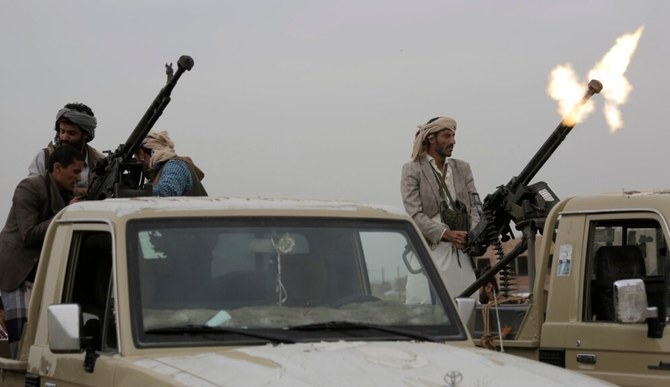
Houthis deploy forces and heavy weapons in Taiz, Marib, and Jouf

A Houthi fighter fires in the air during a gathering aimed at mobilizing more fighters for the Houthi movement, in Sanaa, Yemen, Aug. 1, 2019. (AP Photo)
Short Url
Updated 07 November 2023
Follow

Houthis deploy forces and heavy weapons in Taiz, Marib, and Jouf

  • According to the Yemeni army, the Houthis have used the Gaza conflict to plan a fresh military offensive against government-controlled territories
  • Fighting in Yemen has generally abated since early 2022, when a UN-brokered truce went into effect, despite frequent claims against the Houthis of launching lethal drone and missile strikes

AL-MUKALLA: Yemen’s army accused the Houthis on Tuesday of using public fury over Israel’s Gaza conflict to organize fighters and military equipment outside key government-controlled cities under the guise of preparing to confront the Israelis.

Rashad Al-Mekhlafi, a military official with Yemen’s Armed Forces Guidance Department, told Arab News that the Houthis amassed fighters and deployed military vehicles and heavy weapons outside the central city of Marib, in the northern parts of Jouf province, and outside the besieged city of Taiz in recent weeks.

The Yemeni army is on high alert to deter predicted attacks on those fronts, he said, adding that the “Houthis took advantage of the situation in Gaza” to deploy personnel and equipment and to carry out training and military maneuvers.

The Houthis recently announced military training across territories under their control in order to prepare to fight off Israelis. They also declared the launch of drones and missiles against Israel.

According to the Yemeni army, the Houthis have used the Gaza conflict to plan a fresh military offensive against government-controlled territories.

Fighting in Yemen has generally abated since early 2022, when a UN-brokered truce went into effect, despite frequent claims against the Houthis of launching lethal drone and missile strikes and ground attacks in the provinces of Dhale, Taiz, Marib, Saada, and others.

Combatants, artillery emplacements, drone pad launchers, and bulldozers excavating trenches and erecting barricades were stationed in contested areas north of Jouf province and south of Marib city as a smaller number of Houthi fighters and military equipment have been moved outside the city of Taiz, Yemen’s army said. 

“We believe the Houthis are targeting Marib because of its importance to the national army as well as its oil fields, followed by northern areas of Jouf and the city of Taiz,” Al-Mekhlafi said. 

Yemen’s army has deployed military soldiers and weaponry in the three areas to counter any Houthi military activity.

The army said on Monday that it had foiled a new Houthi onslaught on its positions in the Taiz province’s Al-Kadahah and Maqbanah regions.

Meanwhile, the international organization Save the Children announced on Monday that it had restarted its humanitarian operations in Houthi-controlled areas following a 10-day halt, even as the Houthis continue to disregard the organization’s demands for an investigation into the death of a worker in their prison.

Late last month, the organization ceased its activities in northern Yemen in an effort to compel the Houthis to provide an explanation for the death of Hisham Al-Hakimi, 44, the organization’s safety and security director, who was held captive by the Houthis.

The reason for resuming the operations, the organization said in a statement, is to continue providing humanitarian aid to Yemen’s starving children.

“The needs of the children in Yemen are immense, and they continue to be our driving force. As we resume our operations, we remain dedicated to providing the lifesaving assistance children require,” David Wright, chief operating officer at Save the Children, said in a statement. 

The death of Al-Hakimi, who was kidnapped from Sanaa in September and held captive for 50 days, has triggered criticism and calls for an investigation from the UK, the EU, and other countries, as well as 20 international organizations operating in Yemen.


Syrian government and SDF agree to de-escalate after Aleppo violence

Updated 9 sec ago
Follow

Syrian government and SDF agree to de-escalate after Aleppo violence

  • Turkiye views the US-backed SDF, which controls swathes of northeastern Syria, as a ⁠terrorist organization and has warned of military action if the group does not honor the agreement

DAMASCUS: Syrian government forces and the Kurdish-led Syrian Democratic Forces agreed to de-escalate on Monday evening in the northern city of Aleppo, after a wave of attacks that both sides blamed on each other left at least two civilians dead and several wounded.
Syria’s state news agency SANA, citing the defense ministry, said the army’s general command issued an order to stop targeting the SDF’s fire sources. The SDF said in a statement later that it had issued instructions to stop responding ‌to attacks ‌by Syrian government forces following de-escalation contacts.
The Syrian health ministry ‌said ⁠two ​people ‌were killed and several were wounded in shelling by the SDF on residential neighborhoods in the city. The injuries included two children and two civil defense workers. The violence erupted hours after Turkish Foreign Minister Hakan Fidan said during a visit to Damascus that the SDF appeared to have no intention of honoring a commitment to integrate into the state’s armed forces by an agreed year-end deadline.
Turkiye views the US-backed SDF, which controls swathes of northeastern Syria, as a ⁠terrorist organization and has warned of military action if the group does not honor the agreement.
Integrating the SDF would ‌mend Syria’s deepest remaining fracture, but failing to do ‍so risks an armed clash that ‍could derail the country’s emergence from 14 years of war and potentially draw in Turkiye, ‍which has threatened an incursion against Kurdish fighters it views as terrorists.
Both sides have accused the other of stalling and acting in bad faith. The SDF is reluctant to give up autonomy it won as the main US ally during the war, which left it with control of Islamic ​State prisons and rich oil resources.
SANA, citing the defense ministry, reported earlier that the SDF had launched a sudden attack on security forces ⁠and the army in the Sheikh Maqsoud and Ashrafiyah neighborhoods of Aleppo, resulting in injuries.
The SDF denied this and said the attack was carried out by factions affiliated with the Syrian government. It said those factions were using tanks and artillery against residential neighborhoods in the city.
The defense ministry denied the SDF’s statements, saying the army was responding to sources of fire from Kurdish forces. “We’re hearing the sounds of artillery and mortar shells, and there is a heavy army presence in most areas of Aleppo,” an eyewitness in Aleppo told Reuters earlier on Monday. Another eyewitness said the sound of strikes had been very strong and described the situation as “terrifying.”
Aleppo’s governor announced a temporary suspension of attendance in all public and private schools ‌and universities on Tuesday, as well as government offices within the city center.