



PARIS: Tens of thousands of Gaza’s residents live in eight refugee camps that were set up following the mass exodus of Palestinians during the war that followed the creation of Israel in May 1948.
Over 760,000 Palestinians fled or were driven from their homes in what is referred to by Palestinians as the “Nakba” (catastrophe in Arabic).
Around 180,000 fled to Gaza, with the rest scattered across the West Bank and neighboring Arab countries, specifically Jordan, Lebanon and Syria.
In 1949, the United Nations set up a dedicated agency, UNRWA, to provide them and their descendants, who also have refugee status, with basic services, including health and education.
More than two-thirds of the 2.4 million people living in Gaza are registered refugees.
Israel has persistently rejected their “right of return,” which the UN backed in a 1948 resolution but has been a sticking point in past rounds of peace talks.
While the term refugee camp conjures up images of people living in tents, multi-story cement-block buildings have long since replaced the tents in Gaza.
But conditions in the eight camps dotted around the Gaza Strip were grim even before Israel began its relentless bombardment of the territory in response to Hamas’s attacks.
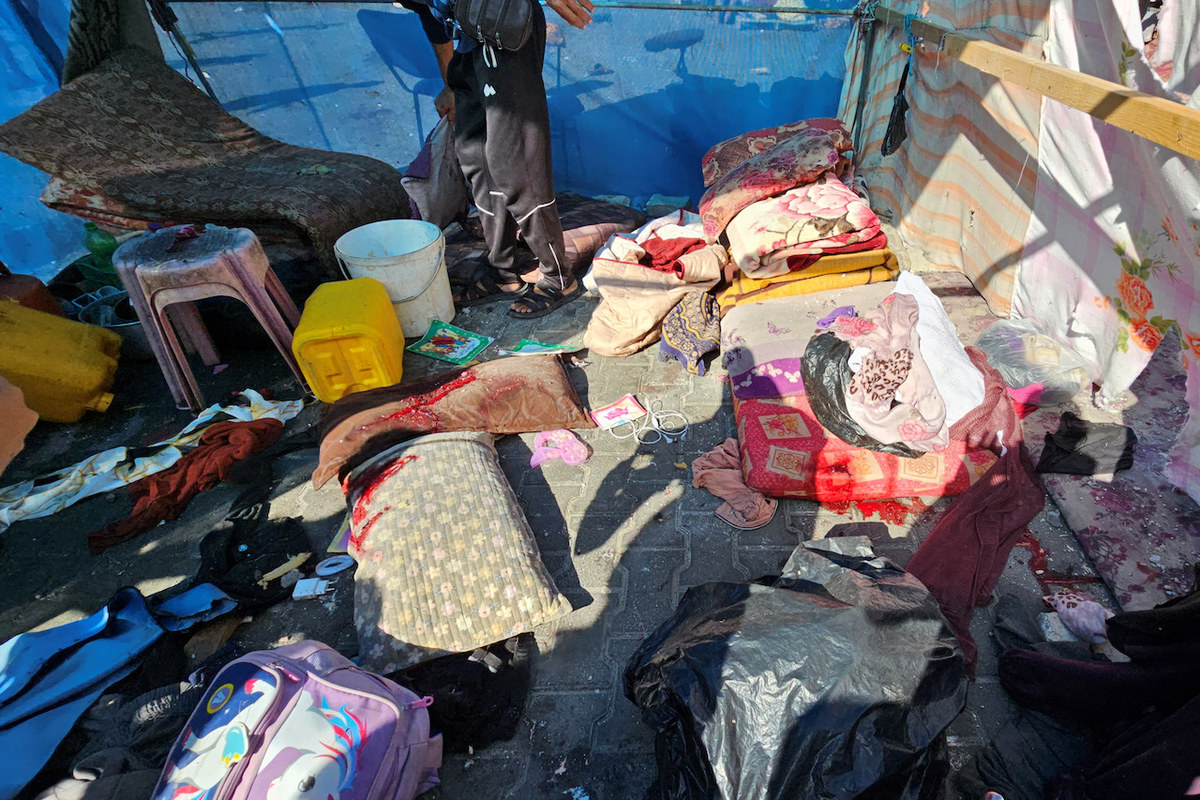
Belongings of Palestinians lie on the ground following a strike at a UN-run school sheltering displaced people, amid the ongoing conflict between Israel and Palestinian Islamist group Hamas, in the Jabalia refugee camp in the northern Gaza Strip November 4, 2023. (Reuters)
Hamas gunmen stormed Israel on October 7, killing more than 1,400 people, and taking more than 240 hostages, according to Israeli authorities.
Israel has responded with a relentless military campaign on Gaza that has so far killed over 10,000 Palestinians, mostly civilians, according to health authorities in the enclave.
Gaza’s camps are among the most densely populated places on the planet, with over 620,000 people packed into less than 6.5 square kilometers of land, according to pre-war figures.
The tight air, sea and land blockade imposed by Israel after Hamas’s takeover of Gaza in 2007 worsened their plight.
Unemployment in the camps stood at 48.1 percent in the third quarter of 2022, according to UNRWA, compared to 46.6 percent in the rest of Gaza.
Refugee camps
Two of the camps — Jabalia and Shati — are situated in the northern part of the territory which Israel on October 13 ordered civilians to evacuate as it pressed its war against Hamas.
About 1.5 million people have fled their homes since the war began, according to the UN, but large numbers are believed to remain in the north.
Jabalia — the biggest camp in Gaza, where the first intifada or uprising against Israel’s occupation of Palestinian territories began in 1987 — has been repeatedly bombed since the start of the offensive.
The Israeli army claims it is targeting Hamas members and tunnels dug under the camp in the strikes which have damaged several UN-run schools hosting displaced people.
Shati camp on the outskirts of Gaza City, has also been been a frequent target.
In central Gaza, the Bureij and Al-Maghazi camps have been hit.
Forty-five people were killed in an Israeli airstrike on Al-Maghazi camp on Saturday, according to the Gaza health ministry.
The dead included four children and four brothers of video-journalist Mohammed Alaloul.

Palestinians react following a strike at a UN-run school sheltering displaced people, amid the ongoing conflict between Israel and Palestinian Islamist group Hamas, in the Jabalia refugee camp in the northern Gaza Strip November 4, 2023. (Reuters)
Many of those who fled their homes in northern Gaza have crammed into the southern cities of Khan Yunis and Rafah, where the UN also runs refugee camps.
UNRWA said that as of November 1, over 530,000 people were sheltering at its facilities in central Gaza, Khan Yunis and Rafah, adding that the shelters were full and that many people were sleeping in the street.
Many are hoping to leave Gaza through the Rafah border crossing into Egypt — the only entry in and out of Gaza not controlled by Israel.
But so far Egypt has only let through a few hundred foreigners, dual nationals and wounded Palestinians.


