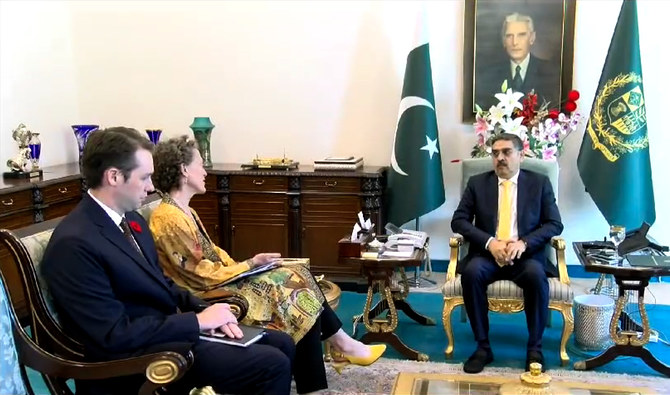
ISLAMABAD: Canadian High Commissioner Leslie Scanlon called on Pakistan’s Caretaker Prime Minister Anwaar-ul-Haq Kakar on Monday to discuss the multi-billion Reko Diq project and economic ties between the two countries, the Prime Minister’s Office (PMO) said.
Canadian mining company Barrick Gold owns a 50 percent stake in Pakistan’s Reko Diq mine, with the remaining 50 percent owned by the governments of Pakistan and its southwestern Balochistan province. Barrick considers the mine one of the world’s largest underdeveloped copper-gold areas.
Scanlon called on Kakar at the Prime Minister’s House where the two representatives discussed various aspects of their bilateral ties, the PMO said. These included Canada’s development programs in Pakistan, humanitarian support for the 2022 floods, economic and trade ties, and Canadian investments in Pakistan, “particularly the Reko Diq Project.”
“The Prime Minister emphasized the significance of strong ties between Pakistan and Canada,” the PMO said, adding that Kakar highlighted the steps being taken by Pakistan to stabilize its economy and facilitate foreign investment through the Special Investment Facilitation Council (SIFC).
The prime minister also highlighted steps taken by the government to repatriate illegal immigrants from Pakistan, the PMO said.
“The Canadian High Commissioner appreciated the support extended by the Government of Pakistan to Canada’s Afghan Relocation Program.”
Pakistan set up the SIFC in June in an attempt to revive its fragile economy, which has been dented by low foreign exchange reserves, massive currency depreciation and record inflation. The council is a hybrid civil-military government body that also features the army chief as well.
It aims to attract foreign investment by capitalizing on the country’s untapped potential in agriculture, mining, information technology, defense production and energy sectors.


![]()
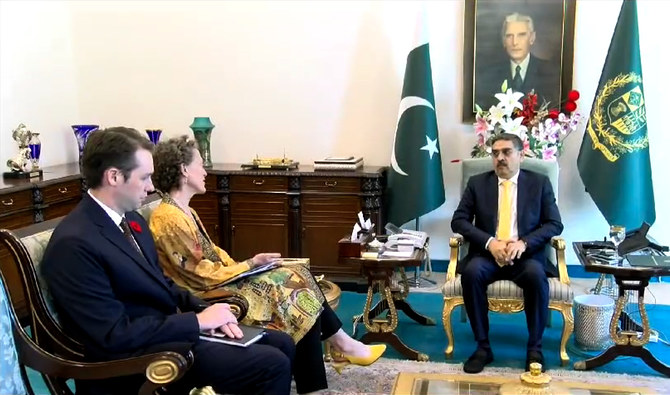
Canadian envoy meets Pakistan’s PM to discuss Reko Diq, bilateral economic ties
Short Url
https://arab.news/4ejmw
Canadian envoy meets Pakistan’s PM to discuss Reko Diq, bilateral economic ties
- Canadian mining company Barrick Gold owns 50% stake in Pakistan’s Reko Diq mine
- PM Kakar highlights steps taken by Pakistan to facilitate foreign investment, says PMO
Latest updates


© 2026 SAUDI RESEARCH & PUBLISHING COMPANY, All Rights Reserved And subject to Terms of Use Agreement.