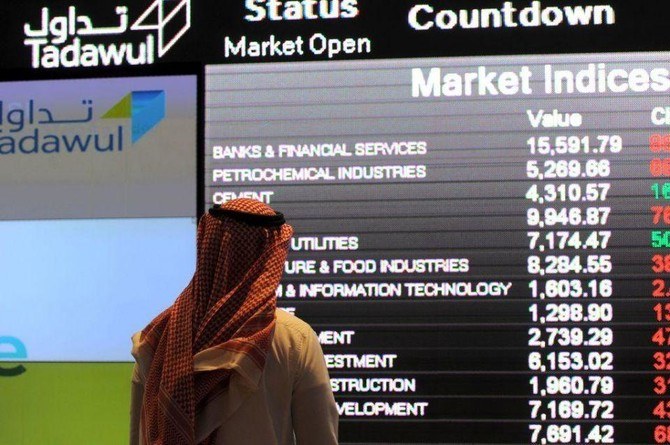

RIYADH: Saudi Arabia’s Tadawul All Share Index concluded its Monday trading at 10,948.86 points, recording an increase of 9.91 points or 0.09 percent.
Meanwhile, the parallel market Nomu concluded at 22,616.54 points, reflecting a gain of 32.16 points or 0.14 percent. The MSCI Index also registered a rise of 5.99 points, closing at 1,423.39, indicating a growth of 0.35 percent.
By the end of the trading day, the primary index recorded a total trade value of SR6.1 billion ($1.6 billion) with 74 stocks advancing and 147 declining. In contrast, Nomu reported a trading volume of SR10.2 million.
On the corporate front, Dallah Healthcare Co. released its financial results for the first nine months of 2023, reporting a net profit of SR246 million, representing a 25.74 percent growth compared to the same period last year.
This increase in profit can be attributed to a 19.11 percent surge in the company’s revenue, rising from SR1.79 billion to SR2.13 billion during the corresponding timeframe, according to a bourse filing.
The positive performance is linked to an increase in patient visits across the company’s hospital network and higher occupancy levels in both inpatient and outpatient services, stemming from the expanded operational capabilities of the company’s medical facilities.
As a result, the company’s stock price closed with a 5.59 percent increase, reaching SR158.80.
Saudi Aramco’s base oil company Luberef also disclosed its financial results for the same period, reporting a net profit of SR1.24 billion, reflecting a growth of 2.15 percent.
This boost in net income can be primarily attributed to a reduction in zakat and income tax expenses, as Luberef has transitioned to being subject to zakat only following its listing. On Monday, the company’s stock price closed at SR136.80, a 3.01 percent increase.
In addition, Saudi Reinsurance Co. reported a 55.09 percent growth in its net profit during the first nine months of the year, reaching SR121 million, compared to SR78 million in the previous year.
The company attributed this increase to a reduction in reinsurance service expenses and a rise in net investment income. However, the company’s stock price experienced a 1.32 percent decline at the close of the day, ending at SR17.94.
On the downside, Abdullah Al Othaim Markets Co. witnessed a substantial drop in its net profit during the same period, declining by 64.5 percent to close at SR321.8 million, despite an 8.26 percent growth in revenue.
The company stated that the loss was primarily due to SR798.1 million in investments during the period, and without this allocation, profits would have recorded an 8.3 percent growth.
Following this significant decrease, the company’s stock price saw a 2.11 percent fall on Monday, closing at SR12.98.
In other developments, the National Agricultural Development Co. received approval from its general assembly to raise capital by SR2 billion through a rights issue.
Tadawul will adjust NADEC’s share fluctuation limit based on an SR22.54 baseline on Nov. 6, with rights shares allocated on Nov. 8.