

Pakistani regulator cancels over 18,000 identity cards amid crackdown on illegal immigrants 

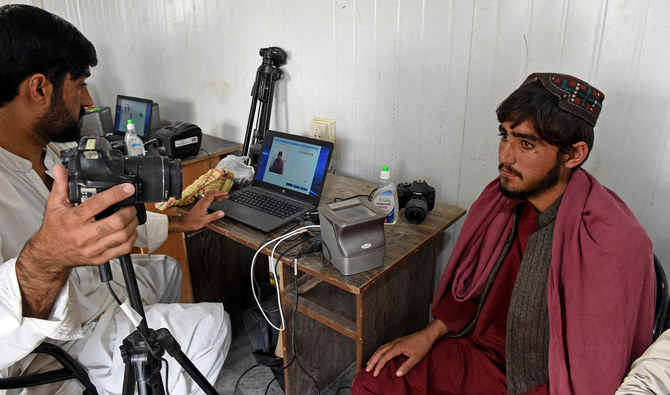
An Afghan refugee (R) provides biometric verification to a member of National Database and Registration Authority (NADRA) at a holding centre near the Pakistan-Afghanistan border in Chaman, before his deportation to Afghanistan on November 4, 2023. (AFP/File)
Short Url
Updated 06 November 2023
Follow

Pakistani regulator cancels over 18,000 identity cards amid crackdown on illegal immigrants 

  • Pakistan’s decision to expel undocumented foreigners followed suicide bombings that the government blamed on Afghans 
  • Provincial minister says ‘two neighbors’ trying to blackmail Pakistan by sponsoring militants, providing sanctuaries to them 

ISLAMABAD: Pakistan’s National Database and Registration Authority (NADRA) has canceled more than 18,000 identity cards, it said on Sunday, amid a crackdown on illegal immigrants in the South Asian country. 

More than 200,000 people have crossed into Afghanistan, including a vast majority that left after an October 3 ultimatum given to the 1.7 million Afghans and other foreigners, who Pakistani authorities said were illegally living in the country. 

Pakistan’s decision to expel illegal immigrants last month followed suicide bombings in the country this year that the government said involved Afghan nationals, though it did not provide any evidence. 

On Sunday, NADRA said the decision to cancel thousands of identity cards was aimed at addressing the issue of counterfeit documents, which posed a threat to national security. 

“More than 18,000 illegal ID cards have been identified and canceled through NADRA’s robust system,” it said in a statement on X. 

“NADRA is making all possible efforts for improvement under strict monitoring and coordination measures with other stakeholders.” 

However, there was no immediate confirmation whether the move was linked with Pakistan’s crackdown on illegal immigrants, mostly Afghans. 

The South Asian country has set up tens of holding centers to speed up the repatriation process as authorities continue to arrest illegal immigrants in nationwide sweeps. 

NADRA said it had introduced new measures for people to obtain their computerized national identity cards (CNICs), including biometric verification of parents and relatives, SMS alerts to family heads, and two-stage verification for data access. 

“These measures are helping identify and control the issue of illegal ID cards and the threats posed by it,” NADRA said. 

The authority said it had also strengthened its internal accountability and inquiry system, leading to penalties and dismissal of employees involved in illegal practices. 

The developments followed militant attacks last week in Pakistan’s northwestern Khyber Pakhtunkhwa and southwestern Balochistan provinces that border Afghanistan. 

“The recent terrorism [incidents] in Mianwali air base, Pasni-Ormara and Zhob have proven that two neighbors wish to blackmail us,” Balochistan’s caretaker information minister, Jan Achakzai, told a press conference on Sunday. 

“Of them, one is sponsoring terrorism and the other is providing them (militants) sanctuaries.” 

Achakzai’s comment was aimed at India and Afghanistan, and was a reference to militant attacks on a training air base in Pakistan’s Mianwali district and a security convoy between Pasni and Ormara that killed 14 soldiers as well as the killing of six militants in an intelligence-based operation in Balochistan’s Zhob. 

The deceased suspects in the Zhob operation were Afghan nationals, he added. 


Pakistan’s Zardari meets UAE vice president, discusses increasing trade, investment cooperation

Updated 8 sec ago
Follow

Pakistan’s Zardari meets UAE vice president, discusses increasing trade, investment cooperation

  • Asif Ali Zardari explores cooperation opportunities in infrastructure, logistics, food security, says president’s office 
  • Pakistan’s president arrived in UAE on Monday to review trade, economic and investment ties with the Gulf country 

ISLAMABAD: Pakistan’s President Asif Ali Zardari met UAE Vice President Sheikh Mohammed bin Rashid Al Maktoum at Dubai’s Zabeel Palace on Wednesday, Zardari’s office said, during which the two sides discussed ways to expand trade, investment and economic cooperation.

Zardari arrived in the UAE on Monday with a high-level delegation for a four-day official visit to the Gulf country. The Pakistani president met his UAE counterpart Sheikh Mohammed bin Zayed Al-Nahyan in Abu Dhabi on Tuesday, where the two sides explored new opportunities in trade, investment and other sectors. 

“The two leaders discussed ways to further strengthen bilateral relations, with a focus on expanding economic, trade and investment cooperation between Pakistan and the UAE,” the Pakistani president’s office said in a statement about Zardari’s meeting with Maktoum. 

It said Zardari praised Dubai’s “remarkable transformation” into a global center for tourism, finance and emerging technologies during the meeting. 

The statement said both sides exchanged views on benefiting from Dubai’s development experience, particularly in ports, logistics, infrastructure, information technology and digital financial services.

“The president highlighted Pakistan’s ongoing economic reforms, including investment facilitation and privatization, and explored opportunities for enhanced cooperation with the UAE in infrastructure development, logistics, food security and technology-driven sectors,” Zardari’s office said. 

The two leaders reaffirmed their commitment to further strengthening fraternal ties between Pakistan and the UAE, the statement said. 

First Lady Aseefa Bhutto-Zardari, Pakistan Peoples Party Chairman Bilawal Bhutto-Zardari, Interior Minister Mohsin Naqvi and Pakistan’s ambassador to the UAE took part in the meeting. 

Pakistan and the UAE maintain close political and economic relations, with Abu Dhabi playing a pivotal role in supporting Islamabad during periods of financial stress through deposits, oil facilities and investment commitments.

The UAE is Pakistan’s third-largest trading partner, after China and the United States, and a key destination for Pakistani exports, particularly food, textiles and construction services.

The Gulf state is also home to more than 1.5 million Pakistani expatriates, one of the largest overseas Pakistani communities in the world, who contribute billions of dollars annually in remittances, a crucial source of foreign exchange for Pakistan’s economy.