

Hyundai UAE unveils first AI smart taxi concept in region

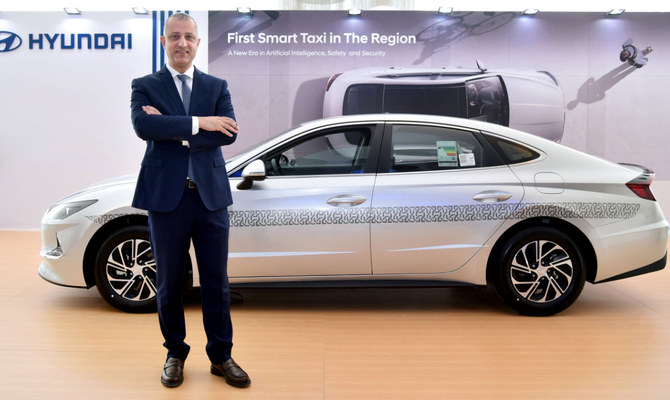
Suliman Al-Zaben, director of Hyundai, poses with the Hyundai Sonata Smart Taxi.
Short Url
Updated 05 November 2023
Follow

Hyundai UAE unveils first AI smart taxi concept in region

Juma Al-Majid Est., the exclusive distributor of Hyundai cars in the UAE, has announced its successful partnership as the “exclusive car partner” of the Abu Dhabi Smart City Summit, which took place on Oct. 31 and Nov. 1 at the Conrad Hotel. The company showcased the Hyundai Sonata Smart Taxi during the event.

Hyundai Sonata Smart Taxi’s launch in Abu Dhabi aligns with the vision of Sheikh Khaled bin Mohamed bin Zayed Al-Nahyan, crown prince of Abu Dhabi and chairman of the Abu Dhabi Executive Council, to establish a world-leading smart and autonomous vehicle industries cluster in Abu Dhabi. The Hyundai Sonata Smart Taxi is equipped with advanced AI technology and streaming services to enhance safety, operations, and customer experience. The AI-equipped cameras inside the car monitor various elements, including the driver’s alertness, reaction time, and other safety indicators to protect the occupants. Furthermore, this AI system records the journey of every passenger. If a customer leaves any belongings behind after a ride, the integrated AI cameras promptly detect them and notify the relevant parties. This ensures safety and provides passengers with a more pleasant journey, offering added peace of mind.

Suliman Al-Zaben, director of Hyundai, said: “Hyundai is proud to be the exclusive car partner of the Abu Dhabi Smart City Summit, showcasing the Sonata Smart Taxi, a true testament to our commitment to pioneering innovative mobility solutions. With advanced AI technology, safety enhancements, and a strong focus on customer experience, we are dedicated to elevating transportation for the people of the UAE. This partnership exemplifies how public and private sectors can unite to shape a sustainable and forward-thinking future for all.”

The smart system charts drivers’ behavior, aiming to analyze the causes and conditions that lead to errors and take proactive measures to reduce the percentage of accidents and dangerous practices. The technical equipment inside the vehicle enables the collection of live data for remote monitoring to take appropriate measures as quickly as possible.

The control and monitoring panel helps control and follow up on drivers’ work, tracks operating efficiency indicators, and avoids any vehicle misuse. It contains clear, legible, and diverse visuals that work together on single and multiple specialized screens. It provides a comprehensive interactive presentation of data, with key insights for quick decision-making, and is characterized by an easy design and simple graphs that assist the responsible employee in performing duties to the fullest.

Furthermore, the Hyundai Sonata Smart Taxi incorporates a lost and found feature, which can identify items that passengers may have forgotten in the vehicle, send pictures and data to the control center, and warn the driver before the passenger disembarks.


How an MIT Jameel AI tool can help save women’s lives in Japan

Updated 09 December 2025
Follow

How an MIT Jameel AI tool can help save women’s lives in Japan

The MIT Jameel Clinic, the epicenter of artificial intelligence and health at the Massachusetts Institute of Technology, and the National Cancer Center Hospital in Japan have announced a new collaboration to evaluate Mirai, a groundbreaking deep learning model that can analyze mammogram to accurately predict the patients’ risk of developing breast cancer up to five years in advance. 
Developed at the Jameel Clinic, which was co-founded in 2018 by MIT and Community Jameel, an international organization that advances science and learning for communities to thrive, Mirai has been validated on more than 2 million mammograms in 72 hospitals across 23 countries.
The partnership was announced at a ceremony attended by Mohammed Jameel KBE, founder and chairman of Community Jameel, and Dr. Yasuyuki Seto, director of the National Cancer Center Hospital.
The collaboration will launch with a study that will evaluate Mirai’s ability to predict breast cancer risk in Japanese women using mammography images. This joint study will analyze mammography data collected between 2013 and 2024 to determine whether Mirai can accurately assess breast cancer risk in Japanese women, further building on its successful validation records.
If successful, the findings could help shape a more personalized approach to breast cancer screening in Japan, enabling closer monitoring for higher-risk individuals while reducing unnecessary tests for those at lower risk.
Breast cancer remains the most common cancer among women in Japan, accounting for approximately 23 percent of all female cancer cases, equivalent to around 98,782 diagnoses each year. It is estimated that approximately 16,000 women die from breast cancer annually. By contrast, when breast cancer is detected at an early stage, the five-year relative survival rate exceeds 90 percent, demonstrating significantly better outcomes.
This data highlights the importance of identifying risk earlier and ensuring appropriate follow-up and care. In Japan, mammography screening is currently recommended every two years for women aged 40 and above. While mammograms allow physicians to detect small lumps and microcalcifications not visible through self-examination, interpretation is still primarily visual and dependent on clinical experience.
Founder and chairman Jameel said: “Mirai is a powerful tool that harnesses AI to improve cancer care for women around the world. With the Jameel family’s deep and long-standing connection to Japan, we are delighted that the MIT Jameel Clinic and Community Jameel are collaborating with the National Cancer Center Hospital to open the way for Mirai to improve care for Japanese women at risk of breast cancer.
Dr. Kan Yonemori, director, Department of Medical Oncology at the National Cancer Center Hospital, said: “This study has the potential to contribute to improving women’s health by predicting an individual’s future risk of breast cancer using large-scale mammography screening data from the past and present. Our team in Japan is committed to advancing this work as part of an international collaboration with the MIT Jameel Clinic, and we look forward to contributing meaningfully to this important global research effort.”
Regina Barzilay, AI faculty lead at the MIT Jameel Clinic, said: “With Mirai’s ability to predict a patient’s cancer risk up to five years in advance, my hope is that this research collaboration will inspire new approaches to breast cancer screening and treatment in Japan.”
The study will focus on analyzing data from individuals screened for breast cancer at the National Cancer Center Hospital and Yotsuya Medical Cube between 2013 and 2024. Mirai will analyze mammography images from these screenings to predict breast cancer risk over a one-to-five-year horizon. Predicted risk scores will then be compared with actual outcomes to evaluate the model’s accuracy and reliability in a Japanese clinical context.
If validated, this research could mark an important step toward introducing AI-supported, risk-based breast cancer screening in Japan — helping detect cancer earlier and personalize care through advanced technology.
The study is supported by Community Jameel and Jameel Corporation.