

Saudi manufacturing sector firms top Forbes Middle East’s Sustainability Leaders’ list 

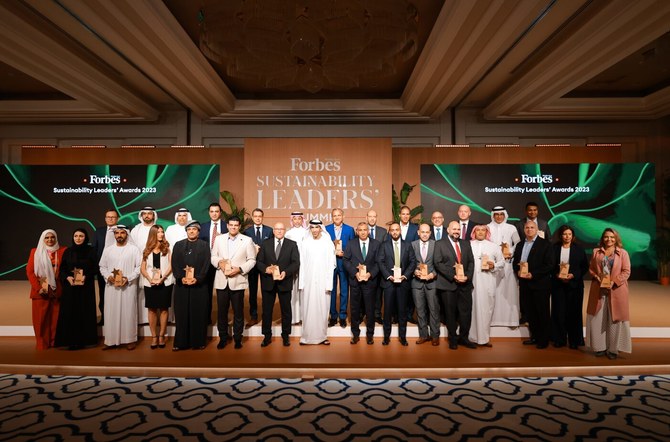
Among the 100 companies featured on Forbes Middle East’s list, 44 are based in the UAE, 22 hail from Saudi Arabia, and 10 represent Qatari businesses. Supplied
Short Url
Updated 05 November 2023
Follow

Saudi manufacturing sector firms top Forbes Middle East’s Sustainability Leaders’ list 

RIYADH: Saudi Arabia’s prominent companies have been acknowledged for their environmental initiatives, securing top positions on Forbes Middle East's Sustainability Leaders list.  

Saudi Basic Industries Corp. and Saudi Arabian Mining Co., also known as Ma’aden, have emerged as leaders in the sector.   

The manufacturing and industrial field is one of 11 key industries categorized, with SABIC taking the top spot, followed by Ma’aden.  

Tasnee, the Kingdom’s National Industrialization Co., secured the eighth spot on the list. 

In the energy and utilities category, Saudi Arabia’s ACWA Power ranked second, following UAE-based Industrialization and Energy Service Co., known as TAQA. 

Saudi Electricity Co. clinched the fourth spot, following Dubai Electricity and Water Authority. 

Saudi banks also played a pivotal role, with Al Rajhi Bank coming third in the banking and financial services category, followed by Saudi National Bank in fifth place, Saudi Awwal Bank in seventh, and Alinma Bank in ninth. 

The Kingdom’s ambitious $500-billion giga-project NEOM topped the real estate and construction category, followed by Red Sea Global in fifth place, and the Kingdom’s Public Investment Fund wholly-owned ROSHN Group in seventh. 

stc Group ranked first on the technology and telecom list, receiving the Forbes ME Sustainability Leaders Award for its efforts in promoting eco-friendly practices and reducing carbon emissions in various areas. 

In the top 10 travel and tourism companies, Saudia, formerly known as Saudi Arabia Airlines, ranked sixth. 

On the investment front, the Kingdom’s PIF secured the second position, following the UAE’s Mubadala Investment Co. 

Forbes ME’s list of 100 companies includes 44 UAE-based firms, 22 Saudi companies, and 10 Qatari-based businesses.  

Additionally, 12 international corporations with regional offices in the UAE and Egypt earned five entries, while Kuwait, Bahrain, and Oman also made notable appearances. 


Arab food and beverage sector draws $22bn in foreign investment over 2 decades: Dhaman 

Updated 28 December 2025
Follow

Arab food and beverage sector draws $22bn in foreign investment over 2 decades: Dhaman 

JEDDAH: Foreign investors committed about $22 billion to the Arab region’s food and beverage sector over the past two decades, backing 516 projects that generated roughly 93,000 jobs, according to a new sectoral report. 

In its third food and beverage industry study for 2025, the Arab Investment and Export Credit Guarantee Corp., known as Dhaman, said the bulk of investment flowed to a handful of markets. Egypt, Saudi Arabia, the UAE, Morocco and Qatar attracted 421 projects — about 82 percent of the total — with capital expenditure exceeding $17 billion, or nearly four-fifths of overall investment. 

Projects in those five countries accounted for around 71,000 jobs, representing 76 percent of total employment created by foreign direct investment in the sector over the 2003–2024 period, the report said, according to figures carried by the Kuwait News Agency. 

“The US has been the region's top food and beverage investor over the past 22 years with 74 projects or 14 projects of the total, and Capex of approximately $4 billion or 18 percent of the total, creating more than 14,000 jobs,” KUNA reported. 

Investment was also concentrated among a small group of multinational players. The sector’s top 10 foreign investors accounted for roughly 15 percent of projects, 32 percent of capital expenditure and 29 percent of newly created jobs.  

Swiss food group Nestlé led in project count with 14 initiatives, while Ukrainian agribusiness firm NIBULON topped capital spending and job creation, investing $2 billion and generating around 6,000 jobs. 

At the inter-Arab investment level, the report noted that 12 Arab countries invested in 108 projects, accounting for about 21 percent of total FDI projects in the sector over the past 22 years. These initiatives, carried out by 65 companies, involved $6.5 billion in capital expenditure, representing 30 percent of total FDI, and generated nearly 28,000 jobs. 

The UAE led inter-Arab investments, accounting for 45 percent of total projects and 58 percent of total capital expenditure, the report added, according to KUNA. 

The report also noted that the UAE, Saudi Arabia, Egypt, and Qatar topped the Arab ranking as the most attractive countries for investment in the sector in 2024, followed by Oman, Bahrain, Algeria, Morocco, and Kuwait. 

Looking ahead, Dhaman expects consumer demand to continue rising. Food and non-alcoholic beverage sales across 16 Arab countries are projected to increase 8.6 percent to more than $430 billion by the end of 2025, equivalent to 4.2 percent of global sales, before exceeding $560 billion by 2029. 

Sales are expected to remain highly concentrated geographically, with Egypt, Saudi Arabia, Algeria, the UAE and Iraq accounting for about 77 percent of the regional total. By product category, meat and poultry are forecast to lead with sales of about $106 billion, followed by cereals, pasta and baked goods at roughly $63 billion. 

Average annual per capita spending on food and non-alcoholic beverages in the region is projected to rise 7.2 percent to more than $1,845 by the end of 2025, approaching the global average, and to reach about $2,255 by 2029. Household spending on these products is expected to represent 25.8 percent of total expenditure in 13 Arab countries, above the global average of 24.2 percent. 

Arab external trade in food and beverages grew more than 15 percent in 2024 to $195 billion, with exports rising 18 percent to $56 billion and imports increasing 14 percent to $139 billion. Brazil was the largest foreign supplier to the region, exporting $16.5 billion worth of products, while Saudi Arabia ranked as the top Arab exporter at $6.6 billion.