


GAZA STRIP, Palestinian Territories: Israel battled into the fifth week Saturday of its war to crush Hamas, showing no signs of letting up even as US Secretary of State Antony Blinken faced a rising tide of anger in meetings with Arab foreign ministers.
Blinken reaffirmed US support for “humanitarian pauses” in the fighting in Gaza to ensure desperate civilians get help a day after Israel’s hawkish Prime Minister Benjamin Netanyahu gave the idea short shrift.
However, US President Joe Biden said progress had been made on securing a so-called “humanitarian pause,” without elaborating.
At a news conference in Amman about sparing civilians and speeding up aid deliveries, Blinken said: “The United States believes that all of these efforts will be facilitated by humanitarian pauses.”
Egyptian Foreign Minister Sameh Shoukry, whose country has been acting as the sole conduit for foreigners to escape the Gaza Strip and for aid to get in, called for an “immediate and comprehensive cease-fire.”
Hamas said late Saturday the evacuation of dual nationals and foreigners from Gaza was being suspended until Israel lets some wounded Palestinians reach Rafah so they can cross the border for hospital treatment in Egypt.
Israeli chief of staff Lt. Gen. Herzi Halevi visited troops inside Gaza on Saturday after they completed encirclement of its largest city.
Defense Minister Yoav Gallant said Israeli forces were fighting “hard” inside Gaza. He said they were “operating from south and north (of Gaza City) and have entered populated areas.”
Israel has vowed to destroy Hamas in punishment for its brutal October 7 attack on communities and military outposts near the Gaza border, which killed more than 1,400 people, mainly civilians.
The health ministry in Gaza, which is run by Hamas, says more than 9,480 Gazans, mostly women and children, have been killed in Israeli strikes and the intensifying ground campaign.
The ministry said at least 12 people had been killed when Israel struck a United Nations school where thousands of displaced Palestinians were sheltering.
“Bombs were falling on us, people got cut into pieces,” said Sajda Maarouf, a Palestinian woman sheltering in the school. “We want a truce, please, we are exhausted.”
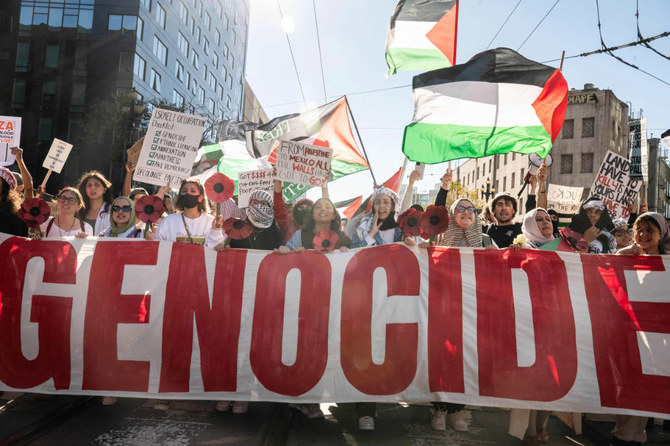
The fighting has provoked anti-Israeli protests around the world, and political opposition from key regional powers, including influential Turkiye, which on Saturday recalled its ambassador from Israel.
Palestinian ally Turkiye had been mending torn relations with Israel until last month’s start of the Israel-Hamas war.
But Ankara’s tone hardened against both Israel and its Western supporters — particularly the United States — as the fighting escalated and the death toll among Palestinian civilians soared.
Turkish President Recep Tayyip Erdogan told reporters he held Netanyahu personally responsible for the growing civilian death toll in Gaza.
“Netanyahu is no longer someone we can talk to. We have written him off,” Turkish media quoted Erdogan as saying.
Israeli foreign ministry spokesman Lior Haiat said the move was “another step by the Turkish president that sides with the Hamas terrorist organization.”
Hamas hailed the move and urged Ankara to “put pressure on President (Joe) Biden and his administration” so that “humanitarian and medical help can reach our besieged people in the Gaza Strip.”
Blinken is to begin a two-day visit to Turkiye on Sunday, the US State Department said. Thousands demonstrated in Istanbul on Saturday against his visit.
The Israeli military describes Gaza City as “the center of the Hamas terror organization,” but the US special envoy for aid assistance, David Satterfield, said between 350,000 and 400,000 civilians remained in the city and adjacent areas.
Overnight, Israeli ground forces launched “a targeted raid” to map tunnels and clear explosive traps in southern Gaza, where it has struck before but rarely sent in troops, the military said.
“The troops encountered a terrorist cell exiting a tunnel shaft. In response, the troops fired shells toward the terrorists and killed them,” it said.
Israel says it has struck 12,000 targets across the Palestinian territory since October 7, one of the fiercest bombing campaigns in recent memory.
A key focus of Blinken’s visit to Israel on Friday was to convince Netanyahu to enact “humanitarian pauses.”
Netanyahu rebuffed the proposal, saying he would not agree to a “temporary truce” until Hamas releases more than 240 Israeli and foreign hostages it abducted during its October 7 attack.
Inside Israel, thousands of people protested on Saturday as pressure mounts on Netanyahu over his government’s lack of preparedness for the October 7 attacks and its handling of the hostage crisis.
In Gaza City, an Israeli strike on Friday hit an ambulance convoy near the territory’s largest hospital Al-Shifa, killing 15 people, according to the Palestinian Red Crescent and the Hamas-run health ministry.
Israel’s military said it had targeted an ambulance used by a “Hamas terrorist cell” and had “neutralized” those inside.
An AFP journalist saw multiple bodies beside the blood-splattered Palestinian Red Crescent vehicle.
The Red Crescent said a convoy of five vehicles had been destined for the Rafah border crossing with Egypt, when they were struck multiple times.
One vehicle had been transporting a 35-year-old woman with shrapnel wounds.
A senior White House official said Hamas had tried to use a US-brokered deal opening the Egyptian border crossing to get its cadres out.
“That was just unacceptable to Egypt, to us, to Israel,” the official said.
Blinken on Saturday held talks in Amman with his counterparts from Jordan, Egypt, Saudi Arabia and the United Arab Emirates, all key players in the crisis.
In his talks with Blinken, King Abdullah II of Jordan underlined that “the only way to end the Palestinian-Israeli conflict is to work toward a political horizon to achieve a just and comprehensive peace based on the two-state solution.”
The US administration has said that it too backs a Palestinian state alongside Israel, but Netanyahu’s hard-right government is implacably opposed.
The Amman talks came amid mounting Arab anger over the civilian death toll in the war.
Jordan, which in 1994 became only the second Arab country after Egypt to make peace with Israel, recalled its ambassador from Israel on Wednesday for the first time since 2019.


