Media barred amid reported refugee detentions as Pakistan cracks down on illegal immigrants

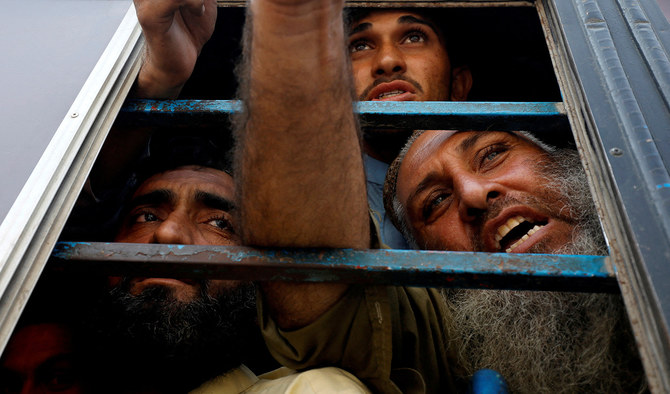
Afghan nationals, who according to police were undocumented, speak to the members of the media from the window of a bus, as they were detained and shifted to a temporary holding center in Karachi, Pakistan on November 2, 2023. (REUTERS)
Short Url
Updated 04 November 2023
Follow

Media barred amid reported refugee detentions as Pakistan cracks down on illegal immigrants

  • Journalists say they cannot access holding centers, though it can keep the deportation process more transparent
  • A rights activist suspects the authorities are hiding facts since documented refugees are also among those detained

KARACHI: Authorities in Pakistan’s southern Sindh province have denied media access to holding centers for illegal immigrants ahead of their deportation amid widespread complaints about the arrests and detention of registered refugees, journalists and refugee representatives said on Saturday.
Last month, Pakistan ordered all unregistered foreign nationals, primarily Afghans, to voluntarily repatriate by November 1, citing the involvement of many of them in militancy and other criminal activities. The government also established numerous holding centers to expedite the deportation following its ultimatum.
“At least 75 people have been detained and taken to a detention center, but 70 of them are registered refugees,” Haji Abdullah, chairman of the Afghan Refugee Council, said in an interview with Arab News.
He argued the refugees were apprehended despite having valid documents and questioned the law enforcement agencies’ rationale for detaining them even for verification purposes.
Pakistani authorities have repeatedly said they want to repatriate unregistered foreigners without undermining their dignity.
However, Hafeezullah Hasan, an Afghan national who came to Pakistan for medical treatment with a valid visa last month, reported that police had confiscated his passport.
“I legally traveled to Pakistan, and now I find myself at the police station awaiting the return of my passport,” he said.
Qaiser Khan Afridi, a spokesperson for the UN Refugee Agency, confirmed his organization had received harassment complaints from documented refugees in Sindh and other Pakistani regions.
“While the government of Pakistan’s plan targets the repatriation of undocumented foreigners in the first phase, we have reports of registered refugees with legal documentation being pressured,” he disclosed to Arab News.
Afridi urged authorities to avoid harassing refugees who are already encountering numerous hardships.
Journalists, including Ubaid Shah of a local news channel, were barred from entering the Sultanabad holding center in Karachi on Saturday.
“Making excuses that inmates may escape with media people, journalists were stopped at the gate,” Shah revealed. “This lack of access hinders our ability to report on the actual conditions.”
He also highlighted that media were not permitted on buses transporting refugees to the Afghan border for deportation.
“The authorities provide us with deportation numbers that frequently change,” he noted. “For example, on the first day, the deputy commissioner of the Keemari region reported that 120 people had been deported, but the figure was later adjusted to 112. Similarly, we were informed a day after that 148 people had left but then the figure was changed to 138.”
Shah maintained this pattern of changing numbers necessitated full media access for accurate and transparent reporting.
Faizullah Khan, another television journalist, shared similar experiences of being barred from the holding center.
“My colleagues and I were denied entry when we went to the center on the first day for reporting,” he said. “The reasons for this denial are unclear to us.”
Moniza Kakar, a lawyer and human rights advocate, said several detainees had been released following family protests.
“The authorities are detaining not only undocumented Afghans but also registered refugees, many of whom are children and Pakistani Pashtuns,” she informed.
Kakar called for increased transparency in the deportation process.
“We suspect that the authorities are concealing facts, given that documented refugees are also among those detained,” she added.
Attempts to get comments from the Karachi commissioner, the deputy commissioner of Keemari, and a spokesperson for the provincial home minister were unsuccessful, as none responded to calls.



‘Look ahead or look up?’: Pakistan’s police face new challenge as militants take to drone warfare

Updated 14 January 2026
Follow

‘Look ahead or look up?’: Pakistan’s police face new challenge as militants take to drone warfare

  • Officials say militants are using weapons and equipment left behind after allied forces withdrew from Afghanistan
  • Police in northwest Pakistan say electronic jammers have helped repel more than 300 drone attacks since mid-2025

BANNU, Pakistan: On a quiet morning last July, Constable Hazrat Ali had just finished his prayers at the Miryan police station in Pakistan’s volatile northwest when the shouting began.

His colleagues in Bannu district spotted a small speck in the sky. Before Ali could take cover, an explosion tore through the compound behind him. It was not a mortar or a suicide vest, but an improvised explosive dropped from a drone.

“Now should we look ahead or look up [to sky]?” said Ali, who was wounded again in a second drone strike during an operation against militants last month. He still carries shrapnel scars on his back, hand and foot, physical reminders of how the battlefield has shifted upward.

For police in the northwestern Khyber Pakhtunkhwa (KP) province, the fight against militancy has become a three-dimensional conflict. Pakistani officials say armed groups, including the Tehreek-e-Taliban Pakistan (TTP), are increasingly deploying commercial drones modified to drop explosives, alongside other weapons they say were acquired after the US military withdrawal from neighboring Afghanistan.

Security analysts say the trend mirrors a wider global pattern, where low-cost, commercially available drones are being repurposed by non-state actors from the Middle East to Eastern Europe, challenging traditional policing and counterinsurgency tactics.

The escalation comes as militant violence has surged across Pakistan. Islamabad-based Pakistan Institute for Conflict and Security Studies (PICSS) reported a 73 percent rise in combat-related deaths in 2025, with fatalities climbing to 3,387 from 1,950 a year earlier. Militants have increasingly shifted operations from northern tribal belts to southern KP districts such as Bannu, Lakki Marwat and Dera Ismail Khan.

“Bannu is an important town of southern KP, and we are feeling the heat,” said Sajjad Khan, the region’s police chief. “There has been an enormous increase in the number of incidents of terrorism… It is a mix of local militants and Afghan militants.”

In 2025 alone, Bannu police recorded 134 attacks on stations, checkpoints and personnel. At least 27 police officers were killed, while authorities say 53 militants died in the clashes. Many assaults involved coordinated, multi-pronged attacks using heavy weapons.

Drones have also added a new layer of danger. What began as reconnaissance tools have been weaponized with improvised devices that rely on gravity rather than guidance systems.

“Earlier, they used to drop [explosives] in bottles. After that, they started cutting pipes for this purpose,” said Jamshed Khan, head of the regional bomb disposal unit. “Now we have encountered a new type: a pistol hand grenade.”

When dropped from above, he explained, a metal pin ignites the charge on impact.

Deputy Superintendent of Police Raza Khan, who narrowly survived a drone strike during construction at a checkpoint, described devices packed with nails, bullets and metal fragments.

“They attach a shuttlecock-like piece on top. When they drop it from a height, its direction remains straight toward the ground,” he said.

TARGETING CIVILIANS

Officials say militants’ rapid adoption of drone technology has been fueled by access to equipment on informal markets, while police procurement remains slower.

“It is easy for militants to get such things,” Sajjad Khan said. “And for us, I mean, we have to go through certain process and procedures as per rules.”

That imbalance began to shift in mid-2025, when authorities deployed electronic anti-drone systems in the region. Before that, officers relied on snipers or improvised nets strung over police compounds.

“Initially, when we did not have that anti-drone system, their strikes were effective,” the police chief said, adding that more than 300 attempted drone attacks have since been repelled or electronically disrupted. “That was a decisive moment.”

Police say militants have also targeted civilians, killing nine people in drone attacks this year, often in communities accused of cooperating with authorities. Several police stations suffered structural damage.

Bannu’s location as a gateway between Pakistan and Afghanistan has made it a security flashpoint since colonial times. But officials say the aerial dimension of the conflict has placed unprecedented strain on local forces.

For constables like Hazrat Ali, new technology offers some protection, but resolve remains central.

“Nowadays, they have ammunition and all kinds of the most modern weapons. They also have large drones,” he said. “When we fight them, we fight with our courage and determination.”