GAZA/JERUSALEM: US Secretary of State Antony Blinken urged Israel on Friday to ensure more humanitarian aid and do more to protect Palestinian civilians in Gaza or else there will be “no partners for peace.” Israel warned that it was on high alert for attacks on its border with Lebanon as fears grew that the conflict could widen.
Israeli troops tightened their encirclement of Gaza City, the focus of their campaign to crush the enclave’s ruling Hamas militants, who launched a brutal attack on Israeli communities that started the war.
But ever since that Oct. 7 assault, there have been concerns the conflict could ignite fighting on other fronts, and Israel and the Iranian-backed militant group Hezbollah have repeatedly traded fire along the Lebanon border.
In his first public speech since the war began, Hezbollah leader Hassan Nasrallah said his group had “entered the battle” with the past weeks’ unprecedented cross-border fighting. “We will not be limited to this,” he said, suggesting escalation was possible. Still, Nasrallah stopped short of announcing that Hezbollah is fully engaging in the war.
Blinken, on his third trip to Israel since the war began, reiterated US support for Israel in the war, saying it has the right to defend itself. But he said a “humanitarian pause” was needed to boost aid deliveries to Palestinian civilians amid growing alarm over the humanitarian crisis in Gaza.
After meeting Blinken, Israeli Prime Minister Benjamin Netanyahu said Israel “refuses a temporary cease-fire that doesn’t include a return of our hostages,” referring to some 240 people Hamas abducted during its attack. He said Israel was pressing ahead with its military offensive with “all of its power.”
Blinken said there had to be a substantial and immediate increase in humanitarian aid to Gaza, where “we need to do more to protect Palestinian civilians.” Without that, “there are no partners for peace,” he said, adding that it was critical to restore the path toward a two-state solution to the Israel-Palestinian conflict.
Hezbollah, an ally of Hamas, attacked Israeli military positions in northern Israel with drones, mortar fire and suicide drones on Thursday. The Israeli military said it retaliated with warplanes and helicopter gunships, and spokesman Rear Adm. Daniel Hagari said civilians were wounded in the Hezbollah attacks.
“We are in a high state of readiness in the north, in a very high state of alert, to respond to any event today and in coming days,” he said.
Blinken said the US, which has deployed aircraft carriers and other forces in the eastern Mediterranean, was committed to ensuring that no “second or third front” opens in the conflict, referring to Hezbollah.
In his speech, Nasrallah said his militia is not deterred by US warnings, saying: “Your fleets in the Mediterranean ... will not scare us.”
A war with Hezbollah would be devastating for both Israel and Lebanon. Hezbollah is much stronger than Hamas, with an arsenal of some 150,000 rockets and missiles, some believed to be precision-guided weapons capable of striking deep inside Israel.
Israel has promised to unleash vast destruction in Lebanon if all-out war erupts, accusing Hezbollah of hiding its military installation in the midst of residential areas. The two enemies fought an inconclusive monthlong war in 2006. Renewed fighting could also risk drawing Iran, which backs both Hamas and Hezbollah, into the conflict.
More than 9,200 Palestinians have been killed in Gaza so far, mostly women and minors, and more and than 23,000 people have been wounded, the Gaza Health Ministry said, without providing a breakdown between civilians and fighters.
More than 1,400 people have died on the Israeli side, mainly civilians killed during Hamas’ initial attack, when some 240 people were also taken hostage. Some 5,400 have also been injured.
Twenty-four Israeli soldiers have been killed in Gaza since the start of the ground operation. Since the start of the war, seven Israeli soldiers and a civilian have been killed in different incidents along Israel’s border with Lebanon.
BLINKEN’S LATEST TRIP
As American officials have before, Blinken pledged unwavering support for Israel and its right to defend itself.
“We stand strongly for the proposition that Israel has not only the right but the obligation to defend itself, and to make sure that October 7 should never happen again,” said Blinken, who also plans to visit Amman, Jordan. It follows President Joe Biden’s suggestion for a humanitarian “pause” in the fighting. The aim would be to let in aid for Palestinians and let out more Palestinians who hold foreign passports and wounded.
Around 800 people left Gaza over the past two days — the first time people departed the besieged territory other than four hostages released by Hamas and another rescued by Israeli forces.
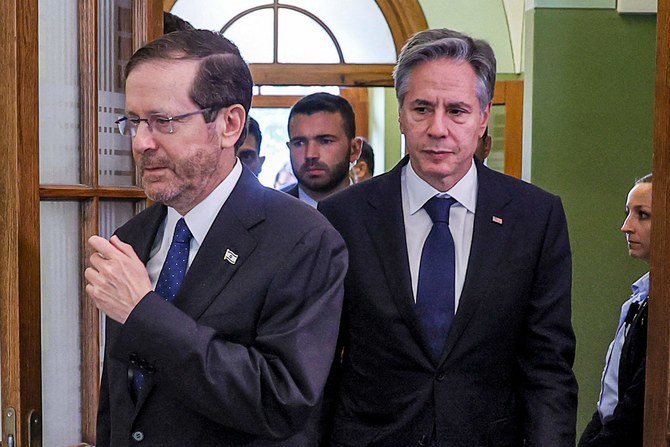
Blinken first held talks with Netanyahu behind closed doors before starting wider discussions with the leader and his War Cabinet and meeting with President Isaac Herzog.
More than 3,700 Palestinian children have been killed in 25 days of fighting, according to the Health Ministry in Hamas-run Gaza. Bombardment has driven more than half the territory’s 2.3 million people from their homes. Food, water and fuel are running low under Israel’s siege, and overwhelmed hospitals warn they are on the verge of collapse.
Israel has allowed more than 260 trucks carrying food and medicine into Gaza, but aid workers say it’s not nearly enough. Israeli authorities have refused to allow fuel in, saying Hamas is hoarding fuel for military use and would steal new supplies.
White House national security spokesman John Kirby said the US was not advocating for a general cease-fire but a “temporary, localized” pause.
Israel has not openly responded to Biden’s suggestion. But Netanyahu, who has previously ruled out a cease-fire, said Thursday: “We are advancing. … Nothing will stop us.” He vowed to destroy Hamas rule in the Gaza Strip.
Israel and the US seem to have no clear plan for what would come next if Hamas rule in Gaza is brought down — a key question on Blinken’s agenda during the visit, according to the State Department.
GAZA CITY ENCIRCLED
Meanwhile, military officials said Israeli forces have now completely encircled Gaza City, a densely packed cluster of neighborhoods that Israel says is the center of Hamas military infrastructure and includes a vast network of underground tunnels, bunkers and command centers.
Israeli forces are “fighting in a built-up, dense, complex area,” said the military’s chief of staff, Herzi Halevy.
Hagari, the military spokesperson, said Israeli forces were in “face to face” battles with militants, calling in airstrikes and shelling when needed. He said they were inflicting heavy losses on Hamas fighters and destroying their infrastructure with engineering equipment.
Hamas’ military wing said early Friday that its fighters battled Israeli troops in several areas in Gaza and claimed they killed four soldiers on the northern edge of the city of Beit Lahiya. It also claimed to have destroyed several tanks with locally made anti-tank rockets.
Neither the reports from Israel nor Hamas could be independently verified.
Casualties on both sides were expected to rise as Israeli troops advance toward the dense residential neighborhoods of Gaza City. Israel has warned residents to immediately evacuate the Shati refugee camp, which borders Gaza City’s center.
But hundreds of thousands of Palestinians remain in the path of fighting in northern Gaza, despite Israel’s repeated calls for them to flee. Many have crowded into UN facilities, hoping for safety.
Still, four UN schools-turned-shelter in northern Gaza and Bureij were hit in recent days, killing 24 people, according to Philippe Lazzarini, general-secretary of the UN agency for Palestinian refugees, known as UNRWA.
In the occupied West Bank overnight, Israeli forces killed seven Palestinians in different places and arrested many more, according to the Israeli military and Palestinian health officials.


![]()


Netanyahu rules out Gaza cease-fire as Blinken presses for more aid, civilian protection
Short Url
https://arab.news/z2abr
Netanyahu rules out Gaza cease-fire as Blinken presses for more aid, civilian protection
- Secretary of State on his third trip to Israel since the war began
- Blinken reiterated US support for Israel, urged a humanitarian pause in Gaza
High-level Turkish team to visit Damascus on Monday for talks on SDF integration
- The visit by Turkiye’s foreign and defense ministers and its intelligence chief comes amid efforts by Syrian, Kurdish and US officials to show some progress with the deal
ANKARA: A high-level Turkish delegation will visit Damascus on Monday to discuss bilateral ties and the implementation of a deal for integrating the Kurdish-led Syrian Democratic Forces (SDF) into Syria’s state apparatus, a Turkish Foreign Ministry source said.
The visit by Turkiye’s foreign and defense ministers and its intelligence chief comes amid efforts by Syrian, Kurdish and US officials to show some progress with the deal. But Ankara accuses the SDF of stalling ahead of a year-end deadline.
Turkiye views the US-backed SDF, which controls swathes of northeastern Syria, as a terrorist organization and has warned of military action if the group does not honor the agreement.
Last week Foreign Minister Hakan Fidan said Ankara hoped to avoid resorting to military action against the SDF but that its patience was running out.
The Foreign Ministry source said Fidan, Defense Minister Yasar Guler and the head of Turkiye’s MIT intelligence agency, Ibrahim Kalin, would attend the talks in Damascus, a year after the fall of former President Bashar Assad.
TURKEY SAYS ITS NATIONAL SECURITY IS AT STAKE
The source said the integration deal “closely concerned Turkiye’s national security priorities” and the delegation would discuss its implementation. Turkiye has said integration must ensure that the SDF’s chain of command is broken.
Sources have previously told Reuters that Damascus sent a proposal to the SDF expressing openness to reorganizing the group’s roughly 50,000 fighters into three main divisions and smaller brigades as long as it cedes some chains of command and opens its territory to other Syrian army units.
Turkiye sees the SDF as an extension of the outlawed Kurdistan Workers Party (PKK) militant group and says it too must disarm and dissolve itself, in line with a disarmament process now underway between the Turkish state and the PKK.
Ankara has conducted cross-border military operations against the SDF in the past. It accuses the group of wanting to circumvent the integration deal and says this poses a threat to both Turkiye and the unity of Syria.
The visit by Turkiye’s foreign and defense ministers and its intelligence chief comes amid efforts by Syrian, Kurdish and US officials to show some progress with the deal. But Ankara accuses the SDF of stalling ahead of a year-end deadline.
Turkiye views the US-backed SDF, which controls swathes of northeastern Syria, as a terrorist organization and has warned of military action if the group does not honor the agreement.
Last week Foreign Minister Hakan Fidan said Ankara hoped to avoid resorting to military action against the SDF but that its patience was running out.
The Foreign Ministry source said Fidan, Defense Minister Yasar Guler and the head of Turkiye’s MIT intelligence agency, Ibrahim Kalin, would attend the talks in Damascus, a year after the fall of former President Bashar Assad.
TURKEY SAYS ITS NATIONAL SECURITY IS AT STAKE
The source said the integration deal “closely concerned Turkiye’s national security priorities” and the delegation would discuss its implementation. Turkiye has said integration must ensure that the SDF’s chain of command is broken.
Sources have previously told Reuters that Damascus sent a proposal to the SDF expressing openness to reorganizing the group’s roughly 50,000 fighters into three main divisions and smaller brigades as long as it cedes some chains of command and opens its territory to other Syrian army units.
Turkiye sees the SDF as an extension of the outlawed Kurdistan Workers Party (PKK) militant group and says it too must disarm and dissolve itself, in line with a disarmament process now underway between the Turkish state and the PKK.
Ankara has conducted cross-border military operations against the SDF in the past. It accuses the group of wanting to circumvent the integration deal and says this poses a threat to both Turkiye and the unity of Syria.
Latest updates


© 2025 SAUDI RESEARCH & PUBLISHING COMPANY, All Rights Reserved And subject to Terms of Use Agreement.