

Pakistan Supreme Court summons election commission tomorrow to announce polls date

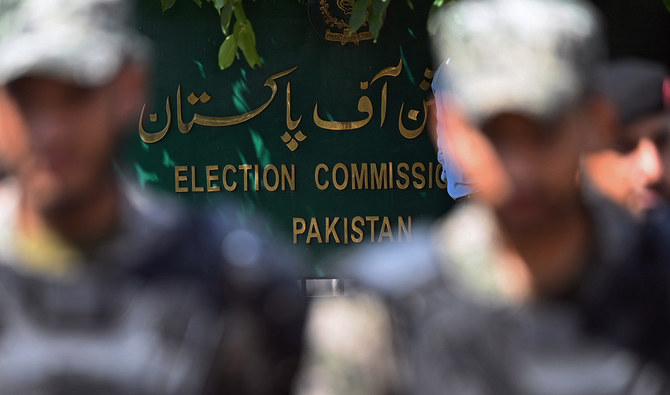
Paramilitary soldiers stand guard outside the Pakistan’s election commission building in Islamabad on August 2, 2022. (AFP/File)
Short Url
Updated 02 November 2023
Follow

Pakistan Supreme Court summons election commission tomorrow to announce polls date

  • Election Commission’s lawyer tells top court the regulator plans elections for February 11
  • Elections were due in November but delayed due to fresh demarcation of constituencies

ISLAMABAD: Chief Justice of Pakistan (CJP) Qazi Faez Isa on Thursday directed the Election Commission (ECP) to confer with President Arif Alvi to fix a date for polls after the lawyer for the regulator informed the Supreme Court general elections in the country would be held on February 11, 2024, Pakistani media widely reported.

Sajeel Swati’s revelation before the top court came as it heard a set of petitions calling for fixing the date of the next election within the 90-day constitutional deadline ending in early November.

Elections in the politically and economically troubled South Asian nation had to be held in November but were delayed due to fresh demarcation of constituencies under a new census. In September, the ECP said it needed until at least January to hold polls.

“Elections in the country will be held in the country [after] completion of delimitation on November 30,” ECP’s lawyer Swati told a three-member bench in remarks widely reported by local media.

All arrangements, including the delimitation of constituencies, would be completed on January 29.

“Elections should be held on Sunday, February 11,” the lawyer informed the court.

Justice Isa instructed the ECP to appear before the court tomorrow, Friday, after consulting on the date with Alvi, as is mandated by the constitution.

“The final date for elections will be announced from the SC,” Justice Isa said, adding that pleas for any extension in the date would not be entertained.

Recently amendments to Sections 57 and 58 of the Election Act 2017 allow the Election Commission to bypass the president and unilaterally announce election dates. However, independent legal analysts say the power of the president to set a date for elections under Article 48(5) is an independent power under the constitution and not subservient to any other provision of the Constitution.

Pakistan is currently being run by a caretaker government under interim Prime Minister Anwaar-ul-Haq Kakar that is meant to oversee a general election.

Despite the delay, the announcement of polls will likely ease political uncertainty as the country struggles to stay on a narrow stabilization path under a $3 billion bailout plan by the International Monetary Fund (IMF).

Analysts and political parties have been demanding that elections be held as soon as possible to boost confidence in the ailing $350 billion economy, which is currently suffering from high inflation, low growth and a weak currency.


Pakistan, global crypto exchange discuss modernizing digital payments, creating job prospects 

Updated 05 December 2025
Follow

Pakistan, global crypto exchange discuss modernizing digital payments, creating job prospects 

  • Pakistani officials, Binance team discuss coordination between Islamabad, local banks and global exchanges
  • Pakistan has attempted to tap into growing crypto market to curb illicit transactions, improve oversight

ISLAMABAD: Pakistan’s finance officials and the team of a global cryptocurrency exchange on Friday held discussions aimed at modernizing the country’s digital payments system and building local talent pipelines to meet rising demand for blockchain and Web3 skills, the finance ministry said.

The development took place during a high-level meeting between Finance Minister Muhammad Aurangzeb, Pakistan Virtual Assets Regulatory Authority (PVARA) Chairman Bilal bin Saqib, domestic bank presidents and a Binance team led by Global CEO Richard Teng. The meeting was held to advance work on Pakistan’s National Digital Asset Framework, a regulatory setup to govern Pakistan’s digital assets.

Pakistan has been moving to regulate its fast-growing crypto and digital assets market by bringing virtual asset service providers (VASPs) under a formal licensing regime. Officials say the push is aimed at curbing illicit transactions, improving oversight, and encouraging innovation in blockchain-based financial services.

“Participants reviewed opportunities to modernize Pakistan’s digital payments landscape, noting that blockchain-based systems could significantly reduce costs from the country’s $38 billion annual remittance flows,” the finance ministry said in a statement. 

“Discussions also emphasized building local talent pipelines to meet rising global demand for blockchain and Web3 skills, creating high-value employment prospects for Pakistani youth.”

Blockchain is a type of digital database that is shared, transparent and tamper-resistant. Instead of being stored on one computer, the data is kept on a distributed network of computers, making it very hard to alter or hack.

Web3 refers to the next generation of the Internet built using blockchain, focusing on giving users more control over their data, identity and digital assets rather than big tech companies controlling it.

Participants of the meeting also discussed sovereign debt tokenization, which is the process of converting a country’s debt such as government bonds, into digital tokens on a blockchain, the ministry said. 

Aurangzeb called for close coordination between the government, domestic banks and global exchanges to modernize Pakistan’s payment landscape.

Participants of the meeting also discussed considering a “time-bound amnesty” to encourage users to move assets onto regulated platforms, stressing the need for stronger verifications and a risk-mitigation system.

Pakistan has attempted in recent months to tap into the country’s growing crypto market, crack down on money laundering and terror financing, and promote responsible innovation — a move analysts say could bring an estimated $25 billion in virtual assets into the tax net.

In September, Islamabad invited international crypto exchanges and other VASPs to apply for licenses to operate in the country, a step aimed at formalizing and regulating its fast-growing digital market.