Van Cleef & Arpels-backed School for Jewelry Arts opens in Dubai 

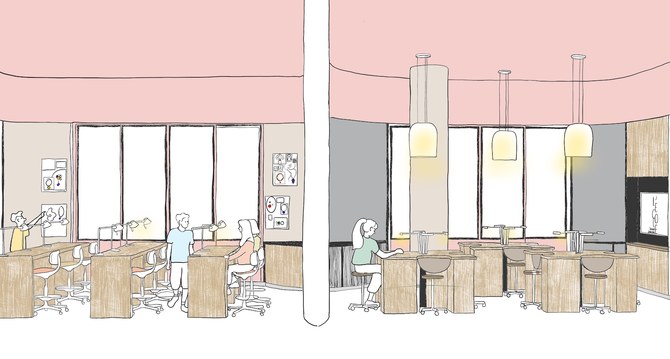
Renderings of L'ÉCOLE Middle East. (Supplied)
Short Url
Updated 02 November 2023
Follow

Van Cleef & Arpels-backed School for Jewelry Arts opens in Dubai 

  • Van Cleef & Arpels-backed establishment opens international campus in UAE 

DUBAI: A range of dazzling gems will soon be on display at the inaugural exhibition of L’École Middle East, School of Jewelry Arts at its new permanent location in Dubai Design District (d3).  

The “Garden of Emeralds” exhibition will reveal the history and hidden secrets of the magnificent titular jewel to the public.  

The exhibition is also to celebrate the opening of the Middle East “edition” of L’École, School of Jewelry Arts, which was founded in Paris in 2012 with support from the French luxury jewelry company Van Cleef & Arpels. 


L’École is a jewelry school founded in Paris in 2012 with support from the French luxury jewelry company Van Cleef & Arpels. (Supplied)

L’École already has two permanent campuses in Paris, one in Hong Kong, which opened in 2019, and another in Shanghai, which opened this year.  

Lise MacDonald, president of L’École, told Arab News that the decision to open another location in Dubai was spurred by the success of its traveling school sessions organized over the past few years in the Middle East and the uptick in interest from the region, which has witnessed a notable rise in the number of jewelry designers over the past decade. 

“When we opened the first school in Paris in 2012, jewelry, at the time, was considered a true work of art by only a few people,” MacDonald told Arab News. “The CEO of Van Cleef & Arpels Nicolas Boos decided to create a school that would show to the visitors and audiences at large the relevance of jewelry as a form of cultural expression from various historical eras.” 


Sophie Claudel. (Supplied)

Jewelry, MacDonald noted, was one of the very first art forms — human beings have been adorning their bodies with various objects, often for ritualistic or aesthetic purposes, throughout history.  

“Jewelry, as one of the first forms of artistic expression, is relevant to people across the world,” she added. “The mission of the school is to spread the world of jewelry to people across the world and generate the largest possible public interest everywhere.”   

L’École in Dubai, like its other locations, is open to all — catering to beginners as well as connoisseurs and collectors or those who are simply curious to learn more about jewelry. It will offer an in-depth program of online and in-person talks, as well as temporary exhibitions such as “The Garden of Emeralds,” which runs from Nov. 23 to March 10, and publications and research projects.  


Raw Emerald, Muzo Valley, Eastern Cordillera, Colombia. (Supplied)

While Van Cleef & Arpels is its backer, L’École showcases work from all jewelry brands.  

“We aim to provide access to the world of jewelry to the widest audience possible,” said Nicolas Boos, president and CEO of Van Cleef & Arpels, in the press release for the new L’École in Paris. “Our world shouldn’t intimidate or turn anyone away.” 

The commitment of L’École to championing the historical importance and diverse breadth of jewelry is exemplified in an upcoming exhibition on costume jewelry that will be on view in Paris later this year at its new location in an 18th-century building on the Grands Boulevards. It is one of Paris’ oldest private homes and one of the French capital’s most remarkable buildings, noted especially for its understated neoclassical stone façade.  


Courses and workshops at L'ÉCOLE , School of Jewelry Arts. (Supplied)

Its inaugural exhibition will feature stage jewelry from the Comédie-Française. It will include 120 accessories, pieces of art, and documents, mostly sourced from the renowned theater’s collections. The exhibition is reflective of L’École’s stated mission, showcasing jewelry pieces not just for their aesthetic beauty but for their historical and cultural importance, serving as a way to better understand different periods in history.  

“Our concept offers a very generous approach to storytelling,” Sophie Claudel, the director of L’École Middle East told Arab News. “Jewelry is an art form, and it should be open and available to all, not just to those who can afford it.” 

Claudel emphasized how the multicultural and cosmopolitan nature of Dubai provides an ideal platform for a jewelry school with such inclusive aims.  

“Jewelry is an intrinsic part of Middle Eastern heritage,” she said, adding that L’École in Dubai will offer a variety of courses, seminars, and at least two exhibitions per year. There will also be a bookstore and a library.  

“We want to provide an anchor for people in the region who love jewelry and for those desiring to know and engage more in the world of jewelry,” she said. “We are open to all.” 


From historic desert landscapes to sound stages: AlUla’s bid to become the region’s film capital

Updated 07 February 2026
Follow

From historic desert landscapes to sound stages: AlUla’s bid to become the region’s film capital

DUBAI: AlUla is positioning itself as the center of cinema for the MENA region, turning its dramatic desert landscapes, heritage sites and newly built studio infrastructure into jobs, tourism and long‑term economic opportunity.

In a wide‑ranging interview, Zaid Shaker, executive director of Film AlUla, and Philip J. Jones, chief tourism officer for the Royal Commission for AlUla, laid out an ambitious plan to train local talent, attract a diverse slate of productions and use film as a catalyst for year‑round tourism.

“We are building something that is both cultural and economic,” said Shaker. “Film AlUla is not just about hosting productions. It’s about creating an entire ecosystem where local people can come into sustained careers. We invested heavily in facilities and training because we want AlUla to be a place where filmmakers can find everything they need — technical skill, production infrastructure and a landscape that offers limitless variety. When a director sees a location and says, ‘I can shoot five different looks in 20 minutes,’ that changes the calculus for choosing a destination.”

At the core of the strategy are state‑of‑the‑art studios operated in partnership with the MBS Group, which comprises Manhattan Beach Studios — home to James Cameron’s “Avatar” sequels. “We have created the infrastructure to compete regionally and internationally,” said Jones. “Combine those studios with AlUla’s natural settings and you get a proposition that’s extremely attractive to producers; controlled environment and unmatched exterior vistas within a short drive. That versatility is a real selling point. We’re not a one‑note destination.”

The slate’s flagship project, the romantic comedy “Chasing Red,” was chosen deliberately to showcase that range. “After a number of war films and heavy dramas shot here, we wanted a rom‑com to demonstrate the breadth of what AlUla offers,” said Shaker. “‘Chasing Red’ uses both our studio resources and multiple on‑location settings. It’s a story that could have been shot anywhere — but by choosing AlUla we’re showing how a comical, intimate genre can also be elevated by our horizons, our textures, our light.

“This film is also our first under a broader slate contract — so it’s a proof point. If ‘Chasing Red’ succeeds, it opens the door for very different kinds of storytelling to come here.”

Training and workforce development are central pillars of the program. Film AlUla has engaged more than 180 young Saudis in training since the start of the year, with 50 already slated to join ongoing productions. “We’re building from the bottom up,” said Shaker. “We start with production assistant training because that’s often how careers begin. From there we provide camera, lighting, rigging and data-wrangling instruction, and we’ve even launched soft‑skill offerings like film appreciation— courses that teach critique, composition and the difference between art cinema and commercial cinema. That combination of technical and intellectual training changes behavior and opens up real career pathways.”

Jones emphasized the practical benefits of a trained local workforce. “One of the smartest strategies for attracting productions is cost efficiency,” he said. “If a production can hire local, trained production assistants and extras instead of flying in scores of entry‑level staff, that’s a major saving. It’s a competitive advantage. We’ve already seen results: AlUla hosted 85 productions this year, well above our initial target. That momentum is what we now aim to convert into long‑term growth.”

Gender inclusion has been a standout outcome. “Female participation in our training programs is north of 55 percent,” said Shaker. “That’s huge. It’s not only socially transformative, giving young Saudi women opportunities in an industry that’s historically male-dominated, but it’s also shaping the industry culture here. Women are showing up, learning, and stepping into roles on set.”

Looking to 2026, their targets are aggressive; convert the production pipeline into five to six feature films and exceed 100 total productions across film, commercials and other projects. “We want private-sector partners to invest in more sound stages so multiple productions can run concurrently,” said Jones. “That’s how you become a regional hub.”

The tourism case is both immediate and aspirational. “In the short term, productions bring crews who fill hotels, eat in restaurants and hire local tradespeople,” said Shaker. “In the long term, films act as postcards — cinematic invitations that make people want to experience a place in person.”

Jones echoed that vision: “A successful film industry here doesn’t just create jobs; it broadcasts AlUla’s beauty and builds global awareness. That multiplies the tourism impact.”

As “Chasing Red” moves into production, Shaker and Jones believe AlUla can move from an emerging production destination to the region’s filmmaking epicenter. “We’re planting seeds for a cultural sector that will bear economic fruit for decades,” said Shaker. “If we get the talent, the infrastructure and the stories right, the world will come to AlUla to film. And to visit.”