

Pakistani politicians, rights activists move top court against government decision to deport illegal immigrants

1 / 2
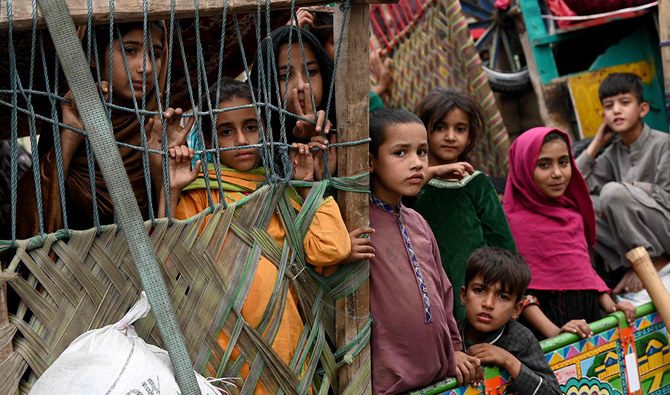
Afghan refugees arrive at a holding centre as they prepare to depart for Afghanistan, in Landi Kotal on November 1, 2023. (AFP)
2 / 2
Afghan children refugees arrive on trucks from Pakistan at the Afghanistan-Pakistan Torkham border in Nangarhar province on November 1, 2023. (AFP)
Short Url
Updated 02 November 2023
Follow

Pakistani politicians, rights activists move top court against government decision to deport illegal immigrants

  • Pakistani had given until Nov. 1 for all undocumented foreigners to leave willingly 
  • Petitioners call government’s policy to deport refugees and asylum seekers ‘inhumane’

ISLAMABAD: Prominent Pakistani politicians and rights activists filed a petition in the Supreme Court on Wednesday, challenging what they called the government’s “inhumane” decision to expel illegal immigrants.
Pakistani authorities on Wednesday began rounding up undocumented foreigners, most of them Afghans, as a Nov. 1 deadline for them to leave voluntarily or face expulsion expired. The government has said any illegal foreigners found staying in Pakistan beyond the deadline would be taken to holding centers before being deported.
“Not only is this policy beyond the mandate of the Caretaker Government provided in Section 230 of the Elections Act, 2017, it is draconian and in contravention of national and international law,” the petitioners said in a press release.

The petitioners include Pakistan Peoples Party (PPP) representative Farhatullah Babar, Jamaat-i-Islami’s Senator Mushtaq Ahmed, rights activist Amina Masood Janjua, politician Mohsin Dawar, lawyer Jibran Nasir and lawyer Imaan Zainab Mazari-Hazir, among others.
The petitioners said under the garb of deporting undocumented residents, authorities were also harassing, detaining and expelling people who possessed Proof of Registration (PoR) cards and other documents that allowed them to legally stay in Pakistan. 
They said it was “unprecedented” that people born in Pakistan and Pakistani citizens by virtue of the country’s Citizenship Act were being banished.
“It is nothing less than a crime to remain silent over the refoulement of fellow humans to imminent misery and persecution,” the petitioners added, calling on the Supreme Court to secure the “life, liberty and dignity” of asylum seekers and refugees in Pakistan. 
“We also seek directions to the UNHCR and the international community to fulfill their duty and commitment to speedily process all pending cases of asylum seekers/refugees.”
The government has set up 49 deportation centers to temporarily house illegal migrants, including an estimated 1.7 million undocumented Afghans.
Although the government insists its expulsion order does not specifically target Afghans, they form the largest number of undocumented foreigners in the South Asian nation, many of them having lived in Pakistan their entire lives. Also, since the deadline announcement, Islamabad has blamed Afghans for multiple militant attacks, including 14 of this year’s 24 suicide bombings. The government also says hosting millions of refugees has drained its resources amid an economic crisis.


Pakistan, China ink 24 agreements to develop digital corridor for IT cooperation

Updated 4 sec ago
Follow

Pakistan, China ink 24 agreements to develop digital corridor for IT cooperation

  • Both countries sign one government-to-government, seven government-to-business and 16 business-to-business MoUs
  • Digital corridor will create new avenues for Pakistani tech companies, expand cooperation with China in ICT, says state media

ISLAMABAD: Pakistan and China have signed 24 agreements to develop a digital corridor aimed at enhancing information technology (IT) cooperation between the two states, state-run media reported on Monday. 

The memoranda of understanding between the two sides were signed in Beijing, according to the state-owned Associated Press of Pakistan (APP). 

The MoUs include one government-to-government, seven government-to-business and 16 business-to-business agreements.

“The initiative focuses on developing an innovative and pragmatic digital corridor to enhance cooperation in the IT industry,” APP reported. 

APP said the digital corridor will create new avenues for Pakistani tech companies and expand bilateral cooperation with China in the information and communication technology infrastructure development.

The development is in line with Pakistan’s recent efforts to boost IT exports and enhance digital cooperation with regional allies. 

In November, Pakistan highlighted the “Digital Silk Road” as the next major phase of the China–Pakistan Economic Corridor (CPEC) while proposing new technology partnerships with Beijing, including joint ventures in 5G/6G, hardware manufacturing and ICT components. 

Launched in 2015, CPEC is a multibillion-dollar connectivity program linking western China to the Arabian Sea. The initiative has historically focused on energy projects, highways, power plants and the Gwadar port, with committed investments estimated at around $60 billion. 

As the two countries enter CPEC’s second phase, cooperation is expanding beyond physical infrastructure into technology, digital governance, manufacturing and skills development.

The Digital Silk Road is Beijing’s framework for cross-border connectivity in fiber, cloud services, data routing, smart manufacturing and emerging technologies. It is increasingly positioned as the backbone of CPEC’s next stage.