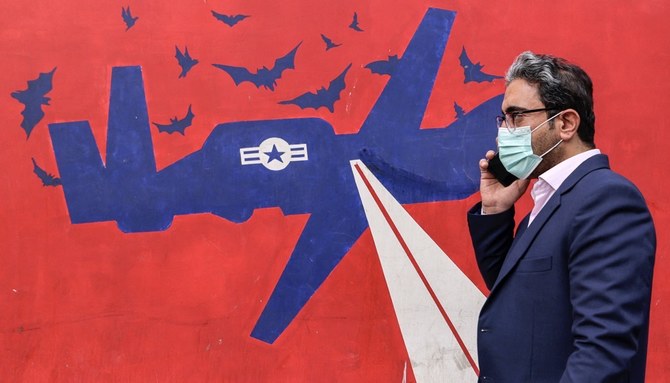
Time capsule US embassy in Iran highlights decades of hostility

1 / 4
The building is a time capsule from the day it was seized by Iranian students on November 4, 1979. (AFP)
2 / 4
The building is a time capsule from the day it was seized by Iranian students on November 4, 1979. (AFP)
3 / 4
The building is a time capsule from the day it was seized by Iranian students on November 4, 1979. (AFP)
4 / 4
The building is a time capsule from the day it was seized by Iranian students on November 4, 1979. (AFP)
Short Url
Updated 02 November 2023
Follow

Time capsule US embassy in Iran highlights decades of hostility

  • Crowds of Iranians gather each year on November 4 outside the building to denounce the “arrogance” of the US
  • Washington officially broke off relations with Tehran in 1980

TEHRAN: It’s hard to miss the former US embassy in the center of Iran’s capital Tehran, because it is daubed with striking anti-American murals.
The building, today known as the “Den of Spies” museum, encapsulates the hostility of Iran-US relations marred by decades of mistrust and crises, including the current Israel-Hamas war.
Visitors to the site are greeted by a tattered Stars and Stripes flag and a mural of the Statue of Liberty, her arm carrying a crumbled-away torch of freedom, while another depicts her with a skull face.
Inside, the building is a time capsule from the day it was seized by Iranian students on November 4, 1979.
It showcases the furniture and office equipment including shredders, computers and painstakingly reconstituted documents that embassy staff frantically tried to destroy in the hours before the compound was stormed.
A portrait of former US president Jimmy Carter still hangs on the wall of what was once the ambassador’s office.
Fifty-two embassy staff were held hostage for 444 days by the students, who demanded that Washington hand over Iran’s recently toppled shah, who was being treated in the US for cancer.
The crisis came less than nine months after the removal of the US-backed shah, and was “a founding act of the Islamic Republic,” master’s student Hossein told AFP near the museum.
Washington officially broke off relations with Tehran in 1980, and they have been frozen ever since.
Today, the museum receives “on average 100 to 200 visitors a day, 70 percent of whom are tourists,” said Majid Alizadeh, the compound’s director.
“Foreigners, especially Russians and Chinese, seem more interested than Iranians.”
Some tourists “come to see the place where the Americans were humiliated,” he said.
Relations between Washington and Tehran have never recovered from the crisis.
“It came at a very high price,” said Hossein, because “the Americans never forgave it and we have lived since in an atmosphere of tensions and sanctions.”
Since the 1979 revolution Iran has maintained strong anti-American rhetoric that sits at the heart of its foreign policy.
On Wednesday, supreme leader Ayatollah Ali Khamenei praised the storming of the embassy ahead of Saturday’s 44th anniversary of its seizure.
“The students entered the American embassy, captured it and exposed its secrets and confidential documents. America’s reputation is gone,” he told a student gathering.
“This was the blow the Iranian nation inflicted on America.”
Crowds of Iranians gather each year on November 4 outside the building to denounce the “arrogance” of the US which is often referred to in the country as the “Great Satan.”
The former embassy has for years been secured by the Basij forces, a paramilitary wing of Iran’s Islamic Revolutionary Guard Corps, the IRGC.
The Swiss delegation represents American interests in Iran, and recently facilitated a painstakingly negotiated prisoner swap between Tehran and Washington.
Iran is represented in the US capital by the Pakistani embassy.
The Islamic republic has been under crippling US sanctions since Washington’s 2018 withdrawal from a landmark deal which granted it sanctions relief in return for curbs on its atomic program.
Tensions between Iran and the US have worsened since the October 7 attacks on Israel by the Palestinian Hamas militant group, which Israeli officials say killed at least 1,400 people. Another 240 were seized as hostages and taken into the Gaza Strip.
Iran has lauded Hamas’s attacks and labelled as “genocide” Israel’s withering bombing campaign against Gaza, which the Hamas-controlled health ministry said on Wednesday had killed more than 8,750 people.
Tehran has also lambasted Washington for backing Israel, with Khamenei saying on October 25 that the US was a “definite accomplice of criminals.”
For its part, Washington has accused Tehran of “actively facilitating” attacks on US forces in the Middle East.
Despite nearly 50 years of hostility, museum director Alizadeh believes the American embassy could be reopened “if the US accepts and respects Iran’s position in the region.”
Generally, “Iranians have never had any personal problems with the Americans,” he added.


Sudan defense minister dismisses ‘intelligence document’ as fabrication after convoy strike

Updated 12 February 2026
Follow

Sudan defense minister dismisses ‘intelligence document’ as fabrication after convoy strike

  • Gen. Hassan Kabroun tells Arab News claims that army hid weapons in aid convoy are “completely false”

RIYADH: Sudan’s defense minister has firmly denied reports attributed to Sudanese intelligence alleging that a convoy targeted in North Kordofan was secretly transporting weapons under the cover of humanitarian aid.

Gen. Hassan Kabroun described the claims as “false” and an attempt to distract from what he called a militia crime.

The controversy erupted after news reports emerged that a document attributed to Sudan’s General Intelligence Service claimed the convoy struck in Al-Rahad on Friday was not a purely humanitarian mission, but was instead carrying “high-quality weapons and ammunition” destined for Sudanese Armed Forces units operating in the state.

The report further alleged that the convoy had been outwardly classified as humanitarian in order to secure safe passage through conflict zones, and that the Rapid Support Forces had destroyed it after gathering intelligence on its route and cargo.

Kabroun categorically rejected the narrative.

“First of all, we would like to stress the fact that this news is false,” he told Arab News. “Even the headline that talks about the security of the regions, such as Al-Dabbah, is not a headline the army would use.”

He described the document as fabricated and politically motivated, saying it was designed to “cover up the heinous crime they committed.”

The minister affirmed that the area targeted by drones is under full control of the Sudanese Armed Forces and does not require any covert military transport.

“Second, we confirm that the region that was targeted by drones is controlled by the army and very safe,” Kabroun said. “It does not require transporting any military equipment using aid convoys as decoys because it is a safe area controlled by the army, which has significant capabilities to transport humanitarian aid.”

According to the minister, the Sudanese military has both the logistical capacity and secure routes necessary to move equipment openly when needed.

“The army is professional and does not need to deliver anything to Kadugli or Dalang on board aid convoys,” he said. “The road between Dalang and Kadugli is open. The Sudanese forces used that road to enter and take control of the region. The road is open and whenever military trucks need to deliver anything, they can do so without resorting to any form of camouflage.”

Kabroun further rejected any suggestion that the military uses humanitarian operations as cover.

“Aid is transported by dedicated relief vehicles to the areas in need of this assistance,” he said. “Aid is not transported by the army. The army and security apparatus do not interfere with relief efforts at all, and do not even accompany the convoys.”

He stressed that the Sudanese Armed Forces maintains a clear institutional separation between military operations and humanitarian work, particularly amid the country’s crisis.

“These are false claims,” he said. “This fake news wanted to cover up the heinous crime they committed.”

Sudan has been gripped by conflict since April 2023, when fighting broke out between the Sudanese Armed Forces and the Rapid Support Forces, plunging the country into what the United Nations has described as one of the world’s worst humanitarian disasters.

The latest dispute over the convoy comes amid intensified fighting in South Kordofan, a strategically sensitive region linking central Sudan with the contested areas of Darfur and Blue Nile.

The false report suggested that intelligence monitoring had enabled the RSF to strike what it described as a military convoy disguised as humanitarian aid. But Kabroun dismissed that version outright.

“The intelligence agency is well aware of its duties,” he said. “The Sudanese Army has enough weapons and equipment to use in the areas of operations. These claims are completely false.”

He argued that the narrative being circulated seeks to shift blame for attacks on civilian infrastructure and humanitarian movements.

“This shows that they are trying to cover up the atrocities,” he added, referring to the militia.

Kabroun maintained that the army has regained momentum on multiple fronts and remains fully capable of sustaining its operations without resorting to deception.

“The region is secure, the roads are open, and the army does not need camouflage,” he said. “We are operating professionally and transparently.”

“These claims are completely false,” Kabroun said. “The Sudanese Army does not use humanitarian convoys for military purposes.”