

‘Babies are suffering’: Afghans fear for kids at crowded border crossing

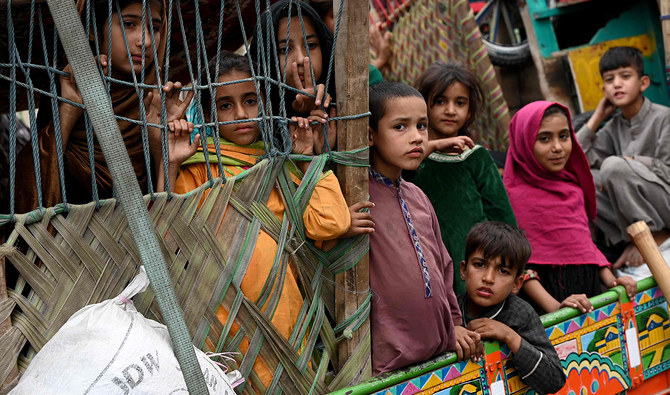
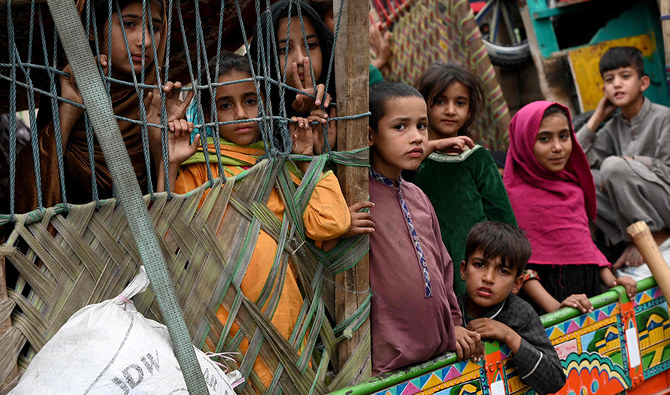
Afghan children refugees arrive on trucks from Pakistan at the Afghanistan-Pakistan Torkham border in Nangarhar province on November 1, 2023. (AFP)
Short Url
Updated 01 November 2023
Follow

‘Babies are suffering’: Afghans fear for kids at crowded border crossing

  • Islamabad issued an ultimatum last month to illegal immigrants: leave before Nov. 1 or face deportation
  • At least 29,000 Afghans crossed into Afghanistan on Tuesday, making it difficult for Taliban authorities to keep up

TORKHAM, Afghanistan: Khalida’s young son fell ill while they were on the road to Afghanistan, racing to leave Pakistan under threat of deportation.

But while they reached their home country before a November 1 deadline set by Islamabad, they could barely get enough food or water to keep up the boy’s strength, let alone the proper medication.

“We don’t have anything to feed him, we got some vegetables yesterday and today so far he has only had a cup of green tea. There is no milk,” said the 25-year-old, holding her son Abdullah, who is under two years old.

“Money talks, but we don’t have any. What can we do?“
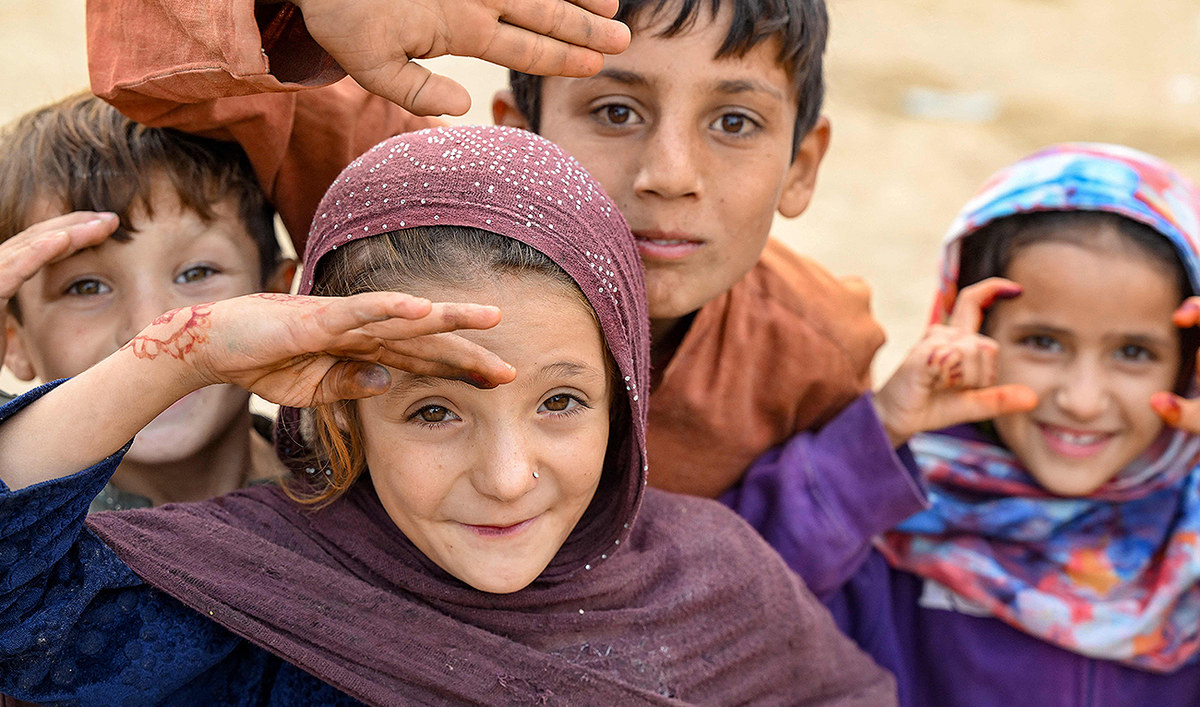


Afghan refugee children gesture as they prepare to depart for Afghanistan, at a holding centre, in Landi Kotal on November 1, 2023. (AFP)

She and her other children sat next to a brightly painted truck, one in a sea of vehicles stacked with belongings clustered near the Torkham border crossing, where thousands of Afghans have returned from Pakistan in recent weeks.

Islamabad issued an ultimatum in early October to 1.7 million Afghans it says were living illegally in Pakistan: leave voluntarily or face arrest and expulsion.

In the week before the deadline, a stream of Afghans heading home has turned into a flood, with authorities working from dawn till dusk to register the new arrivals but struggling to keep up.

The number of returnees has mounted daily — at least 29,000 people crossed into Afghanistan on Tuesday alone — sparking an “emergency situation” at the border post, a border official said.

Conditions deteriorated rapidly in just a few days ahead of the deadline, AFP journalists saw, with many parents expressing worry for children who had fallen ill after sleeping out in the cold.
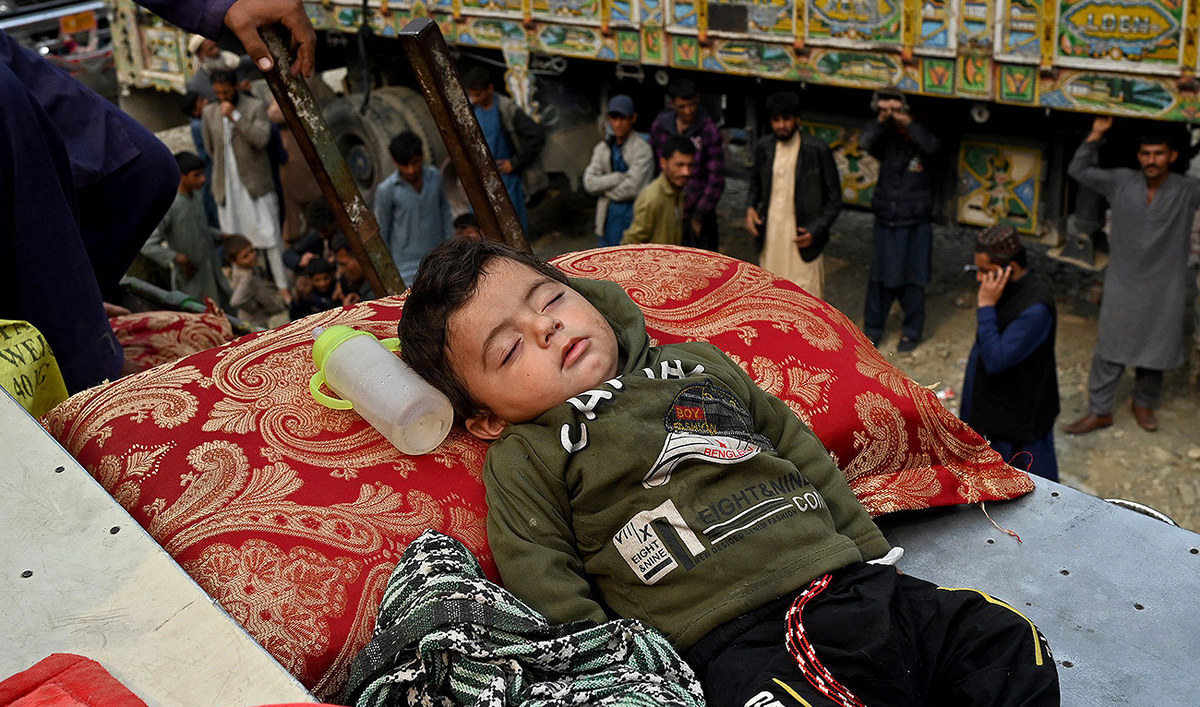


An Afghan child refugee sleeps above a truck as he arrives from Pakistan at the Afghanistan-Pakistan Torkham border in Nangarhar province on November 1, 2023. (AFP)

“He (Abdullah) has diarrhea. We took him to the doctor,” Khalida said. “This woman’s child is sick but she said, ‘Let him be, God will heal him’,” she added, gesturing under her pale pink burqa to a woman nearby.

Taj Mohammad, who traveled from Peshawar just across the border and was waiting to register with the government before going to nearby Jalalabad, said his two-month-old son had developed a chest infection.

“Babies are suffering from flu and chest infections, not only mine but every baby. The weather is cold at night and there are not enough resources.”

Diapers littered the area around the sea of trucks, people and industry that has sprung up around the ad hoc camp, but most people have nothing to clothe their small children in, and human excrement was everywhere.

The government and UN agencies have scrambled to provide services and support, including mobile toilets, water tanks and other supplies, but “we need it to be more,” said Mohammad.

Frustration has mounted with the bottlenecked process. Food and water remain scarce.
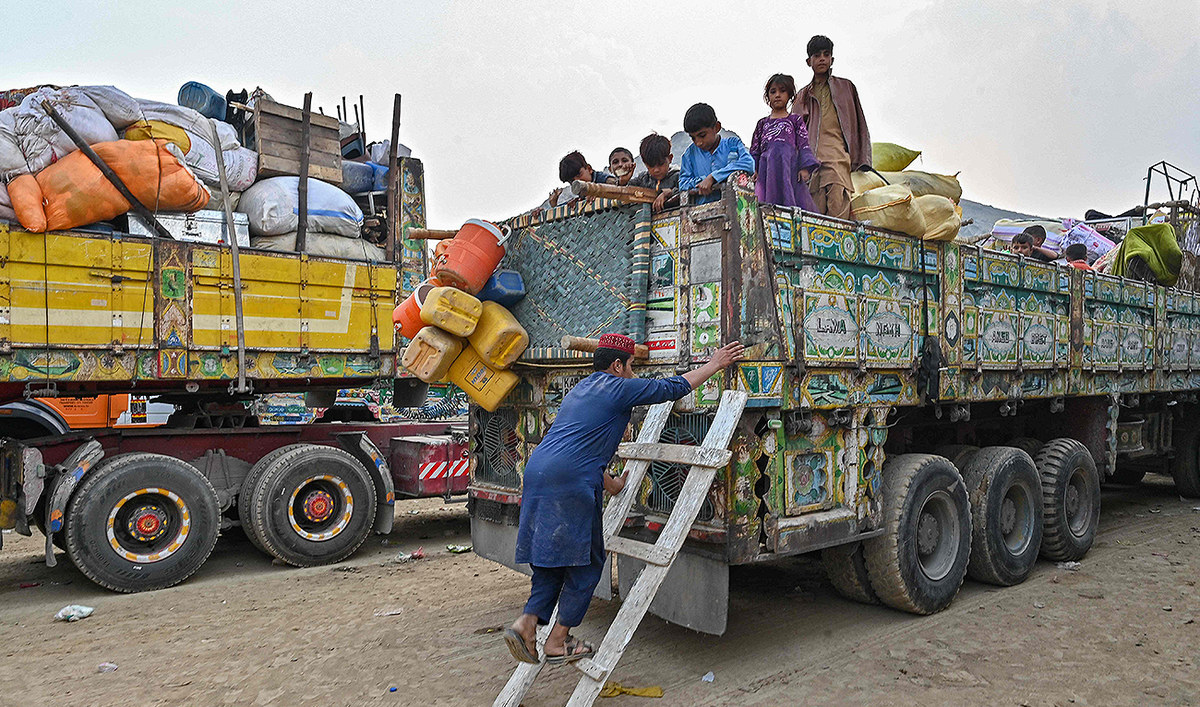


Afghan refugees arrive in a truck at a holding centre as they prepare to depart for Afghanistan, in Landi Kotal on November 1, 2023. (AFP)

“There are fights, people are losing patience. I am young, I will somehow bear this situation but how can a child bear all this?” said Mohammad Ayaz, 24, who crossed the border with 10 family members.

Najla Dilnaz, 25, said she was saving all the water they had for drinking, even as her children’s clothes and skin accumulate dirt from the dusty riverbed near the crossing.

“We don’t wash their hands or feet, there is just some (water) for drinking, we are surviving with that,” she said.

“We drink little and we don’t wash at all.”
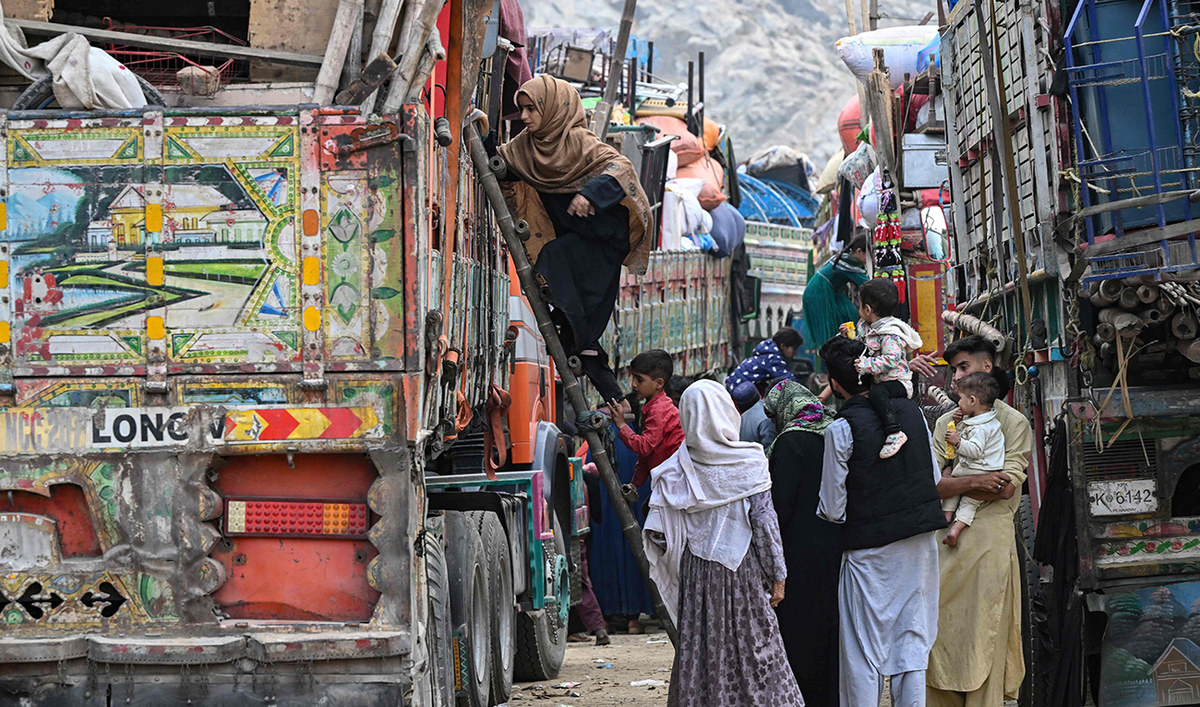


Afghan refugees climb a truck as they prepare to depart for Afghanistan, at a holding centre in Landi Kotal on November 1, 2023. (AFP)

The Pakistani government said its order in early October was to protect Pakistan’s “welfare and security” after a sharp rise in attacks it blames on militants operating from Afghanistan, which Taliban authorities deny.

The order and a crackdown by authorities spurred thousands of Afghans to hurriedly pack what they could and rush to the frontier, unwilling to risk police action or deportation.

For some, that meant abandoning their whole lives or handling the possibility of giving birth along the way, as at least 30 women have, a border official said Monday.

Rabia, a 32-year-old Pakistani, and her Afghan husband packed up their belongings in a rush and had been at Torkham for three nights already on Wednesday.

She is pregnant with her sixth child and due in a less than a week.

They have no home or land to go to, and there is nothing they can do for now but wait, she said.

“Whether it’s easy or hard, we are here now.”


IMF warns against policy slippage amid weak recovery as it clears $1.2 billion for Pakistan

Updated 11 December 2025
Follow

IMF warns against policy slippage amid weak recovery as it clears $1.2 billion for Pakistan

  • Pakistan rebuilt reserves, cut its deficit and slowed inflation sharply over the past one year
  • Fund says climate shocks, energy debt, stalled reforms threaten stability despite recent gains

ISLAMABAD: Pakistan’s economic recovery remains fragile despite a year of painful stabilization measures that helped pull the country back from the brink of default, the International Monetary Fund (IMF) warned on Thursday, after it approved a fresh $1.2 billion disbursement under its ongoing loan program.

The approval covers the second review of Pakistan’s Extended Fund Facility (EFF) and the first review of its climate-focused Resilience and Sustainability Facility (RSF), bringing total disbursements since last year to about $3.3 billion.

Pakistan entered the IMF program in September 2024 after years of weak revenues, soaring fiscal deficits, import controls, currency depletion and repeated climate shocks left the economy close to external default. A smaller stopgap arrangement earlier that year helped avert immediate default, but the current 37-month program was designed to restore macroeconomic stability through strict monetary tightening, currency adjustments, subsidy rationalization and aggressive revenue measures.

The IMF’s new review shows that Pakistan has delivered significant gains since then. Growth recovered to 3 percent last year after shrinking the year before. Inflation fell from over 23 percent to low single digits before rising again after this year’s floods. The current account posted its first surplus in 14 years, helped by stronger remittances and a sharp reduction in imports. And the government delivered a primary budget surplus of 1.3 percent of GDP, a key program requirement. Foreign exchange reserves, which had dropped dangerously low in 2023, rose from US$9.4 billion to US$14.5 billion by June.

“Pakistan’s reform implementation under the EFF arrangement has helped preserve macroeconomic stability in the face of several recent shocks,” IMF Deputy Managing Director Nigel Clarke said in a statement after the Board meeting.

But he warned that Islamabad must “maintain prudent policies” and accelerate reforms needed for private-sector-led and sustainable growth.

The Fund noted that the 2025 monsoon floods, affecting nearly seven million people, damaging housing, livestock and key crops, and displacing more than four million, have set back the recovery. The IMF now expects GDP growth in FY26 to be slightly lower and forecasts inflation to rise to 8–10 percent in the coming months as food prices adjust.

The review warns Pakistan against relaxing monetary or fiscal discipline prematurely. It urges the State Bank to keep policy “appropriately tight,” allow exchange-rate flexibility and improve communication. Islamabad must also continue raising revenues, broadening the tax base and protecting social spending, the Fund said.

Despite the progress, Pakistan’s structural weaknesses remain severe.

Power-sector circular debt stands at about $5.7 billion, and gas-sector arrears have climbed to $11.3 billion despite tariff adjustments. Reform of state-owned enterprises has slowed, including delays in privatizing loss-making electricity distributors and Pakistan International Airlines. Key governance and anti-corruption reforms have also been pushed back.

The IMF welcomed Pakistan’s expansion of its flagship Benazir Income Support Program, which raises cash transfers for low-income families and expands coverage, saying social protection is essential as climate shocks intensify. But it warned that high public debt, about 72 percent of GDP, thin external buffers and climate exposure leave the country vulnerable if reform momentum weakens.

The Fund said Pakistan’s challenge now is to convert short-term stabilization into sustained recovery after years of economic volatility, with its ability to maintain discipline, rather than the size of external financing alone, determining the durability of its gains.