UNITED NATIONS: The United Nations chief said Tuesday he was “deeply alarmed” by the intensifying conflict between Israel and Hamas, while the UN refugee agency appealed for the divided Security Council to act.
The 15-member Council has not adopted any resolution on the three-week-long war in the Middle East, rejecting four drafts.
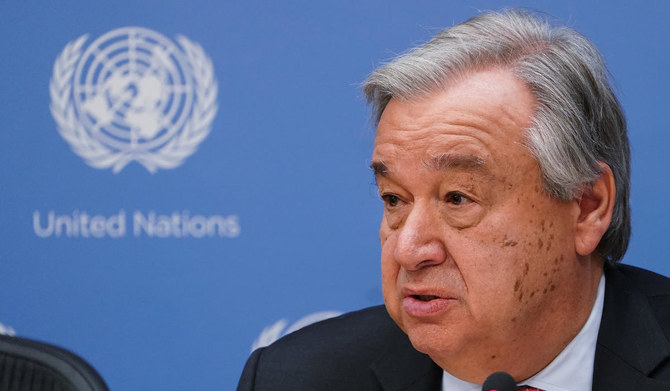
UN Secretary-General Antonio Guterres said that the escalating fighting included “ground operations by the Israel Defense Forces accompanied by intense air strikes, and the continued rocket fire toward Israel from Gaza.”
“Civilians have borne the brunt of the current fighting from the outset,” he said in his statement.
“I repeat my utter condemnation of the acts of terror perpetrated by Hamas on 7 October. There is never any justification for the killing, injuring and abduction of civilians. I appeal for the immediate and unconditional release of those civilians held hostage by Hamas.
“I condemn the killing of civilians in Gaza and I am dismayed by reports that two-thirds of those who have been killed are women and children.”
Guterres also underlined his fears “about the risk of a dangerous escalation beyond Gaza.”
As fierce fighting raged Tuesday, the United Nations high commissioner for refugees urged the UN Security Council to unite and back a cease-fire.
“A humanitarian cease-fire can at least stop this spiral of death and I hope that you will overcome your divisions and exercise your authority in demanding one,” Filippo Grandi told the Security Council in New York.
Grandi later told reporters that bringing help into Gaza was the most important humanitarian goal.
“Palestinians do not want to leave Gaza. They want aid to come into Gaza and that should be the priority,” he said.
Some Security Council draft texts have been blocked by the United States because they did not mention Israel’s right to defend itself, while one was stymied by Russia and China in particular because it did not clearly call for a cease-fire.
Israel launched its most intense military campaign ever on Gaza after suffering the bloodiest attack in its history when Hamas gunmen on October 7 killed some 1,400 people in a brutal cross-border raid, according to Israeli officials.
Israeli warplanes on Tuesday kept up a relentless barrage of strikes on Gaza, where the Hamas-run health ministry said that at least 8,525 people had been killed, including over 3,500 children.


![]()

UN alarmed as Middle East war intensifies
Short Url
https://arab.news/jc6vv
UN alarmed as Middle East war intensifies
- Antonio Guterres: ‘Civilians have borne the brunt of the current fighting from the outset’


Latest updates


© 2026 SAUDI RESEARCH & PUBLISHING COMPANY, All Rights Reserved And subject to Terms of Use Agreement.