GAZA STRIP, Palestinian Territories: Israeli troops pushed deeper into Gaza Tuesday, driving tanks and armored bulldozers through the rubble of shattered buildings, scouring for Hamas militants who carried out the worst attack in the country’s history.
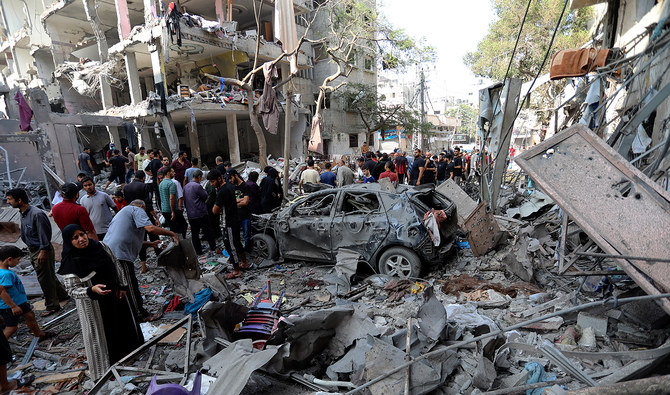
As Israel stepped up its relentless bombing of Gaza, desperate Palestinian families scrabbled through debris searching for survivors and mourned over the bodies of some of the thousands killed, draped in white shrouds.
Israeli army footage showed soldiers, who are also seeking to free at least 240 hostages, advancing through a bomb-scarred landscape, with buildings reduced to a mangled mess of stone and twisted metal by weeks of withering air and artillery strikes.
Israel said it had struck 300 targets during the fourth night of land operations in Gaza, where troops came under Hamas anti-tank and machine-gun fire, after Prime Minister Benjamin Netanyahu dismissed mounting international calls for a cease-fire.
AFPTV footage over Gaza showed a huge plume of smoke billowing up from another Israeli strike. The bombing campaign has killed 8,525 people, according to Gaza’s Hamas-run health ministry, many of them children.
The humanitarian toll has sparked a global backlash, with aid groups and the United Nations saying time is running out for many of the territory’s 2.4 million people denied access to food, water, fuel and medicine.
Surgeons are conducting amputations on hospital floors without anaesthetic, and children are forced to drink salty water, said Jean-Francois Corty, vice president of Medecins Sans Frontieres, which has 20 staff on the ground.
Israel has accused Hamas of using hospitals as military headquarters and civilians as “human shields,” charges the Islamist militants dismiss as “baseless” propaganda.
“We want to live like any other people in this world, to live quietly,” said Ahmed Al-Kahlout, a Gaza resident living near an Orthodox Cultural Center destroyed in a strike.
“We don’t know what to do. The least they can do is give us a truce, give us three hours, a temporary truce or a cease-fire,” Kahlout told AFP.
Netanyahu has said pausing operations now would be a “surrender” to the Palestinian militant group responsible for brutal raids on Israeli homes, farms and villages that killed an estimated 1,400 people, according to Israeli officials.
The incursion scored an early victory Monday: the rescue of Private Ori Megidish, an Israeli soldier in Hamas captivity who was reunited with her family and provided “intelligence that we’ll be able to use for future operations,” said army spokesman Jonathan Conricus.
But there was heartbreak for the family of another missing woman, 23-year-old German-Israeli Shani Louk, who had been abducted from a music festival then “tortured and paraded around Gaza,” according to Israel’s foreign ministry.
Her remains were found on Monday, with her sister Adi voicing her “great sorrow” as she shared news of her death on social media.
Other families have endured an unbearable wait for news about loved-ones kidnapped by Hamas militants and thought to be held in a labyrinth of tunnels in Gaza.
Hadas Kalderon walked through the scorched homes of the Nir Oz kibbutz, near Israel’s border with Gaza, where gunmen killed her mother and niece and seized her 12-year-old son and 16-year-old daughter.
“I don’t have any control and knowledge about army actions, I just know my children are still there in the middle of a war,” said the 56-year-old.
“It’s a disaster. It’s really hell. There is no word to express this.”
Hamas on Monday released a video of what it said were three women hostages, seated against a tile wall. One urged Israel to agree to a Hamas-demanded prisoner swap.
Netanyahu dismissed the clip, the time and place of which could not be verified, as “cruel psychological propaganda.”
As even Israel’s staunchest allies voiced concern about the dire humanitarian crisis in southern Gaza, the UN agency for Palestinian refugees UNRWA said there was not nearly enough aid to meet the “unprecedented” needs.
“When an eight-year-old tells you that she doesn’t want to die, it’s hard not to feel helpless,” said UN humanitarian chief Martin Griffiths.
Hisham Adwan, Gaza director of the Rafah crossing with Egypt where some aid has been allowed in, said 36 trucks had been waiting there since the previous day.
“I feel that it’s extremely slow and there’s disruption to UNRWA’s work, and we don’t know why,” he said.
Israel said it is inspecting cargo to make sure weapons are not being smuggled in, and is monitoring to guarantee supplies are not seized by Hamas.
Meanwhile, fears are mounting the violence could spiral into a broader regional war, with the White House warning Israel’s enemies — in particular Iran-allied groups — not to get involved.
In a sign of the broadening conflict, Yemen’s Iran-backed Houthi rebels fired drones toward Israel, a senior official from the group told AFP. Israel’s army also said it had intercepted a “missile” fired from the Red Sea region.
Lebanese caretaker prime minister Najib Mikati has told AFP it was his “duty to prevent Lebanon from entering the war.”
Israel’s military has struck targets in Syria and traded cross-border fire with Hezbollah militants in Lebanon, insisting Israel has a duty to defend civilians.
Anis Abla, head of Lebanon’s Civil Defense Center in Marjayoun, near the Israeli border, said they were completely unprepared for war.
“Our equipment is very primitive and there is a shortage of all tools, such as fire suits and extinguisher cylinders,” he told AFP.


![]()

Israel scales up Gaza incursion as humanitarian crisis deepens
Short Url
https://arab.news/wqbum
Israel scales up Gaza incursion as humanitarian crisis deepens
- As Israel stepped up its relentless bombing of Gaza, desperate Palestinian families scrabbled through debris for survivors
- Humanitarian toll has sparked a global backlash, with aid groups and the United Nations saying time is running out for many
Latest updates


© 2026 SAUDI RESEARCH & PUBLISHING COMPANY, All Rights Reserved And subject to Terms of Use Agreement.