

Gaza’s civilians have entered survival mode, says UNRWA official

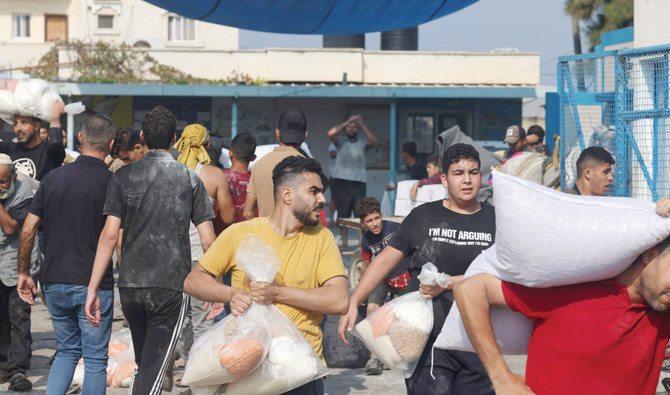
Palestinians collect bags of dried pulses from a UN-run aid supply center recently. (AFP)
Short Url
Updated 30 October 2023
Follow

Gaza’s civilians have entered survival mode, says UNRWA official

  • Four UN aid distribution centers and a storage facility out of action in Gaza

GAZA CITY: A breakdown in civil order has put four UN aid distribution centers and a storage facility out of action in Gaza as people search desperately for food and water, a UN Palestinian refugee agency official said on Monday.

Tom White, director of UNWRA Affairs in Gaza, also said that a logistics base at the Rafah border crossing vital to aid distribution had become increasingly difficult because 8,000 people were sheltering at it.

“With the breakdown of civil order, every day now, we’ve got hundreds of people trying to get into the warehouses to steal flour,” he said.

“Right now, people are in survival mode. It’s about getting enough flour, and it’s about getting enough water.”

Thousands of Gaza residents broke into UN warehouses on Sunday to seize flour and other items. 

In Deir Al-Balah in central Gaza, one of the warehouses is where UNRWA stores supplies delivered by humanitarian convoys crossing into Gaza from Egypt.

“Effectively, we have lost Deir Al-Balah. We’ll see whether we can get that up and operational again. Still, of course, it’s complicated because the Rafah log (logistics) base has become a magnet for people seeking shelter, protection under the UN flag or trying to get into the warehouses to get flour,” White said.

Aid to Gaza has been choked since Israel began bombarding the Palestinian enclave in response to an attack by Hamas on Oct. 7.

There has been a mounting international outcry over the toll from the bombing. 

Medical authorities in Gaza, which has a population of 2.3 million people, said on Monday that 8,306 people — including 3,457 minors — had been killed.

The Palestinian Red Crescent said 140 trucks of aid had entered Gaza since Oct. 7 and the biggest delivery so far of 33 trucks arrived on Sunday.

But UN officials say at least 100 trucks daily are required to cover Gaza’s urgent needs. 

Before the war, several hundred trucks were usually arriving in Gaza daily.

Aid entering from Egypt is being driven on a round-trip of more than 84 km from Rafah for inspection on the Egypt-Israel border, triggering Egyptian complaints.

On Sunday, US President Joe Biden and Egypt’s Abdel Fattah El-Sisi committed to significantly accelerating assistance. 

Humanitarian and security sources said several dozen trucks set off from the Egyptian side of Rafah on Monday.

But White said that due to delays, the situation was so bad that more aid was no longer a solution to Gaza’s plight. A humanitarian ceasefire was needed, he said.

“With a collapse of public services, that’s not going to be something that’s going to be solved by food, water or medicine. If the public sector collapses here, you’re into a different magnitude of need,” he said

UNRWA could not distribute flour to bakers on Sunday and was down to distributing 1 liter of potable water per person to displaced people. 

He added that in a humanitarian response, the survival rate was 3 liters per day.

White said Gaza’s south had been overwhelmed by an influx of displaced people from the north.

Access on roads was reasonable in the south but increasingly difficult in the north due to damage and security as Israeli forces attacked Gaza’s central northern city.

Tommaso Della Longa, spokesperson of the International Federation of Red Cross and Red Crescent Societies, said Gaza was in desperate condition.

“The longer it continues the more we will see desperation,” he said. 

“If you cannot get supplies to starving people, people will find a way.”


Sudan defense minister dismisses ‘intelligence document’ as fabrication after convoy strike

Updated 12 February 2026
Follow

Sudan defense minister dismisses ‘intelligence document’ as fabrication after convoy strike

  • Gen. Hassan Kabroun tells Arab News claims that army hid weapons in aid convoy are “completely false”

RIYADH: Sudan’s defense minister has firmly denied reports attributed to Sudanese intelligence alleging that a convoy targeted in North Kordofan was secretly transporting weapons under the cover of humanitarian aid.

Gen. Hassan Kabroun described the claims as “false” and an attempt to distract from what he called a militia crime.

The controversy erupted after news reports emerged that a document attributed to Sudan’s General Intelligence Service claimed the convoy struck in Al-Rahad on Friday was not a purely humanitarian mission, but was instead carrying “high-quality weapons and ammunition” destined for Sudanese Armed Forces units operating in the state.

The report further alleged that the convoy had been outwardly classified as humanitarian in order to secure safe passage through conflict zones, and that the Rapid Support Forces had destroyed it after gathering intelligence on its route and cargo.

Kabroun categorically rejected the narrative.

“First of all, we would like to stress the fact that this news is false,” he told Arab News. “Even the headline that talks about the security of the regions, such as Al-Dabbah, is not a headline the army would use.”

He described the document as fabricated and politically motivated, saying it was designed to “cover up the heinous crime they committed.”

The minister affirmed that the area targeted by drones is under full control of the Sudanese Armed Forces and does not require any covert military transport.

“Second, we confirm that the region that was targeted by drones is controlled by the army and very safe,” Kabroun said. “It does not require transporting any military equipment using aid convoys as decoys because it is a safe area controlled by the army, which has significant capabilities to transport humanitarian aid.”

According to the minister, the Sudanese military has both the logistical capacity and secure routes necessary to move equipment openly when needed.

“The army is professional and does not need to deliver anything to Kadugli or Dalang on board aid convoys,” he said. “The road between Dalang and Kadugli is open. The Sudanese forces used that road to enter and take control of the region. The road is open and whenever military trucks need to deliver anything, they can do so without resorting to any form of camouflage.”

Kabroun further rejected any suggestion that the military uses humanitarian operations as cover.

“Aid is transported by dedicated relief vehicles to the areas in need of this assistance,” he said. “Aid is not transported by the army. The army and security apparatus do not interfere with relief efforts at all, and do not even accompany the convoys.”

He stressed that the Sudanese Armed Forces maintains a clear institutional separation between military operations and humanitarian work, particularly amid the country’s crisis.

“These are false claims,” he said. “This fake news wanted to cover up the heinous crime they committed.”

Sudan has been gripped by conflict since April 2023, when fighting broke out between the Sudanese Armed Forces and the Rapid Support Forces, plunging the country into what the United Nations has described as one of the world’s worst humanitarian disasters.

The latest dispute over the convoy comes amid intensified fighting in South Kordofan, a strategically sensitive region linking central Sudan with the contested areas of Darfur and Blue Nile.

The false report suggested that intelligence monitoring had enabled the RSF to strike what it described as a military convoy disguised as humanitarian aid. But Kabroun dismissed that version outright.

“The intelligence agency is well aware of its duties,” he said. “The Sudanese Army has enough weapons and equipment to use in the areas of operations. These claims are completely false.”

He argued that the narrative being circulated seeks to shift blame for attacks on civilian infrastructure and humanitarian movements.

“This shows that they are trying to cover up the atrocities,” he added, referring to the militia.

Kabroun maintained that the army has regained momentum on multiple fronts and remains fully capable of sustaining its operations without resorting to deception.

“The region is secure, the roads are open, and the army does not need camouflage,” he said. “We are operating professionally and transparently.”

“These claims are completely false,” Kabroun said. “The Sudanese Army does not use humanitarian convoys for military purposes.”