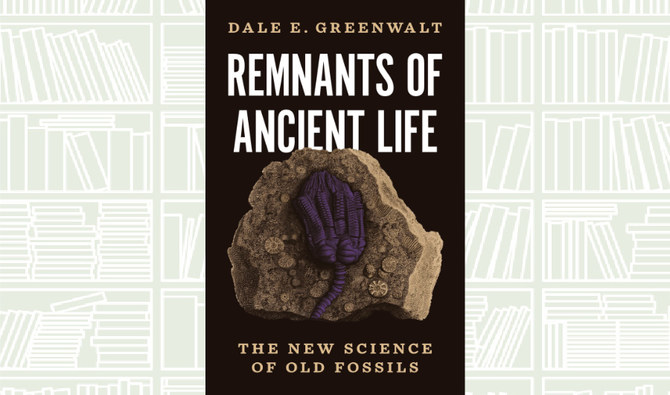
What We Are Reading Today: Remnants of Ancient Life

Short Url
Updated 29 October 2023
Follow

What We Are Reading Today: Remnants of Ancient Life

Author: Dale E. Greenwalt

We used to think of fossils as being composed of nothing but rock and minerals, all molecular traces of life having vanished long ago. We were wrong.

“Remnants of Ancient Life” reveals how the new science of ancient biomolecules—pigments, proteins, and DNA that once functioned in living organisms tens of millions of years ago—is opening a new window onto the evolution of life on Earth.

Paleobiologists are now uncovering these ancient remnants in the fossil record with increasing frequency, shedding vital new light on long-extinct creatures and the lost world they inhabited. 


What We Are Reading Today: A Capital’s Capital

Updated 16 February 2026
Follow

What We Are Reading Today: A Capital’s Capital

Authors: Gilles  Postel-Vinay and Jean-Laurent Rosenthal

Successful economies sustain capital accumulation across generations, and capital accumulation leads to large increases in private wealth. In this book, Gilles Postel-Vinay and Jean-Laurent Rosenthal map the fluctuations in wealth and its distribution in Paris between 1807 and 1977. 

Drawing on a unique dataset of the bequests of almost 800,000 Parisians, they show that real wealth per decedent varied immensely during this period while inequality began high and declined only slowly. 

Parisians’ portfolios document startling changes in the geography and types of wealth over time.

Postel-Vinay and Rosenthal’s account reveals the impact of economic factors (large shocks, technological changes, differential returns to wealth), political factors (changes in taxation), and demographic and social factors (age and gender) on wealth and inequality.

Before World War I, private wealth was highly predictive of other indicators of welfare, including different forms of human capital, age at death, and access to local public goods.