

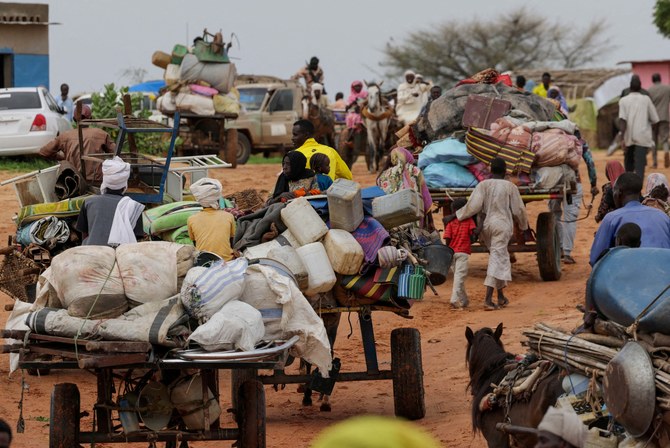

TUNIS: Sudan, currently mired in a protracted war and economic turmoil, stands at the center of a multifaceted humanitarian crisis that ripples across its neighboring nations.
With Sudan’s economy in decline, the adjoining countries, deeply intertwined with its economic prospects, grapple with the fallout — disrupted trade and skyrocketing inflation. These challenges pose the risk of social upheaval and political instability that extends beyond Sudan’s borders, impacting millions throughout the region.
Armed groups operating in Sudan have also shown a propensity to seize opportunities presented by the chaos. They engage in criminal activities such as arms smuggling, human trafficking, and illicit trade, further destabilizing the region. The unrestricted flow of arms and fighters across borders poses a direct threat to the security of neighboring nations, creating challenges for humanitarian organizations striving to uphold the sacred “do no harm” principle.
Additionally, the aid sector grapples with a glaring gap between the pressing need for assistance and its actual delivery. According to the UN, a staggering 18 million people in Sudan require humanitarian aid, but only 3.5 million have received any assistance thus far. This stark disparity underscores the dire circumstances faced by millions of Sudanese citizens and raises critical questions about the effectiveness of humanitarian efforts in this complex environment.
The destruction of infrastructure in the most heavily affected regions, namely Khartoum, Darfur, and Kordofan, is estimated at $60 billion, equivalent to 10 percent of its total worth, according to Ibrahim El-Badawi, Sudan’s former finance minister and an economics researcher. He predicts a potential 20 percent drop in the gross domestic product for this year.
The former minister emphasizes that if the conflict were to cease, Sudan would require emergency economic support ranging from $5 billion to $10 billion to resuscitate the economy. He warns that the continuation of the war would lead to the further deterioration of the Sudanese economy and the state itself.
Experts highlight that beyond the physical insecurity plaguing the nation, the financial underpinnings of the aid sector are entangled in a web of challenges.
Grace Ndungu, a communications manager at Mercy Corps, a global nongovernmental humanitarian aid organization, underscores this point, stating: “Armed groups operating in the region often seize opportunities presented by Sudan’s chaos.”
These groups’ involvement in criminal activities, coupled with their ability to exploit international and regional financing meant for humanitarian assistance, further complicates the situation. At the same time, disputes over vital resources like water and arable land escalate tensions along the country’s borders.
Historically, Sudan’s violent conflicts have often been rooted in contestation over revenue. The ongoing conflict that erupted in April 2023 follows similar patterns, partially fueled by warring parties’ strategies for self-enrichment, including looting, manipulation of international and regional financing, and smuggling of resources such as gold.
The heart of Sudan’s current conflict lies in its historic domination by Khartoum, where revenue sources were frequently concentrated, leaving economic peripheries, including Darfur and Red Sea State, in dependent relations. This inequitable political economy has fueled grievances against the Khartoum-led rule, leading to violent conflicts.
The country is now compelled to utilize its limited remaining resources to assist an internally displaced population that, when considering those previously displaced by past conflicts, totals nearly 7.1 million people, surpassing any other nation globally. According to UN data, more than 5.25 million out of Sudan’s 49 million citizens have been displaced since the conflict began. Over 1 million have sought refuge in neighboring countries, while more than 4.1 million remain within Sudan, facing mounting financial hardships.
Against this background, Sudan’s cash crisis, coupled with soaring inflation rates, has exacerbated economic challenges for its citizens, limiting access to much-needed cash. Also, Sudanese state and non-state armed groups rely on the established network of profitable business interests to sustain their war chests, as they continue to control key aspects of the country’s financial landscape. The Military Industry Corp., responsible for concealing state control of businesses within a broader web of military-controlled companies, penetrates crucial sectors like manufacturing, gold, agriculture, and livestock production, contributing to Sudan’s complex war economy.
Over time, “the humanitarian aid has also become a resource leveraged by various armed groups and state institutions in Sudan,” Dallia Abdelmoniem, a Sudanese political analyst, told Arab News, as the groups occasionally co-opt humanitarian aid not only for financial benefits but also for legitimacy in the eyes of host populations.
She stresses that these challenges necessitate a conflict-sensitive human security approach to humanitarian response, rooted in cooperation with civic actors to mitigate risks. “Customized cash programming modalities can be a viable solution to navigate the intricacies of Sudan’s financial challenges,” Abdelmoniem said.
Experts say that in this tumultuous landscape of Sudan’s conflict and humanitarian crisis, proactive and sensitive approaches can mitigate risks and ensure that humanitarian assistance reaches those who need it most.
Ndungu advocates for collaboration and due diligence procedures to protect aid from being captured by Sudan’s security arena, thereby ensuring that it remains a lifeline for those in desperate need. “The struggle to ensure the safe transport of aid becomes a Herculean task in the face of political complexities.”
Abdelmoniem added that “as the aid theft has re-emerged as a distressing phenomenon in Sudan, perpetrated by both sides of the conflict and opportunistic looters, in order to navigate the intricacies of Sudan’s financial challenges and uphold humanitarian principles, international humanitarian actors must adopt a conflict-sensitive approach.”
She emphasizes that by focusing on collaboration, accountability, and civic engagement, the humanitarian sector can strive to alleviate suffering and support Sudanese civilians as they navigate the complex aftermath of conflict.
Ndungu echoes her views, proposing establishing forums for collaboration and due diligence procedures to vet financial modalities that can help protect aid from being captured by Sudan’s security arena.
“This approach should involve close collaboration with in-country civic groups and transparency initiatives to ensure that aid does not become a financial or political resource for combatants,” she added, stressing the importance of the role that regional and international actors play in shaping the dynamics of the crisis.


