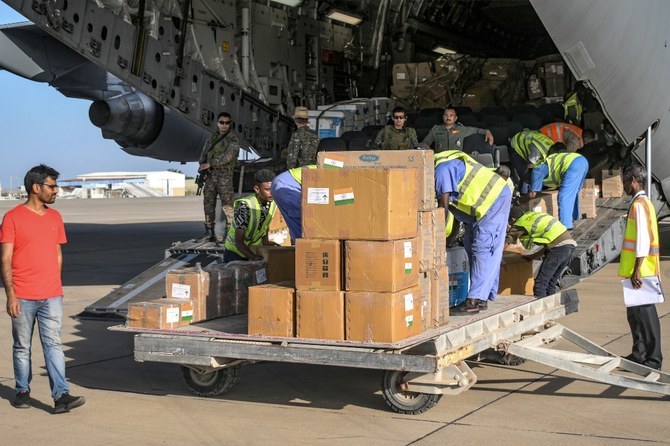
GENEVA: The lack of security in Sudan’s civil war combined with meagre international funds is hampering efforts to help millions in need in the country, the United Nations said Thursday.
“We need to reach 18 million people and we will not give up on that target but we need more international support, better access to the people who need us and safety for our operations,” the UN’s resident and humanitarian coordinator in Sudan, Clementine Nkweta-Salami told a press conference in Geneva.
She recalled that 19 members of humanitarian organizations have been killed since the conflict erupted in mid-April, while 29 others have been injured.
While she did not wish to be drawn on whether they had been specifically targeted, she noted that “in many instances, our efforts are being hampered,” despite care being taken to indicate “where it is we will be, and what we will be doing.”
The fighting in Sudan broke out on April 15. The army, led by Abdel Fattah Al-Burhan, has been battling the paramilitary Rapid Support Forces commanded by his former deputy Mohamed Hamdan Daglo, after the two fell out in a power struggle.
Nearly 7,500 people have been killed in Sudan since the conflict broke out, according to a conservative estimate from the Armed Conflict Location & Event Data project.
Battles have displaced almost 4.3 million people within Sudan, in addition to around 1.2 million more who have fled across borders, UN figures show.
One of the poorest countries in the world, Sudan has seen its health system brought to its knees by the conflict.
Humanitarian aid has been attacked and looted by armed gangs and criminals.
The UN is combating this complex humanitarian crisis despite a funding shortage.
“The $2.6 billion humanitarian appeal is just one-third funded,” said Nkweta-Salami.
“The population of Sudan is balancing on a knife-edge as their country is gradually consumed by this conflict.”

Insecurity, lack of funds slowing Sudan aid: UN
Short Url
https://arab.news/pmv69
Insecurity, lack of funds slowing Sudan aid: UN
- “We need to reach 18 million people and we will not give up on that target,” the UN’s resident and humanitarian coordinator in Sudan, Clementine Nkweta-Salami said
- She recalled that 19 members of humanitarian organizations have been killed
Iraq says it will prosecute Daesh detainees sent from Syria
- Iraq government says transfer was pre-emptive step to protect national security
- Prosoners have been held for years in prisons and camps guarded by the Kurdish-led SDF
BAGHDAD: Iraq’s Supreme Judicial Council said on Thursday it would begin legal proceedings against Daesh detainees transferred from Syria, after the rapid collapse of Kurdish-led forces in northeast Syria triggered concerns over prison security.
More than 10,000 members of the ultra-hard-line militant group have been held for years in about a dozen prisons and detention camps guarded by the Kurdish-led Syrian Democratic Forces (SDF) in Syria’s northeast.
The US military said on Tuesday its forces had transferred 150 Daesh detainees from Syria to Iraq and that the operation could eventually see up to 7,000 detainees moved out of Syria.
It cited concerns over security at the prisons, which also hold thousands more women and children with ties to the militant group, after military setbacks suffered by the SDF.
A US official told Reuters on Tuesday that about 200 low-level Daesh fighters escaped from Syria’s Shaddadi prison, although Syrian government forces had recaptured many of them.
Iraqi officials said Prime Minister Mohammed Shia Al-Sudani mentioned the transfer of Daesh prisoners to Iraq in a phone call with Syrian President Ahmad Al-Sharaa on Tuesday, adding that the transfers went ahead following a formal request by the Iraqi government to Syrian authorities.
Iraqi government spokesperson Basim Al-Awadi said the transfer was “a pre-emptive step to protect Iraq’s national security,” adding that Baghdad could not delay action given the rapid pace of security and political developments in Syria.
Daesh emerged in Iraq and Syria, and at the height of its power from 2014-2017 held swathes of the two countries. The group was defeated after a military campaign by a US-led coalition.
An Iraqi military spokesperson confirmed that Iraq had received a first batch of 150 Daesh detainees, including Iraqis and foreigners, and said the number of future transfers would depend on security and field assessments. The spokesperson described the detainees as senior figures within the group.
In a statement, the Supreme Judicial Council said Iraqi courts would take “due legal measures” against the detainees once they are handed over and placed in specialized correctional facilities, citing the Iraqi constitution and criminal laws.
“All suspects, regardless of their nationalities or positions within the terrorist organization, are subject exclusively to the authority of the Iraqi judiciary,” the statement said.
Iraqi officials say under the legal measures, Daesh detainees will be separated, with senior figures including foreign nationals to be held at a high-security detention facility near Baghdad airport that was previously used by US forces.
Two Iraqi legal sources said the Daesh detainees sent from Syria include a mix of nationalities, with Iraqis making up the largest group, alongside Arab fighters from other countries as well as European and other Western nationals.
The sources said the detainees include nationals of Britain, Germany, France, Belgium and Sweden, and other European Union countries, and will be prosecuted under Iraqi jurisdiction.
More than 10,000 members of the ultra-hard-line militant group have been held for years in about a dozen prisons and detention camps guarded by the Kurdish-led Syrian Democratic Forces (SDF) in Syria’s northeast.
The US military said on Tuesday its forces had transferred 150 Daesh detainees from Syria to Iraq and that the operation could eventually see up to 7,000 detainees moved out of Syria.
It cited concerns over security at the prisons, which also hold thousands more women and children with ties to the militant group, after military setbacks suffered by the SDF.
A US official told Reuters on Tuesday that about 200 low-level Daesh fighters escaped from Syria’s Shaddadi prison, although Syrian government forces had recaptured many of them.
Iraqi officials said Prime Minister Mohammed Shia Al-Sudani mentioned the transfer of Daesh prisoners to Iraq in a phone call with Syrian President Ahmad Al-Sharaa on Tuesday, adding that the transfers went ahead following a formal request by the Iraqi government to Syrian authorities.
Iraqi government spokesperson Basim Al-Awadi said the transfer was “a pre-emptive step to protect Iraq’s national security,” adding that Baghdad could not delay action given the rapid pace of security and political developments in Syria.
Daesh emerged in Iraq and Syria, and at the height of its power from 2014-2017 held swathes of the two countries. The group was defeated after a military campaign by a US-led coalition.
An Iraqi military spokesperson confirmed that Iraq had received a first batch of 150 Daesh detainees, including Iraqis and foreigners, and said the number of future transfers would depend on security and field assessments. The spokesperson described the detainees as senior figures within the group.
In a statement, the Supreme Judicial Council said Iraqi courts would take “due legal measures” against the detainees once they are handed over and placed in specialized correctional facilities, citing the Iraqi constitution and criminal laws.
“All suspects, regardless of their nationalities or positions within the terrorist organization, are subject exclusively to the authority of the Iraqi judiciary,” the statement said.
Iraqi officials say under the legal measures, Daesh detainees will be separated, with senior figures including foreign nationals to be held at a high-security detention facility near Baghdad airport that was previously used by US forces.
Two Iraqi legal sources said the Daesh detainees sent from Syria include a mix of nationalities, with Iraqis making up the largest group, alongside Arab fighters from other countries as well as European and other Western nationals.
The sources said the detainees include nationals of Britain, Germany, France, Belgium and Sweden, and other European Union countries, and will be prosecuted under Iraqi jurisdiction.
© 2026 SAUDI RESEARCH & PUBLISHING COMPANY, All Rights Reserved And subject to Terms of Use Agreement.


