

The sweet smell of success for local farmer at Tabuk festival

1 / 3
Local farmer Turki Al-Atwi’s eight-year journey began with a feasibility study to assess growing roses in the rugged terrain of Jabal Al-Lawz. (SPA)
2 / 3
Local farmer Turki Al-Atwi’s eight-year journey began with a feasibility study to assess growing roses in the rugged terrain of Jabal Al-Lawz. (SPA)
3 / 3
Local farmer Turki Al-Atwi’s eight-year journey began with a feasibility study to assess growing roses in the rugged terrain of Jabal Al-Lawz. (SPA)
Short Url
Updated 29 October 2023
Follow

The sweet smell of success for local farmer at Tabuk festival

  • Al-Atwi’s eight-year journey began with a feasibility study to assess growing roses in the rugged terrain of Jabal Al-Lawz
  • He eventually selected the renowned Damascus rose for its suitability in the mountainous region

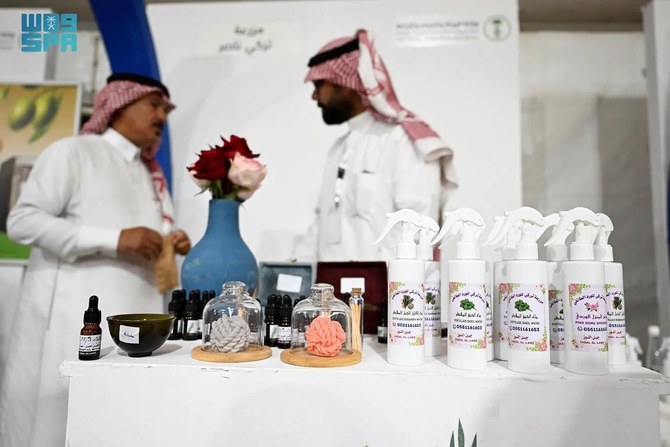
RIYADH: Local farmer Turki Al-Atwi stole the spotlight at Tabuk’s third Olive Festival with his impressive rose exhibit and products.

The festival, which took place from Oct. 24-29 at Prince Fahad bin Sultan Park in Tabuk, featured the products of aromatic materials from locally grown roses for the first time, the Saudi Press Agency reported.

Al-Atwi’s eight-year journey began with a feasibility study to assess growing roses in the rugged terrain of Jabal Al-Lawz. He eventually selected the renowned Damascus rose for its suitability in the mountainous region.

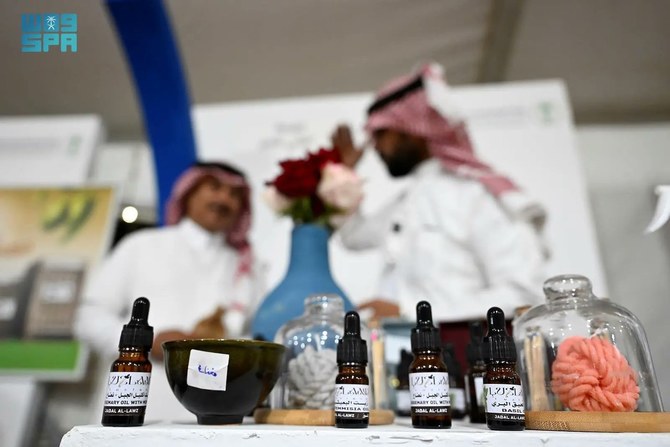
Al-Atwi planted nearly 4,000 rose trees, which yield over 1.7 million roses annually. This success led to the production of essential oil for perfumes, cosmetics, candles, soaps, creams, and sprays.

Roses grown in Jabal Al-Lawz have a unique aroma influenced by local factors like soil and climate. Extracting essential oil from them requires specialized skills and high-quality distillation equipment.

Roses are harvested in April and May to preserve their aroma, and quick processing maintains their aromatic properties. The extracted oil is used in various industries to create rose-based products.

Al-Atwi aims to expand his business from his farm in Jabal Al-Lawz. He plans to farm roses in a variety of suitable regions to meet the demands of the market.

Tabuk’s Olive Festival helps local farmers by creating new marketing opportunities. With over 40 farmer pavilions and 10 devoted to government agencies, the event hosts several local producer platforms, helping to enhance the festival’s atmosphere.


Royal reserve intensifies efforts for environmental conservation

Updated 05 December 2025
Follow

Royal reserve intensifies efforts for environmental conservation

  • Protection contributes toward sustainability to align with Saudi Vision 2030

RIYADH: The King Salman bin Abdulaziz Royal Reserve Development Authority is intensifying efforts to protect the vegetation, wildlife, and public property within its reserve, the largest in the Kingdom at 130,700 sq. km.

Distinguished by its nature, terrain and archaeological sites (some dating back to 8000 B.C.), its protection contributes to environmental sustainability and aligns with Saudi Vision 2030’s goal of making the Kingdom a global environmental tourist destination, the Saudi Press Agency reported.

The authority’s efforts include enforcing regulations against violators, in partnership with the Special Forces for Environmental Security; rehabilitating damaged lands affected by overgrazing and desertification; planting nearly 4 million seedlings; rehabilitating 750,000 hectares of degraded land to restore plant life; and distributing tonnes of native wild seeds.

The authority has urged adherence to regulations, stressing continuous monitoring and enforcement against violations.

The royal reserve, a vast ecological haven across the Northern Borders, Jouf, Tabuk and Hail regions, is a vital hub for migratory birds. It is home to more than 290 bird species, with 88 percent being migratory and 12 percent resident.

This accounts for 58 percent of all bird species recorded in the Kingdom. The reserve also protects 26 bird species listed as threatened on the International Union for Conservation of Nature Red List.

The reserve serves as the Kingdom’s first stop for flocks arriving from Asia and Europe in the autumn, and their last station before departing in spring.

With its rich biodiversity, balanced environment and varied landscapes, the reserve also stands as a natural sanctuary, hosting remarkable species such as the steppe eagle, the eastern imperial eagle, and the houbara bustard.