



ISLAMABAD: As Israel continues to relentlessly bombard Gaza, Palestinians in Pakistan have said they are in an agonizing state, worrying constantly about the well-being of their friends and families besieged in the densely populated area.
Israel has rained bombs on Gaza for what it says is retaliation for a full-pronged attack launched by Hamas, which governs Gaza Strip, on Oct. 7. According to Israel, over 1,300 people were killed in the attack and hundreds were taken hostage by Hamas fighters. Hamas says the attack was in response to desecration of the Al-Aqsa Mosque by Israeli forces and increased settler violence.
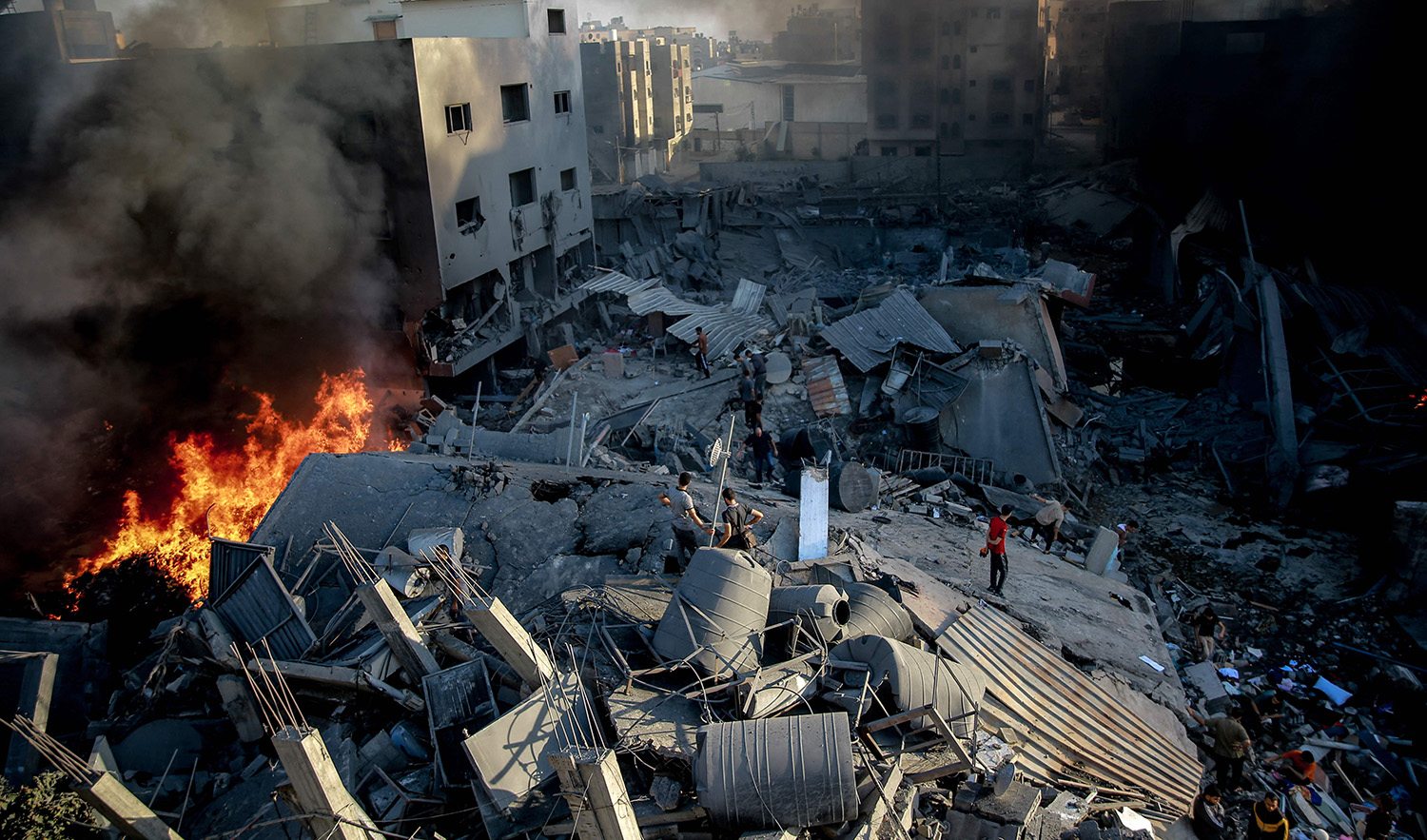
Smoke and fire rise from a leveled building as people gather amid the destruction in the aftermath of an Israeli strike on Gaza City on October 26, 2023. (AFP)
Israel has since then imposed a blockade on Gaza, refusing to allow Palestinian civilians access to food, medicines and relief items. Meanwhile, Tel Aviv has continued to strike targets in the area, reducing thousands of structures to debris, as the world scrambles to arrange a cease-fire.
The Gaza Health Ministry says over 8,400 Palestinians, among them women, children and the elderly, have died since Oct. 7 as Israel continues to bombard Gaza.
Basma Al-Masharqa, a Palestinian woman who operates a catering business from her home, spoke of suffering from “sleepless nights” as she witnessed the crisis unfolding in Gaza. A resident of Islamabad, Al-Masharqa hails from Hebron city in the West Bank.
“That’s right, we are here and we are so far, but believe me, we cannot sleep, we cannot eat, we cannot do anything as we are worried and we keep the TV on,” she told Arab News last week.
“We are always trying to keep in touch with the people there as we want to hear any good news that they are still safe, they are still alive.”
Several displaced people sheltered at a church compound in Gaza were killed and injured after an Israeli strike struck the compound last week, the Palestinian interior ministry said.
The church is not far from the Al-Ahli Arab hospital, which was hit by a deadly airstrike on Oct. 17. Hamas accused Israel of hitting the hospital during its massive bombing campaign. At least 471 died in the strike, according to Palestinian authorities.
Al-Masharqa, who has lost a number of loved ones in the recent Israeli attacks, said any delay in contacting relatives and friends in Gaza makes her fear for their safety.
“If they are late, we are so afraid, because it means something has happened,” she said. “I have my friend’s full family with four kids and husband, and the lady, she is between 25 to 26 years old only, and she and her husband, children, mother-in-law, were all killed by the Israeli attack.”
She said the ongoing violence in Gaza and other Palestinian territories was impacting civilians, including children and women. “It is not a normal thing, it’s a different thing this time,” she added.
Nadir Al-Turk, deputy head of the Palestine mission in Pakistan who hails from Gaza, says his mother, sisters and in-laws are currently living in the city amid heavy Israeli bombardment.
“In the last two weeks, we didn’t get the opportunity to even text them, maybe every four or five days, we receive a letter,” he told Arab News on Wednesday. “Only they mentioned, ‘Alhamdulillah, we are still alive.’”
Dr. Fuad Ahmad, a Palestinian businessman and journalist in Islamabad who belongs to Hebron, agreed with Al-Masharqa that it was a “much hostile situation” in Gaza this time.
Ahmad said he was worried about his extended family and friends living in Gaza. He said Palestinians were fighting for the Al-Aqsa Mosque, which did not solely belong to them but to every Muslim around the world.
“My message to the Muslim world is that today it is we who are suffering, tomorrow it can be you, so please help Gaza, help human beings there,” he said last week.
Samer Adnan, a Palestinian student from Gaza who is currently in the second year of a Masters in Electrical Engineering program in Islamabad’s COMSATS University, said Israel had not only attacked Gaza, but cut off water, food and electricity supplies to the area.
He appealed to the world to come forward and save Gaza for the “sake of humanity.”
“I am super worried about the situation back in Gaza, my city, my family, friends, people, all are being attacked by Israeli forces, and especially children,” he said last week.


