

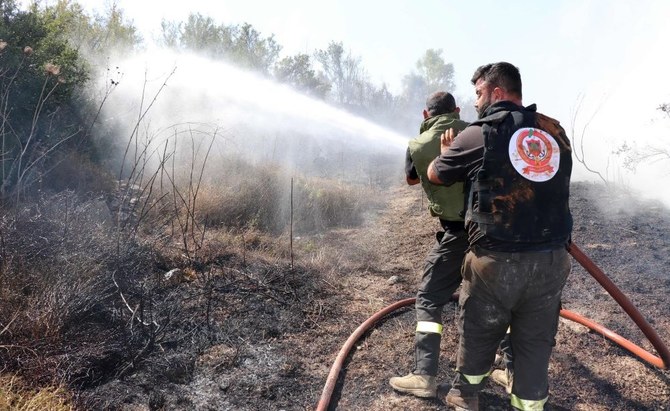

BEIRUT: Lebanese firefighters on Thursday were struggling to contain a series of night fires believed to have been started by Israeli phosphorus shells fired into forests and orchards near the country’s southern border.
Residents of the border town of Aita Al-Shaab urged UN peacekeeping forces, Lebanese troops and Civil Defense personnel to join in efforts to extinguish fires that have ravaged nearby farming land.
Eyewitnesses said the fires detonated land mines and cluster bombs left behind by Israeli bombardments.
Israeli shelling hindered attempts by Lebanese troops to reach threatened forests near Aita Al-Shaab and also trapped Syrian workers on cattle farms on the outskirts of the nearby town of Aitaroun.
Nabih Berri, the Lebanese parliamentary speaker, denounced what he described as “the scorched earth policy that Israel is pursuing in the Gaza Strip and along the southern Lebanese borders.”
He said that internationally prohibited white phosphorus shells are being fired on Lebanon within view of international envoys gathered in the region.
Lebanese Red Cross workers on Thursday retrieved the bodies of two Hezbollah fighters killed by Israeli shelling near the town of Yaroun. The killings bring the militant group’s death toll to 40 in the past two weeks.
Israel announced the previous day that its forces had intercepted a surface-to-air missile launched from southern Lebanon, according to the Israeli Yedioth Ahronoth newspaper.
“The air defense intercepted the missile that was launched from Lebanese territory toward an Israeli army military drone, and an Israeli Air Force aircraft struck the source of the missile firing in southern Lebanon,” army spokesman Daniel Hagari said.
Meanwhile, Baalbek-Hermel Gov. Bashir Khadr said that he had held talks with international organizations on a contingency plan to handle possible repercussions from “the war on Gaza and developments on the southern Lebanese border.”
Baalbek-Hermel governorate is considered a Hezbollah stronghold.
Khadr said that the worst-case scenario is for Lebanon to enter a full-scale war that would be harsher than the July 2006 conflict with Israel.
“We must prepare for the worst, while hoping we do not reach this scenario,” he said.
Khadr warned that the governorate would not be a suitable refuge in case of war “because it will be part of the battle.”
He said: “We must act on the basis that this region might be subject to Israeli airstrikes or incursions, meaning it will be one of the battlefields in Lebanon.
“We are not planning to receive displaced individuals, but we are developing a contingency plan to determine the safer areas for displacement in the governorate, even though the experience with the Israeli enemy suggests that there are no safe areas.”
Jihad Haidar, head of the governorate’s Disaster Management Room, warned of “the risks of psychological and electronic warfare, with rumors and misleading media.”
He said: “It is necessary to exercise control and accuracy, spread awareness, and seek information from reliable sources.”
Haidar added: “We may face the destruction of buildings and infrastructure, and we must be fully prepared, provide equipment to remove rubble, and open alternative roads for rescue, relief and evacuation, secure safe centers and shelter places, and provide sources of water, food and medicine.”


