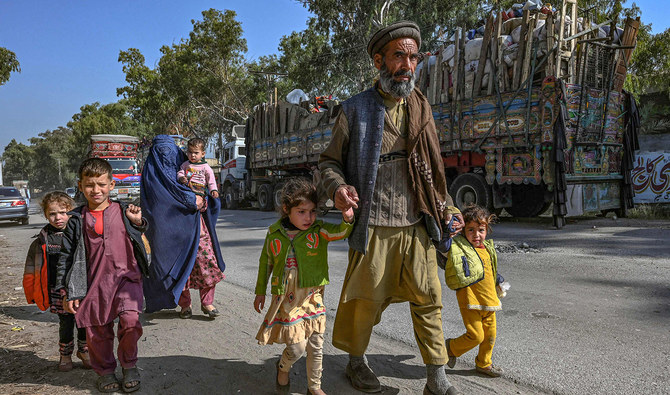
ISLAMABAD: Pakistan and Iran host 90 percent of Afghan refugees, according to a report released by the United Nations on Wednesday, as the humanitarian crisis in Afghanistan shows no signs of abating, leading to a displacement of 9.7 million of its nationals until the middle of this year.
Afghanistan witnessed an end to a war that lasted for about two decades in August 2021 when the United States-led international forces pulled out of the country and the Taliban swept back to power by seizing control of Kabul and extending administrative outreach to other cities.
While the conflict has largely subsided, the UN report on forced displacement noted that rising prices, a collapsing economy and ever-increasing restrictions on the rights of women and girls continued to cause social and economic miseries.
“Poverty is endemic, half of the population of more than 40 million people faces acute food insecurity, and nearly 3.3 million people in the country remained displaced from their homes at mid-2023,” it said while pointing out that the total number of Afghan refugees had globally increased from 5.7 million to 6.1 million.
“Together, the Islamic Republic of Iran (3.4 million) and Pakistan (2.1 million) hosted 90 percent of all Afghan refugees,” the report added.
The UN also highlighted that the total number of refugees had increased worldwide by 1.2 million or 3 percent during the first half of the year due to outbreak of conflicts in places like Sudan and the continuation of the war in Ukraine.
By the end of June, there were an estimated 35.8 million refugees globally, most of whom have been in displacement for many years.
“The world’s focus now is – rightly – on the humanitarian catastrophe in Gaza,” said UN High Commissioner for Refugees Filippo Grandi. “But globally, far too many conflicts are proliferating or escalating, shattering innocent lives and uprooting people.”
“The international community’s inability to solve conflicts or prevent new ones is driving displacement and misery,” he added. “We must look within, work together to end conflicts and allow refugees and other displaced people to return home or restart their lives.”


![]()

UN report reveals Pakistan and Iran host 90 percent Afghan refugees amid ongoing crisis
Short Url
https://arab.news/4d3tp
UN report reveals Pakistan and Iran host 90 percent Afghan refugees amid ongoing crisis
- The UN says the total number of Afghan refugees has globally increased from 5.7 million to 6.1 million
- The UN report laments the international community’s inability to solve old conflicts and prevent new ones
Latest updates






© 2026 SAUDI RESEARCH & PUBLISHING COMPANY, All Rights Reserved And subject to Terms of Use Agreement.