

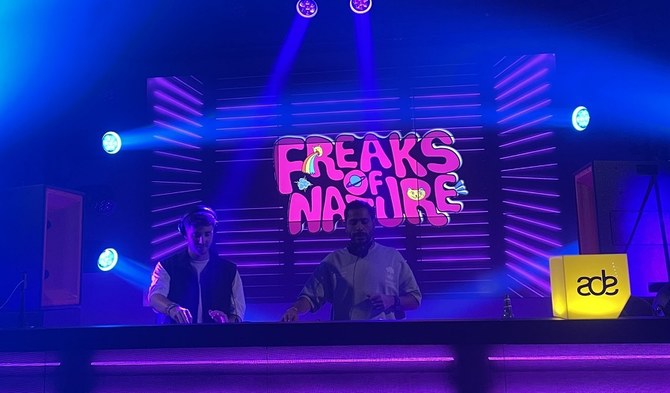
Saudi EDM festival Freaks of Nature debuts in Amsterdam

Short Url
Updated 25 October 2023
Follow

Saudi EDM festival Freaks of Nature debuts in Amsterdam

AMSTERDAM: Freaks of Nature, Saudi Arabia’s homegrown boutique electronic music festival series, made its first appearance at the Amsterdam Dance Event (ADE) this week. Originating in Riyadh, the creators of Freaks of Nature organized this event, named “querencia,” with the vision of creating a dreamlike place for free expression and unity among “fabulous freaks.”

The Amsterdam showcase featured a lineup of Saudi talents including Sound of Yaz, Rash, DJ Igniter, Bigg3, Yazeed and DJ Hannah, who presented back-to-back sets with international artists such as Toby Romeo and Lucaz, as well as Dutch artists like DJ Basicz, Brooks, WeDamnz, Seth Hills.

Every October, Amsterdam becomes the epicenter of the world’s electronical music industry during the Amsterdam Dance Event (ADE). It features a mix of music festivals, warehouse raves, boat parties, hundreds of panels, conferences, business sessions, and many other adjacent events. The city comes alive with non-stop energy throughout the five-day event, spanning over 200 clubs and cultural institutions hosting over 1,000 activities.

Freaks of Nature’s organizers said that their mission is to connect international DJs, industry professionals and booking agencies with Saudi artists. They want to provide them with a platform and boost their presence beyond the Kingdom.

Dutch DJ Basicz, who has performed in Riyadh twice, said, “Saudi Arabia is not really on the map right now in the event scene, so it’s great that they (they organizers) are bringing it to ADE, it will gain more recognition now.” He unexpectedly discovered the Saudi music scene when he met Yazeed Al-Hashim, the festival’s CEO, in Amsterdam. DJ Basicz explained, “he liked my vibe and invited me to be part of the new music scene in Saudi.” In an earlier interview with Arab News, Al-Hashim talked about ADE, mentioning, “for us, it was really essential to show the international music community the Saudi entertainment scene as well as Saudi local artists.”  

Saudi talent Bigg3 said that ADE is also an opportunity to learn about new music technologies and industry trends. He emphasized ADE’s importance, saying “it’s almost necessary for all the event makers, DJ’s and producers to be at ADE; everyone is here.”

Bigg3 and DJ Basicz, paired up for one of the night’s sets, discussed the contrasts between performing in the two countries. They noticed that the Dutch crowd is more familiar with techno music, while in Saudi Arabia, Bigg3 said, “we are just starting to get used to it, we are building the industry.”

A little over two weeks ago, Freaks of Nature organized a two-day festival in Riyadh, also themed “querencia.” “Every event of our series is unique, but we want people to recognize it under the same title, just like the well-known Awakenings techno festival,” the organizers said. During the festival, partygoers enjoyed performances by both international DJs like Lost Frequencies, Agents of Time, Nic Fanciulli, DJ Morten, as well as local and regional artists.


Akio Fujimoto discusses RSIFF Golden Yusr winner ‘Lost Land’ 

Akio Fujimoto at the Red Sea International Film Festival in Jeddah. (Getty Images)
Updated 19 December 2025
Follow

Akio Fujimoto discusses RSIFF Golden Yusr winner ‘Lost Land’ 

  • The Japanese filmmaker on his groundbreaking Rohingya-language feature

JEDDAH: Some stories demand to be told. Not just as narratives, but as acts of witness.  

Japanese filmmaker Akio Fujimoto’s “Lost Land” is one such story. Billed as the first feature film in the Rohingya language, the movie took home the top prize — the Golden Yusr — at this year’s Red Sea International Film Festival. 

“Lost Land” — which premiered in the Horizons section at this year’s Venice Film Festival, where it won the special jury prize — follows two young Rohingya siblings, Somira and Shafi, fleeing persecution in Myanmar as they undertake a perilous journey d to join their uncle in Malaysia. 

Shomira Rias Uddin (R) and Muhammad Shofik Rias Uddin in 'Lost Land.' (Supplied) 

Presenting the Golden Yusr to Fujimoto, RSIFF jury head, the US filmmaker Sean Baker, said the film “confronts the plight of displaced children with unflinching empathy and poetic urgency.” 

Fujimoto’s journey to this film is a profound narrative of personal reckoning. Having worked in Myanmar for more than a decade, he recognized the unspoken tensions surrounding discussions about refugee experiences but never spoke out himself due to fear of persecution. The 2021 military coup in Myanmar, he said, forced him to confront a lingering sense of guilt about his previous silence on the subject. 

“Looking back on my decade of work, I realized I had been avoiding topics I wanted to focus on as a filmmaker,” Fujimoto said in an interview with Arab News at RSIFF. 

That self-reflection became the catalyst for “Lost Land,” transforming personal hesitation into a powerful act of cinematic storytelling. 

Eschewing traditional casting methods, Fujimoto discovered his lead actors through serendipity during community fieldwork. Shomira Rias Uddin and Muhammad Shofik Rias Uddin, real-life siblings who play the film’s young leads, were found walking near interview locations, compelling the filmmaker to reshape the entire script around their natural chemistry. While the original script was written with two teenage brothers in mind, the discovery of the Rias Uddin siblings led Fujimoto to alter the script significantly. 

Communication between the cast and crew became an intricate dance of translation and cultural bridge-building. With Fujimoto speaking primarily Japanese and some Burmese, the team relied on Sujauddin Karimuddin, a Rohingya translator who did far more than linguistic conversion. “He wasn’t just translating words but conveying messages, creating trust, and establishing a collaborative atmosphere,” said Watanabe, Fujimoto’s translator. 

One of the most remarkable aspects of “Lost Land” is its linguistic significance. Beyond being a narrative, the film serves as a critical instrument of cultural preservation. Karimuddin, who is also a producer on the film, approached his role like a linguistic curator. “As a Rohingya myself, I had the privilege of choosing words carefully, trying to instill poetry, capturing linguistic nuances that are slowly disappearing. So, the film is very important when it comes to the preservation of a people’s language. It was a privilege for me to contribute to it,” he said. 

As they were making the first fiction film focused on Rohingya experiences, the team felt an immense responsibility. “Lost Land” aims to humanize a community often reduced to statistics, giving voice and complexity to individual experiences.

Shomira Rias Uddin and Muhammad Shofik Rias Uddin (R) in 'Lost Land.' (Supplied) 

“In our film, we had around 200 people — including extras — who were all part of the Rohingya community. I felt in order to show their feelings and their voice; it was really important to bring in the Rohingya people and tell the story together with them,” said Fujimoto. 

For Fujimoto, whose previous films include “Passage of Life” (2017) and “Along the Sea” (2020), the film represents more than an artistic achievement. It’s a form of personal and collective redemption. “I can now clearly talk about these people without hesitation,” he said. 

The filmmaker’s future ambitions involve expanding on this project. He sees “Lost Land” as a crucial first step, and hopes to support Rohingya filmmakers in telling their own stories directly. 

“The next phase is bringing narratives from the Rohingya perspective, directed by Rohingya filmmakers,” he said.