UNITED NATIONS, US: The UN Security Council on Wednesday failed again to take action on the Israel-Hamas war, with Russia and China vetoing a US-led draft resolution and a text led by Moscow drawing insufficient support.
The rival powers went ahead and put forward texts doomed to defeat despite what diplomats said was a last-ditch effort led by France to delay a vote and work toward consensus.
The United States, Israel’s historic backer which exercised its own veto last week, put forward a resolution that would support “humanitarian pauses” to let aid into the blockaded Gaza Strip and back the right of “all states” to self-defense within the confines of international law.
The US-led draft did not call for a full cease-fire. Russia put forward its own proposal that sought “an immediate, durable and fully respected humanitarian cease-fire” and “condemns all violence and hostilities against civilians.”
Ten countries backed the US resolution but Russia and China exercised their veto power. The United Arab Emirates, whose relations with Israel have warmed markedly since normalization in 2020 but represents the Arab bloc, also voted in opposition, with the other two countries, Brazil and Mozambique, abstaining.
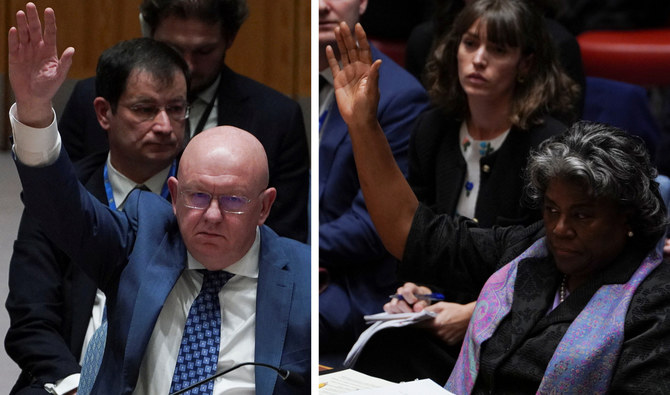
“It has became clear from that the US simply doesn’t want UN Security Council decisions to have any kind of influence on a possible ground offensive by Israel in Gaza,” said the Russian representative, Vassily Nebenzia.
“This extremely politicized document clearly has one aim — not to save civilians but to shore up the US political position in the region,” he said.
The US ambassador, Linda Thomas-Greenfield, insisted that the United States had incorporated feedback from the rest of the world since its veto.
Secretary of State Antony Blinken, promoting the resolution during a high-level Security Council session on Tuesday, spoke of “humanitarian pauses” even while ruling out a formal cease-fire.
“The United States is deeply disappointed that Russia and China vetoed this resolution,” Thomas-Greenfield said. “We did listen to all of you.”
She accused Russia, often on the receiving end of criticism since its invasion of Ukraine, of “cynical and irresponsible behavior” for putting forward its own text “with zero consultations” and “a number of problematic sections.”
Only Russia, China, the United Arab Emirates and Gabon voted for the draft resolution. The United States and Britain voted no, with the other nine countries including US allies France and Japan abstaining.
The UAE ambassador, Lana Nusseibeh, said that the Security Council needed to respond “tangibly” to the dire situation in Gaza.
At the high-level session Tuesday, “we heard dozens of statements imploring this council to assign the same value to Palestinian life as it does to Israeli life,” she said.
“We cannot allow any equivocation on this point. There is no hierarchy of civilian lives.”
With the Security Council deadlocked, the broader UN General Assembly is scheduled to debate the war on Thursday and Friday.
Resolutions from this body representing all UN members, with no one holding veto power, are non-binding. Still, Arab countries are working on a resolution that could be voted on this week, diplomats said.
This draft seen by AFP urges an immediate cease-fire and unhindered access for humanitarian aid to reach Gaza.
Israel has been bombarding since October 7 when Hamas gunmen poured across the border killing 1,400 people, mostly civilians, and kidnapping 222 others, officials say, in the worst attack in Israel’s history.
So far, more than 6,500 Palestinians have been killed, mostly civilians, and there are fears the toll could further soar if Israel pushes ahead with a widely expected ground invasion in a bid to destroy Hamas and rescue the hostages.


![]()
US, Russian bids on Israel-Hamas war fail at Security Council
Short Url
https://arab.news/4nm3e
US, Russian bids on Israel-Hamas war fail at Security Council
- US has called for pauses to allow aid to enter Gaza, while Russia wants a humanitarian cease-fire

Latest updates




© 2026 SAUDI RESEARCH & PUBLISHING COMPANY, All Rights Reserved And subject to Terms of Use Agreement.