

Pakistan asks UN Security Council to hold Israel accountable for ‘war crimes’ in Gaza

1 / 2
United Nations (UN) Security Council meeting on the conflict in Middle East at the UN headquarters in New York City on October 24, 2023. (AFP)
2 / 2
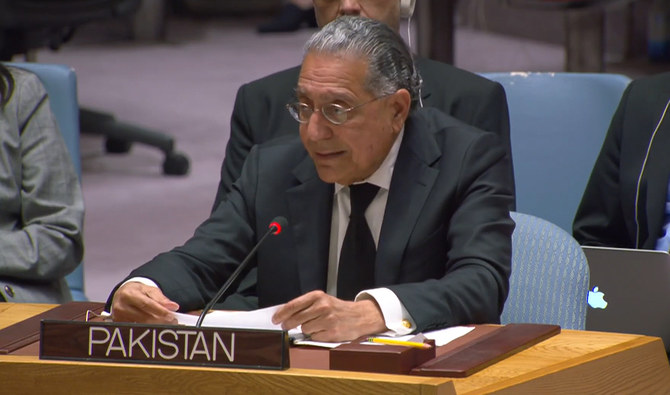
Pakistan’s Permanent Representative to the United Nations Ambassador Munir Akram speaks during the High-Level Debate of the UN Security Council on the situation in the Middle East at the United Nations headquarters in New York City, USA, on October 24, 2023. (Photo courtesy: Pakistan Mission to the United Nations NewYork/YouTube)
Short Url
Updated 25 October 2023
Follow

Pakistan asks UN Security Council to hold Israel accountable for ‘war crimes’ in Gaza

  • Ambassador Munir Akram calls for ‘immediate and unconditional cease-fire,’ warning of wider and more dangerous conflict
  • The Pakistani envoy maintains resistance to foreign occupation cannot be described as terrorism under international law

ISLAMABAD: Pakistan criticized the United Nations Security Council (UNSC) for failing to seek an end to Israel’s Gaza airstrikes on Tuesday, asking its member states to hold all those responsible for committing “war crimes” in the area by targeting civilians and residential neighborhoods.
Israel besieged the Gaza Strip and launched airstrikes after a surprise attack initiated by Hamas on October 7 in retribution to the deteriorating condition of Palestinian people living under Israeli occupation.
According to the health ministry in Gaza, at least 5,791 Palestinians have so far been killed in the Israeli attacks.
Discussing the situation in the Middle East, Pakistan’s Permanent Representative to the United Nations Ambassador Munir Akram called for an immediate cease-fire to deescalate the conflict.
“The Israeli attacks on civilians, civilian objects and infrastructure, the blockade of water, fuel and food, as well as the forced transfer of people from the occupied territory are flagrant violations of international humanitarian law and amount to war crimes,” he told the UNSC. “Those responsible for these atrocity crimes must be held accountable.”
“Pakistan calls for an immediate and unconditional cease-fire,” he added. “The continuation of Israeli campaign in Gaza will lead to further massive civilian casualties and could trigger a wider and more dangerous conflict.”

Akram expressed Pakistan’s disappointment that the UNSC had not sought an end to the conflict, adding that those who were causing its continuation carried a heavy responsibility.
He also criticized those who described Palestinian resistance as terrorism.
“Any attempt to create a false equivalence between Israel, the occupying power, and Palestinians, the victims of this occupation, is untenable – legally, morally, and politically,” he continued. “Pakistan condemns terrorism in all its forms and manifestations. Yet, under international law, the struggle of people living under foreign occupation for self-determination and national liberation is legitimate and cannot be equated with terrorism.”
“It is the suppression of the struggle which is illegal,” he added.
Akram noted that colonial powers had always described resistance to their rule as terrorism.
He recognized the UN charter gave its members right to self-defense while pointing out that a state which was forcibly occupying a foreign territory could not invoke that principle against those whose territory it was occupying.
“The perpetuation of Israeli occupation will not bring peace to the Holy Land,” he said. “Durable peace will emerge from the internationally agreed two-state solution.”


Pakistan president meets UAE counterpart, explores trade, investment opportunities

Updated 27 January 2026
Follow

Pakistan president meets UAE counterpart, explores trade, investment opportunities

  • Asif Ali Zardari is in UAE on four-day visit to strengthen bilateral ties, review bilateral cooperation
  • Both sides discuss regional, international developments, reaffirm commitment to promote peace

ISLAMABAD: President Asif Ali Zardari met his UAE counterpart Sheikh Mohammed bin Zayed Al-Nahyan in Abu Dhabi on Tuesday during which both sides explored new opportunities in trade, investment, energy and other sectors, Zardari's office said. 

Zardari arrived in Abu Dhabi on Monday evening with a high-level delegation on a four-day official visit to the UAE to review trade, economic and security cooperation. 

"The leaders discussed ways to further deepen the longstanding and brotherly relations between Pakistan and the UAE," a statement from Zardari's office said about his meeting with the UAE president. 

"They reviewed the full spectrum of bilateral cooperation and explored new opportunities in trade, investment, energy, infrastructure, technology, and people-to-people exchanges, highlighting the significant potential for expanding economic and strategic partnership.

Zardari highlighted the significance of Al-Nayhan's visit to Pakistan last month, the statement said, expressing appreciation for the UAE's continued support for strengthening bilateral ties.

It said both sides also exchanged views on a range of regional and international developments, reaffirming their commitment to promoting peace, stability and sustainable development.

The meeting was also attended by Pakistan's First Lady Aseefa Bhutto-Zardari, the Pakistani president's son Bilawal Bhutto-Zardari, who is also the chairman of the Pakistan Peoples Party, Interior Minister Mohsin Naqvi and Pakistan's ambassador to the UAE. 

ZARDARI MEETS AD PORTS CEO

Zardari earlier met AD Ports Group CEO Captain Mohamed Juma Al-Shamisi to discuss the group's investment initiatives in Karachi. 

"Both sides agreed that the expansion and modernization of port infrastructure would strengthen trade flows and support Pakistan’s broader economic development and country’s seaborne trade," the President's Secretariat said in a statement.

It added that Zardari described the AD Ports Group's long-term investment and expanding role in Pakistan's maritime and logistics sector as a key pillar of Pakistan–UAE economic cooperation.

Pakistan and the UAE maintain close political and economic relations, with Abu Dhabi playing a pivotal role in supporting Islamabad during periods of financial stress through deposits, oil facilities and investment commitments. 

The UAE is Pakistan's third-largest trading partner, after China and the United States, and a key destination for Pakistani exports, particularly food, textiles and construction services.

The Gulf state is also home to more than 1.5 million Pakistani expatriates, one of the largest overseas Pakistani communities in the world, who contribute billions of dollars annually in remittances, a crucial source of foreign exchange for Pakistan’s economy.

Beyond trade and labor ties, Pakistan and the UAE have steadily expanded defense and security cooperation over the years, including military training, joint exercises and collaboration in counter-terrorism and regional security matters.