PARIS: French President Emmanuel Macron evoked an international coalition along the lines of the one that defeated Daesh extremists in Iraq and Syria to fight Palestinian militant group Hamas but such an idea will struggle to even get off the ground, experts say.
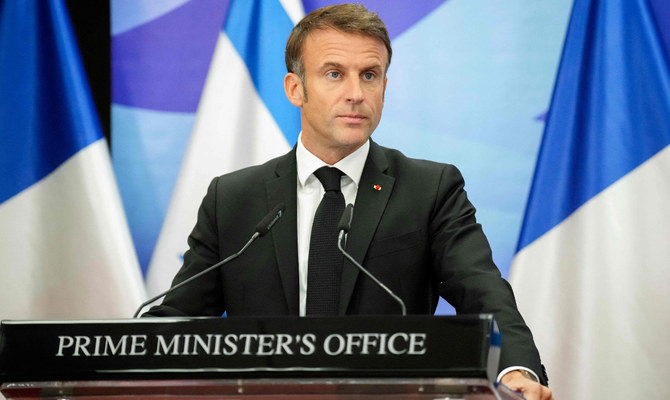
Macron floated the proposal during a visit to Israel Tuesday, as a conflict rages between Israel and Hamas that has seen thousands of civilians killed on both sides.
It appears he did not wish to signal that any international forces should be sent into the Hamas-ruled Gaza Strip, as Israel prepares for a ground operation that it wants to destroy the Islamist group, even if the comments created a certain ambiguity.
The war was triggered by an unprecedented attack on Israel launched by Hamas on October 7 from the Gaza Strip. More than 220 hostages are being held by Hamas in the territory.
During his visit to Israel for talks with Prime Minister Benjamin Netanyahu, Macron said that “France is ready for the international coalition against Daesh ... to also be able to fight against Hamas.”
“I propose to our international partners that we should build a regional and international coalition to battle against terrorist groups that threaten us all,” he added.
Macron’s advisers appeared eager to rapidly dampen any assumptions his comments may have created about the potential of any Western-backed ground force emerging to join Israel in its stated aim of destroying Hamas.
An Elysee source said the aim of such a coalition would be to draw “inspiration” from the anti-Daesh alliance that emerged from 2014 to defeat the Islamist extremists in Iraq and Syria.
The source also emphasised that the anti-IS coalition was “not limited to operations” on the ground but also the training of Iraqi forces, the sharing of information between partners and the fight against terror financing.
Macron’s proposal “draws inspiration from the experience of the Global Coalition Against Daesh and seeing what aspects can be replicated against Hamas,” said the source, who asked not to be named.
The coalition worked to dislodge and ultimately defeat the Daesh group which had seized swathes of territory in northern Syria and northern Iraq including the key Iraqi city of Mosul.
It was set up in 2014 and says it has 86 “members” — countries and groups such as the European Union and the Arab League — and worked notably with Kurdish fighters who handled the bulk of fighting on the ground in Syria backed and trained by Western special forces.
Experts say that the degree of unanimity that was found over the campaign to defeat Daesh would not translate into a campaign against Hamas, making it tough to simply expand the existing coalition.
The list of anti-Daesh coalition members includes “many countries which absolutely do not share France’s position on Hamas” such as Qatar, Jordan and Turkiye, said Elie Tenenbaum of the French Institute of International Relations (IFRI).
“Israel is not a member of this coalition, so that would also be problematic,” he added.
“The feasibility of extending the scope of the global coalition against Daesh to the fight against Hamas seems highly improbable to me.”
Renad Mansour, senior research fellow at London-based think tank Chatham House, added that whereas there was large local support from Iraqi and Syrian populations in the fight against Daesh any such the campaign against Hamas “will be much more difficult because it (Hamas) is more organic, from Gaza.”
“It would be a much more difficult task and, as we have already seen, the nature of Gaza and Palestine is going to result in significant casualties of civilians.”
At least 5,791 Palestinians, mostly civilians, have been killed across the Gaza Strip in relentless Israeli bombardments since October 7, according to the Hamas government’s Ministry of Health.
More than 1,400 people have also been killed in Israel since Hamas carried out an unprecedented attack on 7 October, according to Israeli authorities.
Tenenbaum nevertheless emphasised that such coalitions against extremist groups are not limited to operations on the ground.
“Missions to combat propaganda, the financing of terrorism, stabilization missions and reconstruction of liberated areas can have their place in the fight against Hamas,” he said.


![]()

Skepticism over Macron idea of anti-Daesh ‘coalition’ to fight Hamas
Short Url
https://arab.news/cjbcx
Skepticism over Macron idea of anti-Daesh ‘coalition’ to fight Hamas
- Macron floated the proposal during a visit to Israel Tuesday, as a conflict rages between Israel and Hamas that has seen thousands of civilians killed on both sides


Latest updates


© 2026 SAUDI RESEARCH & PUBLISHING COMPANY, All Rights Reserved And subject to Terms of Use Agreement.