

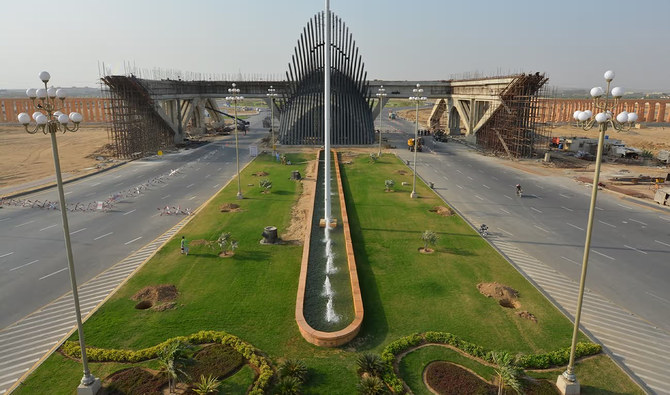
One of Pakistan’s largest land developers barred from advertising, selling property in southern Pakistan

The undated photo shows the entrance of Bahria Town Karachi. (Photo courtesy: Bahria Town)
Short Url
Updated 23 October 2023
Follow

One of Pakistan’s largest land developers barred from advertising, selling property in southern Pakistan

  • A case has been registered against Bahria Town Karachi owners, Malik Riaz and his son, for the dishonoring of three cheques, each worth Rs64.1 million
  • In May 2018, a Supreme Court bench had also stopped the real estate developer from selling or allotting property over discrepancies in its acquisition of lands

KARACHI: Authorities in the southern Pakistani province of Sindh have barred one of the country’s largest real estate developers, Bahria Town Karachi, from advertising or selling any property and registered a case against its owners for failing to clear dues, it emerged Monday.

The Sindh Building Control Authority (SBCA), a provincial body that oversees land-related matters in Sindh, said the owners of Bahria Town Karachi had failed to pay scrutiny fees to the regulator. The SBCA didn’t specify the amount owed by the developer.

It said it had issued a show-cause notice to the real estate developer, for the dishonoring of its cheques, but the firm did not respond to the notice.

“You have failed to clear your dues due to dishonoring [of] your cheques, detail of which had been communicated to you... even you failed to respond [to] the show-cause notice,” the SBCA said in its letter addressed to Bahria Town Karachi.

“As per orders of competent authority, SBCA, the provisional NoC (no-objection certificate) for sale and advertisement of the project “Bahria Town Karachi” of M/s Bahria Town (Private) Limited (DL-3069) has been canceled/withdrawn with immediate effect on account of non-payment of scrutiny fees.”

Separately, a case was registered against Bahria Town Karachi owners, Malik Riaz and Ali Riaz Malik, for the dishonoring of their three cheques, each amounting to Rs64, 168, 762.

This is not the first time that Bahria Town has faced regulatory action with regard to its mega real estate project in Pakistan’s commercial hub of Karachi.

In May 2018, a three-judge Supreme Court bench had stopped the real-estate developer from selling or allotting plots and residential units over discrepancies in its acquisition of lands for Bahria Town Karachi from the Sindh government.

The court later accepted Bahria Town’s Rs460 billion offer for the lands it acquired in the Malir district of Karachi and restrained the country’s anti-corruption watchdog from filing references against the developer.


Pakistan receives $1.2 billion from IMF under EFF, RSF loan programs— central bank

Updated 9 sec ago
Follow

Pakistan receives $1.2 billion from IMF under EFF, RSF loan programs— central bank

  • IMF Executive Board approved Pakistan’s second review under EFF, first review under RSF loan programs this week 
  • Disbursements from IMF have been crucial for cash-strapped Pakistan as it tries to recover from economic crisis 

ISLAMABAD: Pakistan’s central bank announced on Thursday that it has received $1.2 billion under the International Monetary Fund’s (IMF) External Fund Facility and Resilience and Sustainability Facility (RSF) loan programs. 

The IMF approved a $7 billion bailout package for Pakistan under its EFF program in September 2024 while in May 2025, it approved a separate $1.4 billion loan to Pakistan under its climate resilience fund. The RSF will support Pakistan’s efforts in building economic resilience to climate vulnerabilities and natural disasters. 

The global lender approved Pakistan’s second review under its $7 billion EFF program and first review under the RSF loan on Tuesday. As per the State Bank of Pakistan (SBP), the central bank received a combined sum of $1.2 billion under the EFF and RSF on Dec. 10. 

“The amount would be reflected in SBP’s foreign exchange reserves for the week ending on Dec. 12, 2025,” the SBP said in a statement. 

IMF bailouts have been crucial for cash-strapped Pakistan, which has been struggling with a prolonged economic crisis that has exhausted its financial reserves and weakened its currency. Pakistan came to the brink of a sovereign default in 2023 before a last-gasp IMF bailout package helped it avert the crisis. 

Pakistan has had to take tough decisions to comply with the IMF’s loan requirements, which include scrapping subsidies from food and fuel items to trigger inflation. Since then, Pakistan has attempted to regain stability by sharply reducing inflation and recording a current account surplus. 

The disbursement, however, comes at an important time for the South Asian country as it mitigates losses from a deadly monsoon season that killed over 1,000 people since late June and caused at least $2.9 billion in damages to agriculture and infrastructure.