

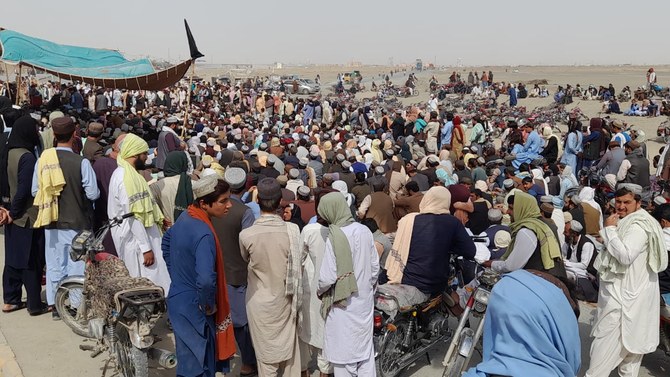

QUETTA: Residents of the southwestern Pakistani town of Chaman that borders Afghanistan protested for the second consecutive day on Sunday Islamabad’s proposed passport and visa policy at the Pakistan-Afghan border crossing in the area, which is due to be implemented after November 1.
The Pakistani central government has tightened its travel policy for citizens of all neighboring countries, following deadly attacks in the country’s northwestern Khyber Pakhtunkhwa (KP) and southwestern Balochistan provinces earlier this year.
Pakistan shares a 2600-kilometer porous border with Afghanistan which lies through KP and Balochistan. The Chaman border crossing is one of the key border crossings between the two countries in Pakistan’s Balochistan that connects with Afghanistan’s Kandahar province.
Since Pakistan’s independence from the British India, Islamabad has been practicing a relaxed travel policy for residents living in border towns on either side. But the Pakistani government has lately announced a strict policy that allows only the residents of Chaman and Kandahar to cross the border by showing their proof of residence.
The rest of the citizens from both countries are required to have passports and visas to travel across the border.
“More than 15,000 to 20,000 people in Chaman daily cross through the Pak-Afghan border for business purposes, the central government’s passport and visa policy will cause dire economic woes for the locals,” Mufti Muhammad Qasim, one of the organizers of the protest sit-in in Chaman, told Arab News.
“Local traders, political and religious parties and residents of Chaman have joined the sit-in against Islamabad’s new policy at the Pak-Afghan Friendship Gate. The protest will continue at Chaman’s leading highway leading to the Pak-Afghan border until the government reverses this decision.”
Chaman is the second most populous city in Pakistan’s southwestern Balochistan province and lies around 125-kilometers away from the provincial capital of Quetta. A majority of residents of the border town rely on trade between the two neighboring countries.
Hajji Jalat Khan Achakzai, a former president of the Chaman Chamber of Commerce and Industries, said there were no agricultural, educational or economic opportunities for the residents of Chaman and the government’s new travel policy would further impact them.
“Locals in Chaman own land in Afghanistan, they have families living there, some have buried their family members on the other side of the border,” he said. “I don’t know how this decision will be implemented at the Chaman border.”
Before implementing this new policy, Achakzai said, the central government should create job opportunities for the locals.
Pakistan announced tightening its travel policy after suicide attacks killed more than a hundred Pakistanis in the northwestern Bajaur and southwestern Mastung districts in July and September.
The country has been witnessing an uptick in militant violence in its northwestern and southwestern regions, particularly after the Pakistani Taliban called off their fragile truce with the government in November last year. The militant group, which is said to have sanctuaries in neighboring Afghanistan, is separate from but a close ally of the Afghan Taliban.
The recent attacks have also prompted authorities in Pakistan to ask all illegal immigrants to leave the country by November 1.
Jan Achakzai, Balochistan’s caretaker information minister, said the government had decided to fully implement the visa regime, but they were in talks with the protesters in Chaman to address their concerns.
“The central and provincial governments have been jointly working to create job opportunities for the residents of Chaman,” he told Arab News. “However, the new visa policy will be fully implemented at the Pak-Afghan border after the November 1 deadline.”


