

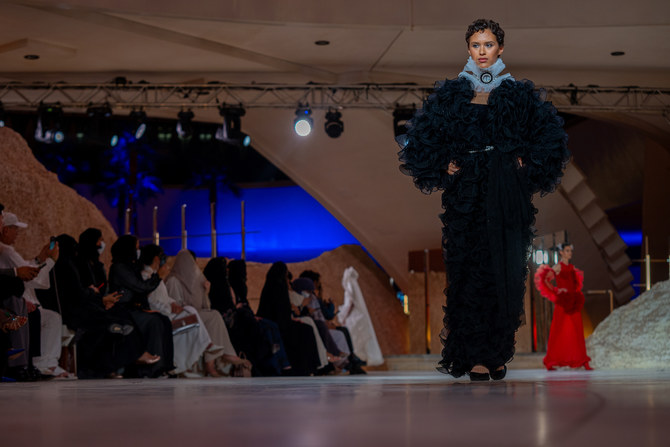
Atelier Hekayat contrasts memories, modernity at inaugural Riyadh Fashion Week 

1 / 3
Atelier Hekayat presented a collection steeped in nostalgia that simultaneously looked to the future of Saudi fashion. (AN/ Huda Bashatah)
2 / 3
(AN/ Huda Bashatah)
3 / 3
(AN/ Huda Bashatah)
Short Url
Updated 23 October 2023
Follow

Atelier Hekayat contrasts memories, modernity at inaugural Riyadh Fashion Week 

RIYADH: On the second night of the inaugural Riyadh Fashion Week, Jeddah-based Atelier Hekayat presented a collection steeped in nostalgia that simultaneously looked to the future of Saudi fashion.  

The rock-marked runway bloomed with the smell of lavender as each audience member was offered a bundle with a note attached. “We dedicate our success to our great father. May his soul rest in peace. He gave us love. Taught us how to love. Filled our life with love,” some of the lines read.  


The label’s collection is titled “I am coming home.” (AN/ Huda Bashatah)

Founded by sister-duo Abeer and Alia Oraif, Atelier Hekayat's collection was inspired by their father and, more specifically, their childhood memories. Some pieces boasted tributes to their father’s architectural background and his interest in woodworking. One pistachio green gown stunned the crowd with crystal and pearl embellishments, accessorized with a miniature chair in lieu of a shoulder bag.  

Ballet dancing seemed to inspire many of the looks, including a simple yet elegant lavender bodysuit that extended into a bold ruffled skirt, and a black-and-baby pink ensemble complete with tights, flats, a ruffled cape and tutu, a pearl tiara, and another unlikely accessory — a pair of pointe shoes dangling from the model’s hand.   


The ensembles were elevated with voluminous circle skirts. (AN/ Huda Bashatah)

The show initially kicked off with two models strutting side-by-side sporting a shirt-and-trousers combination, reminiscent of traditional pajama sets, printed with a porcelain-like print of Saudi cultural elements like palm trees, camels and historical architecture. The ensembles, one pink and the other blue, were elevated with voluminous circle skirts, demonstrating a double entendre in the name of eveningwear.  

The label’s collection titled “I am coming home” was dominated by soft pastel colors, but also made statements with elegant true red and black pieces. Pleated tulle trims were prominent and reminiscent of soft clouds as they were paraded down the runway. 


Atelier Hekayat is founded by sister-duo Abeer and Alia Oraif. (AN/ Huda Bashatah)

The collection was met with loud applause, cheers, and whistles as the two designers greeted the crowd to conclude the show.  

They label was launched in 2012 and participated in the first Fashion Futures Saudi Arabia, an event that spotlights the growing fashion industry, in 2019. The label was also selected for the Saudi 100 Brands exhibition organized by the Fashion Commission, and one of their designs was featured on the cover of the first edition of “The State of Fashion in the Kingdom of Saudi Arabia” report, published earlier this year.  


Nationalist Bollywood hit ‘Dhurandhar’ ignites India-Pakistan controversy

Updated 8 sec ago
Follow

Nationalist Bollywood hit ‘Dhurandhar’ ignites India-Pakistan controversy

  • Movie stars Ranveer Singh as an Indian intelligence agent who infiltrates alleged criminal networks in Karachi
  • Film has drawn sharp criticism from Pakistani officials while becoming one of the year’s biggest hits in India

A Bollywood spy thriller set in Pakistan has sparked heated debate across both countries over its portrayal of cross-border tensions, even as the film breaks box office records in India amid a surge in nationalist cinema.

“Dhurandhar,” starring Ranveer Singh as an Indian intelligence agent infiltrating criminal networks in Pakistan’s Karachi, has drawn sharp criticism from Pakistani officials and some international critics while becoming one of the year’s biggest commercial hits in India.

The 3.5-hour film, directed by Aditya Dhar, weaves real historical events including the 1999 plane hijacking, the 2001 Parliament attack, and the 2008 Mumbai attacks into a fictional narrative about an Indian spy’s mission to dismantle alleged links between Karachi gangs and terror networks.

Released Dec. 5 with minimal publicity, “Dhurandhar” has grossed more than 12.15 billion rupees ($134.76 million) in ticket sales, making it the highest-grossing Bollywood film last year. 

“It is a unique thing. Most films are set in India, but in this film, a RAW agent infiltrates Pakistan and is living there, hiding his identity, and the film portrays all of that through this setup, about Karachi and everything. That’s why it is such a good film. I mean, it is very important to watch this film,” said movie-goer Naresh Kumar.

The film represents a growing trend in Indian cinema toward nationalist blockbusters that align with Prime Minister Narendra Modi’s policies, following controversial hits like “The Kashmir Files” and “The Kerala Story” that sparked debates over historical accuracy while achieving commercial success.

In India, some film critics faced online harassment for negative reviews, prompting the Film Critics Guild to condemn “targeted attacks” against reviewers.

“Films that evoke patriotic fervor among audiences generally do well, but that is not to say that any film with this kind of subject would have done well,” said Bollywood film analyst Komal Nahta. “Everything seems to have gone right with the film.” 

The controversy highlights how cinema continues to reflect decades-old tensions between the nuclear-armed neighbors, who have fought four wars since partition in 1947. Fighting erupted between the countries in May following an attack on tourists in Kashmir that India blamed on Pakistan-backed militants.

In Pakistan’s Lyari neighborhood, which was depicted in the film, residents criticized the portrayal as inaccurate.

“It is a completely baseless movie because our neighboring country doesn’t know anything about our country,” said Mohammad Zohaib, a Lyari resident and burger shop owner. “They don’t know anything about Lyari, so how can they make a completely realistic film about someone?” 

The Pakistan Peoples Party filed legal action in a Karachi court last month over the film’s unauthorized use of assassinated former Prime Minister Benazir Bhutto’s image and its portrayal of party leaders as terrorist sympathizers.

“About 10 percent of what has been shown in the movie is reality, 90 percent is not real,” said Khizer Abdul Wahid, a Lyari resident and beauty salon owner.

Pakistan banned Indian films in 2019, but Bollywood remains popular there with audiences using VPNs or illegal downloads to watch new releases.

Theatre admissions in India have fallen 45 percent since their 2018 peak of 1.58 billion, according to Ernst and Young, as streaming services offer content that complements cheap mobile data available to most Indians.

Even global hits like the latest Avatar film struggled to secure screens due to “Dhurandhar’s” strong showing, analysts said.