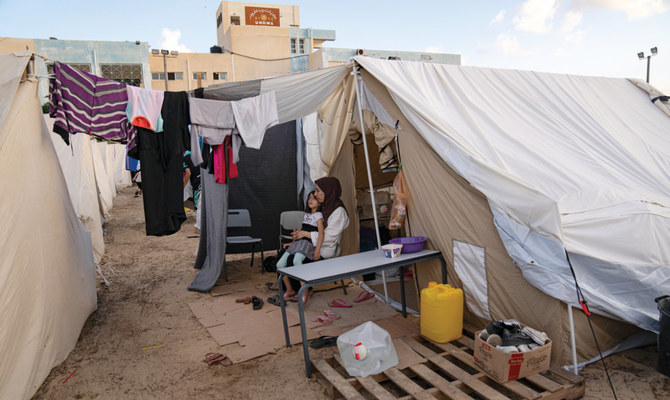

CAIRO: When the sun rose and the autumn heat baked the rotten debris on Gaza’s streets, Mohammed Elian emerged from the zipper hole of his new canvas home.
He — and hundreds of other Palestinians displaced by the latest war between Israel and Hamas — have crowded into a squalid tent camp in southern Gaza, an image that has brought back memories of their greatest trauma.
Last week after the Israeli military ordered Elian’s family, along with more than 1 million other Palestinians, to evacuate the north, the smartly dressed 35-year-old graphic designer from Gaza City ended up homeless in the city of Khan Younis, with few comforts but thin mattresses, solar-powered phone chargers and whatever clothes and pots he could squeeze into his friend’s car.
With nowhere else to go, Elian, his wife and four kids landed in the sprawling tent camp that cropped up this week as UN shelters overflowed in Gaza, where most people are already refugees from the 1948 war surrounding Israel’s creation.
“We have left behind everything, and we are not even safe,” Elian said from a nearby hospital where he searched for water to bring back to his kids, ages 4-10. The distant roar of airstrikes could be heard over the phone.
Scores of Palestinians have lost or fled their homes during the intense Israeli bombardment prompted by a bloody cross-border attack by Hamas militants nearly two weeks ago.
The impromptu construction of the tent city in Khan Younis to help shelter them has elicited anger, disbelief and sorrow across the Arab world.
Row after row of white tents rise from the dusty parking lot. Children sit in the shade and play languidly with rocks. Men cut each other’s hair.
Newly acquainted neighbors wait outside to receive their shared meal from UN workers — a couple of loaves of bread and cans of tuna or beans.
“These images are something that the Arab world cannot accept,” said Daoud Kuttab, a Palestinian journalist in Jordan.
Scenes of Palestinians hastily setting up UN tents are dredging up painful memories of the mass exodus that Palestinians refer to as the Nakba, or “catastrophe.”
In the months before and during the 1948 war, an estimated 700,000 Palestinians fled or were expelled from what is now Israel. Many expected to return when the war ended.
Seventy-five years later, those temporary tents in the West Bank, Gaza and neighboring Arab countries have become permanent cinderblock homes.
“1948 is immediately brought to mind when Palestinians in Gaza are told to flee, it’s immediately brought to mind when you see those images (of tents),” said Rashid Khalidi, a professor of Arab studies at Columbia University. “Palestinian writers have etched this into the Arab consciousness.”
The UN Palestinian refugee agency said the camp is not permanent. It said that the agency distributed tents and blankets to dozens of displaced families in Khan Younis who couldn’t fit in other UN facilities “to protect them from the rain and provide dignity and privacy.”
Gaza already is home to eight permanent camps, which over the years have turned into crowded rundown urban neighborhoods.
But regional anxiety over the Khan Younis tents and Israeli evacuation warnings has grown, adding fuel to the huge, angry protests surging in Mideast capitals over the war in Gaza that began on Oct. 7, when Hamas mounted its raid that killed 1,400 Israelis.
Since then, Israel’s retaliatory bombing campaign has killed more than 4,000 Palestinians, according to the Hamas-run Health Ministry. Many of the victims are women and children.
“It’s very worrisome for the government of Jordan,” Kuttab, said of the wave of displaced Palestinians. “They don’t want to see even a hint of this idea.”
Protests in the kingdom of Jordan, home to a large population of people descended from Palestinian refugees, have rocked the capital, drawing thousands of demonstrators with an intensity unseen in years.
Elian has been so stressed about where to sleep and get food he said he hasn’t had time to fret over the symbolism.
He and his family tried sheltering in one of the crowded UN schools, but the conditions were “horrific,” he said — no space to sleep, no privacy. At least here he can close his tent flap.
“We are living from one moment to the next,” he said. “We try not to think about what comes next — how or when we’ll go home.”