

Saudi-born comedian urges people to verify social media news, slams ‘narrative manipulation’ in Israel-Hamas war

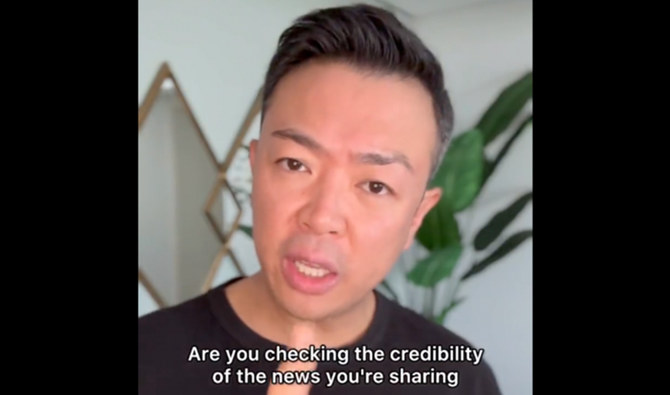
The still image taken from a video on October 21, 2023, shows South Korean-Vietnamese comedian Chung Won-hu. (Photo courtesy: @WonhuChung/X)
Short Url
Updated 21 October 2023
Follow

Saudi-born comedian urges people to verify social media news, slams ‘narrative manipulation’ in Israel-Hamas war

  • Chung Won-hu says he wants to ‘raise his voice in English’ about how claims of Hamas beheading babies spread like ‘wildfire’
  • Citing White House backtracking on claims, apology by CNN’s Sara Sidner, Chung says ‘it was fake news, but damage was done’

LONDON: South Korean-Vietnamese comedian Chung Won-hu has urged people to check the credibility of news they share online, and slammed some media coverage of the Israel-Hamas war as “narrative manipulation” and “propaganda.”

Chung, a bilingual television personality born in Jeddah and raised in Amman, said he wanted to “raise his voice in English” about how claims of Hamas beheading babies spread like “wildfire” and how misinformation can wreak damaging consequences.

“I want to highlight a narrative that is often not heard by the international community. There is a propaganda machine at work, and its misinformation and narrative manipulation has led to this war,” he said.

“It alters the truth by making outrageous claims like: ‘They beheaded children,’” he added.

Citing the White House backtracking on claims that Hamas militants beheaded Israeli children during an attack on a kibbutz, and CNN reporter Sara Sidner’s apology for not verifying the information, Chung said: “It was fake news, but the damage was done; it spread like wildfire on social media. These false narratives have devastating consequences.”

Calling for international law to be upheld and for those responsible for crimes against civilians to be held accountable, he added: “The truth is on the side of those who seek justice, equality and peace.”


Philippines struggles to evacuate nationals from Middle East as attacks escalate across region

Philippine President Ferdinand Marcos Jr. leads a Special Cabinet Meeting to discuss the situation in the Middle East.
Updated 03 March 2026
Follow

Philippines struggles to evacuate nationals from Middle East as attacks escalate across region

  • Over 1,400 Philippine nationals in Middle East have requested for repatriation
  • Filipinos are told to shelter in place, follow host government’s advice on situation

MANILA: The Philippines is in talks to evacuate its nationals from across the Middle East, President Ferdinand Marcos Jr. said on Tuesday, as an increasing number of Filipinos are seeking to leave amid growing destruction from US-Israeli strikes on Iran and Tehran’s counterstrikes against US bases in Gulf countries.

More than 2.4 million Filipinos live and work in the Middle East, where tensions have been high since Saturday, after coordinated US-Israel strikes killed Iran’s Supreme Leader Ali Khamenei and senior Iranian officials.

Tehran responded by targeting US military bases in Gulf countries, and violence has been widening across the region. 

Evacuating Philippine nationals across the region is not yet possible, Marcos said, as countries closed their airspace, leading to airport shutdowns and the cancellation of thousands of flights throughout the Middle East.

“For now, we are depending on the advice that will be given to us by the local authorities in the place where our nationals — where our people — are,” Marcos told reporters in Manila on Tuesday.

The Philippine government has received requests for repatriation from more than 1,400 Filipino nationals in various Middle Eastern countries, including 872 from the UAE and almost 300 from Israel. Similar requests have also been made by Filipinos in Iran, Bahrain and Jordan.

“Right now, the most dangerous area for our people right now would be Israel as attacks there are continuous,” Marcos said.

“The problem now is that no planes are flying and airports are being hit. That’s why the situation is very fluid, our assessment is that it may be too dangerous to mount flights.

“Even if we could charter an aircraft, we cannot do anything because number one, the airports are closed. They are all no-fly zones.”

As the Philippine government prepares for multiple scenarios, officials have secured buses and other vehicles for possible evacuation by land.

Filipinos in “danger areas” have been moved to a safer place, Marcos said, citing the targeting of Saudi Arabia’s Ras Tanura oil refinery by Iranian drones on Monday morning.

“But essentially our advice to them is shelter in place and follow the host government’s advice … For now it’s extremely difficult to enter or exit the region because the only aircraft flying are fighter jets and drones, and missiles.

“That’s why it is not a place that you would want to put in a civilian aircraft to take out our nationals,” he said.

“But again, as I said, the situation is changing by the minute, by the hour. We just have to be in very good and close contact with the local authorities.”