

Pakistan top court to take up pleas challenging military trials of civilians on Oct 23

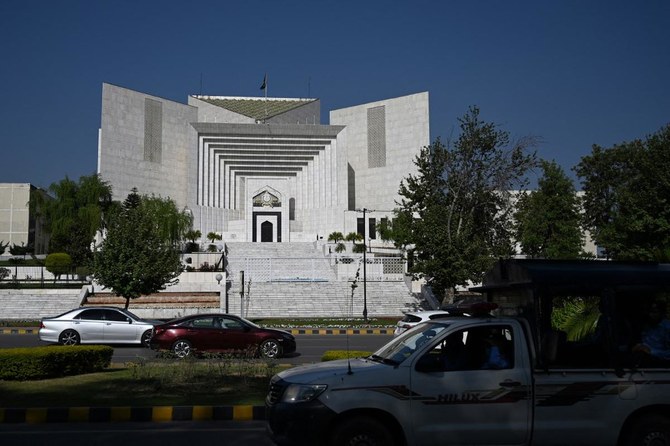
Motorists drive past Pakistan's Supreme Court in Islamabad, Pakistan on April 5, 2022. (AFP/File)
Short Url
Updated 20 October 2023
Follow

Pakistan top court to take up pleas challenging military trials of civilians on Oct 23

  • Government said earlier this year suspects involved in violent protests in May would be tried in military courts
  • Ex-PM Khan’s brief arrest on May 9 unleashed protests in which his supporters attacked and damaged army properties

ISLAMABAD: A five-member bench of the Pakistan Supreme Court will take up on Monday about a dozen petitions challenging the trials of civilians by military courts in a case that is certain to pit the judiciary under Chief Justice Qazi Faez Isa against the country’s all-powerful army. 

The Pakistan government and army said earlier this year suspects accused of attacking army installations in countrywide protests in May in the wake of the brief arrest of former Prime Minister Imran Khan would be tried in military courts.

The announcement has faced widespread criticism from within Pakistan and rights organizations globally because of their secretive nature and their existence alongside a functioning civilian legal system.

A bench led by Justice Ijazul Ahsan and including Justice Munib Akhtar, Justice Yahya Afridi, Justice Mazahar Ali Akbar Naqvi and Justice Ayesha Malik will hear the petitions against trying civilians in military courts at 11:30am on October 23.

The pleas include those filed by Khan, the Supreme Court Bar Association (SCBA), politician and lawyer Aitzaz Ahsan, former chief justice of Pakistan Jawwad S Khawaja and others.

“The court would want to res­train the Pakistan Army from taking any unconstitutional step,” then Chief Justice Umar Ata Bandial had observed when the case was last heard earlier this year. He has since retired and been replaced by Chief Justice Isa, whose elevation garnered nationwide interest given his reputation as a maverick judge and his hard-hitting judgments criticizing the role of the country’s powerful military in politics.

On Thursday, CJ Isa had remarked, during another hearing, that the top court would be hearing important cases, such as on the trial of civilians by military courts and holding elections on time, in the coming weeks.

During a hearing on June 27, the federal government had assured the court that a formal trial had not yet commenced against 102 individuals held by military authorities in connection with the May 9 violent protests.

Pakistan’s Army Act of 1952 established military courts primarily to try members of the military or enemies of the state. Civilians can only be tried there under a federal government order.

Civilians accused of offenses such as waging war against the armed forces or law enforcement agencies, or attacking military installations or inciting mutiny, can be tried at military courts.

Military courts operate under a separate system from the civilian legal system and are run by military officers. The judges are also military personnel and cases are tried at military installations.

Trials are closed to outsiders, and no media presence is allowed.

Anyone tried under the Army Act has the right to defend themselves and a counsel of their choice.

There is no right to appeal but individuals can challenge the question of jurisdiction in high courts and the Supreme Court.

Anti-fuel smuggling drive boosts Pakistan revenues 82%, PM office says

Updated 19 December 2025
Follow

Anti-fuel smuggling drive boosts Pakistan revenues 82%, PM office says

  • Crackdown targets illegal petroleum trade using GPS tracking and pump registration
  • July–November gains cited as government intensifies tax, customs enforcement

ISLAMABAD: The Pakistani prime minister’s office said on Friday revenues from petroleum products rose 82% between July and November 2025 after a nationwide crackdown on fuel smuggling, as the government steps up enforcement to curb tax evasion and losses that have long strained public finances.

The increase was cited during a weekly performance review of the Federal Board of Revenue (FBR), where Prime Minister Shehbaz Sharif directed authorities to accelerate action against smuggling and tax evasion, according to a statement issued by the PM’s Office.

Fuel smuggling has been a persistent problem in Pakistan, where subsidised or untaxed petroleum products are often trafficked across borders or sold through unregistered pumps, depriving the state of revenue and distorting domestic energy markets. Successive governments have blamed the practice for billions of rupees in annual losses, while international lenders have repeatedly urged tighter enforcement as part of broader fiscal reforms.

“Every year the nation loses billions due to smuggling,” Sharif was quoted as saying in a statement, praising customs authorities for successful operations and noting that revenues from petroleum products increased by 82% from July to November 2025 compared with the same period last year.

The PM said stricter enforcement had brought several goods back into the formal economy, adding that there would be “no leniency” toward those involved in tax evasion or illegal trade.

Officials briefed the prime minister that Pakistan Customs has rolled out a nationwide enforcement framework, including GPS tracking of petroleum product transportation, registration of fuel stations through a digital monitoring system, and legal action against illegal machinery under updated petroleum laws.

The government has also instructed provincial administrations to cooperate fully with federal authorities in shutting down illegal petrol pumps, the statement said.

Sharif said enforcement efforts would continue until smuggling networks were dismantled and tax compliance improved, as the government seeks to strengthen revenues amid ongoing economic reforms.

Pakistan has struggled for years with weak tax collection and a narrow revenue base, forcing repeated bailouts from the International Monetary Fund. Smuggling of fuel, cigarettes, electronics and consumer goods has been identified by policymakers as a major obstacle to improving revenues and stabilising the economy.

Independent research shows that Pakistan loses an estimated Rs750 billion (about $2.7 billion) annually in tax revenue due to illicit trade and smuggling across sectors such as petroleum, tobacco and pharmaceuticals. Broader analyzes suggest total tax revenue losses linked to the informal economy and smuggling may reach as high as Rs3.4 trillion (around $12.1 billion) a year, roughly a quarter of the government’s annual tax targets.

Smuggled petroleum products alone are thought to cost the state about Rs270 billion (around $960 million) a year in lost revenue, underscoring why authorities have focused recent enforcement efforts on fuel tracking and pump registration.