

German defense minister from Lebanon: Withdrawing UNIFIL would send wrong signal

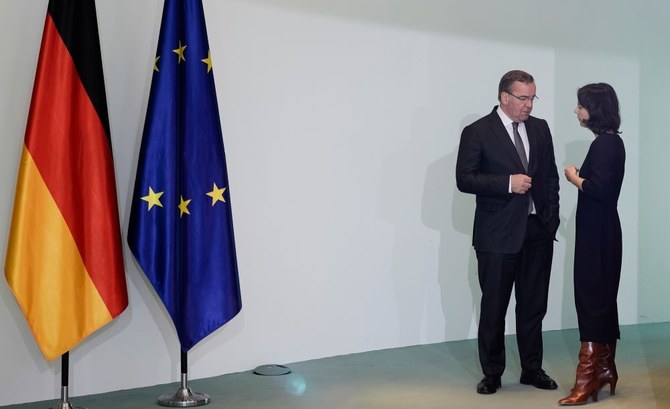
German Defense Minister Boris Pistorius and German FM Annalena Baerbock talk prior to a meeting of the German security cabinet at the chancellery in Berlin, Germany, Oct. 18, 2023. (AP Photo)
Short Url
Updated 19 October 2023
Follow

German defense minister from Lebanon: Withdrawing UNIFIL would send wrong signal

  • Beirut prepares for the possibility of war — hospitals receive emergency surgical supplies
  • Pistorius’s visit comes against the backdrop of the escalation between Israel and Hamas in Gaza

BEIRUT: Germany’s Defense Minister Boris Pistorius has warned against withdrawing the long-running UN peacekeeping mission from the country, arguing that such a move would send the wrong signal at this time.

Pistorius was visiting German soldiers serving in the peacekeeping force in southern Lebanon.

Berlin has deployed some 140 soldiers on a corvette off the Lebanese coast and at UNIFIL mission headquarters in southern Lebanon.

UNIFIL includes 9,994 peacekeepers from 49 countries.

Pistorius’s visit came against the backdrop of the escalation between Israel and Hamas in the Gaza Strip and clashes on the Blue Line between Hezbollah and Palestinian groups with the Israel Defense Forces.

Arab and foreign embassies have already urged their citizens to leave or avoid Lebanon on Thursday.

The countries include the US, UK, Australia, Canada, France, Germany, Spain, Saudi Arabia, Kuwait, and Bahrain.

The warnings came as Pierre Al-Ashkar, head of the Federation of Tourist Syndicates, said the recent events affected the tourism sector’s regular activity after the summer.

He added that European visitors canceled their reservations in Lebanon in October and November due to travel warnings from their countries.

Caretaker Foreign Minister Abdullah Bou Habib met on Thursday with Arab ambassadors to Lebanon.

He emphasized the importance of an immediate ceasefire in Gaza, providing aid, rejecting displacement, ending Israeli occupation, and establishing a Palestinian state as the solution.

The World Health Organization has delivered medical aid to Lebanon’s Ministry of Health.

It includes medicines and supplies necessary for emergency surgical operations from WHO’s logistical hub in Dubai.

The aid will be distributed to government and private hospitals and those at risk, especially in Beirut and the south.

It aims to provide medical assistance to injured patients in the event of a military conflict to prevent any potential health crisis.

The WHO noted that Lebanon’s health system has been “crippled while there are severe shortages of specialized medical doctors and health workers, and medicines and medical equipment.”

Also on Thursday, caretaker Prime Minister Najib Mikati met with officials of the UN humanitarian, development, and relief agencies operating in Lebanon.

The discussion centered on emergency plans drawn up by the UN to keep pace with developments in Lebanon in terms of services, humanitarian, health, and social aspects.

Maj. Gen. Mohammed Al-Mustafa, secretary-general of the Supreme Defense Council, and Imran Riza, UN resident and humanitarian coordinator for Lebanon, took part in the talks.

Caretaker ministers for health, interior, and environment were also present.

The protests that Lebanon witnessed on Wednesday in solidarity with the Gaza Strip turned into riots in the vicinity of the US Embassy in the Awkar area in Mount Lebanon.

Protesters assaulted neighboring buildings and set them on fire.

The protesters moved at night to the vicinity of the American University in Beirut, assaulted its walls, and smashed windows.

Police officers pursued the attackers, and strict security measures were implemented on Thursday morning.

Two missiles were fired from Lebanon on Thursday afternoon toward the settlements of Al-Manara and Misgav Am in the Upper Galilee, opposite the southern towns of Mays Al-Jabal and Hula.

IDF artillery targeted Lebanese border areas. Several villages in the western sector were subjected to direct Israeli bombardment in the early dawn.

Israeli warplanes raided the vicinity of the town of Naqoura, but no human casualties or material damages were recorded.


Trump’s Iranian missile claim unsupported by US intelligence, say sources

Updated 17 sec ago
Follow

Trump’s Iranian missile claim unsupported by US intelligence, say sources

  • Trump’s claim about Iran’s missile capability came as representatives from the US and Iran negotiate over Tehran’s nuclear program

WASHINGTON: US President Donald Trump’s claim that Iran will soon have a missile that can hit the United States is not backed by US intelligence ​reports, and appears to be exaggerated, according to three sources familiar with the reports, casting doubt on part of his case for a possible attack on the Islamic Republic.
In his State of the Union address to Congress on Tuesday, Trump began making his case to the American public for why the US could launch strikes against Iran, saying Tehran was “working on missiles that will soon reach” the United States.
But there have been no changes, two sources said, to an unclassified 2025 US Defense Intelligence Agency assessment that Iran could take until 2035 to develop a “militarily viable intercontinental ballistic missile” (ICBM) from its existing satellite-lofting space-launch vehicles (SLV).
“President Trump is absolutely right to highlight the grave concern posed by Iran, a country that chants ‘death to America,’ possessing intercontinental ballistic missiles,” said White House spokesperson Anna Kelly.
One source said that even if China or North Korea — which closely cooperate with Iran — provided technological ‌assistance, Iran would probably ‌take up to eight years at the earliest to produce “something that is actually ICBM level and ​operational.”
The ‌sources, ⁠who spoke ​on ⁠condition of anonymity in order to discuss sensitive intelligence, said they were unaware of any US intelligence assessments that Iran was developing a missile that could soon range the US homeland but did not rule out the possibility of a new intelligence report they were unaware of.
The New York Times first reported that US intelligence agencies believe Iran is probably years away from having missiles that can hit the United States.

Rubio says Iran on ‘pathway’ to weapons that can reach us
Trump’s claim about Iran’s missile capability came as representatives from the US and Iran negotiate over Tehran’s nuclear program, with no signs of a breakthrough that could avert potential US strikes amid a massive military buildup in the region.
The US president has done little to explain publicly why he might be leading ⁠the US into its most aggressive action against the Islamic Republic since its 1979 revolution.
In his address ‌on Tuesday, Trump pointed to Tehran’s support for militant groups, its killing of protesters and the ‌country’s missile and nuclear programs as threats to the region and the United States.
Without providing ​evidence, Trump said that Tehran was beginning to rebuild the nuclear program ‌that he claimed had been “obliterated” by US airstrikes last June on three major sites involved with uranium enrichment.
US Secretary of State Marco Rubio on ‌Wednesday referred to Iran’s ballistic missile program in less definitive terms than Trump, saying that Tehran is “on a pathway to one day being able to develop weapons that could reach the continental US“
Iran denies seeking a nuclear arsenal, saying its enrichment of uranium – a process that produces fuel for power plants and nuclear warheads depending on its duration – is strictly for civilian uses.
In an interview with India Today TV released on Wednesday, Iranian Foreign Minister Abbas Araghchi denied that Iran was expanding its ‌missile capabilities.
“We are not developing long range missiles. We have limited range to below 2000 kilometers intentionally,” he said. “We don’t want it to be a global threat. We only have (them) to defend ourselves. Our missiles ⁠build deterrence.”

Weapons program shuttered in ⁠2003, according to IAEA
The US intelligence community and the International Atomic Energy Agency (IAEA), the UN nuclear watchdog, have said that Iran shuttered a nuclear weapons development program in 2003.
But according to the IAEA, Tehran has in recent years continued enriching uranium, including to near weapons-grade.
Trump has threatened to attack Iran if it executes people arrested during nationwide anti-government protests in January or fails to agree a deal on its nuclear program in talks with the US
Iran has the largest ballistic missile force in the Middle East, with its missiles able to strike Israel, US bases in the region and parts of Europe.”
It also has developed so-called space-launch vehicles that have put satellites into orbit and that experts say could be modified into ICBMs that could loft nuclear warheads.
While SLVs loft satellites, ICBMs release re-entry vehicles that protect warheads from the high temperatures and forces produced by hurtling down through the Earth’s atmosphere.
But David Albright, a former UN nuclear inspector, said Iran was a long way away from being able to mount atop a missile a nuclear warhead-carrying re-entry vehicle that could survive the extreme heat and forces of plunging through Earth’s atmosphere.
“Iran can launch a very long-range missile ​because of its space launch program,” said Albright, the president of the Institute ​for Science and International Security think tank. “But it needs lots of work to develop an adequate RV (re-entry vehicle).”
Albright and other experts noted that Israeli airstrikes last year and in 2024 had badly damaged key facilities where Tehran produces liquid- and solid-fuel ballistic missiles.