

Kidnappers free two anti-polio vaccinators in Pakistan’s militancy-hit northwest — police

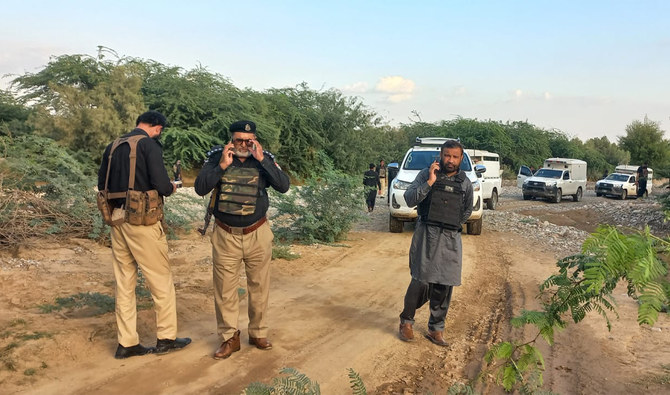
Pakistani police personnel are pictured after kidnappers release two anti-polio workers in Umar Khan village in the Pakistan's Tank district on October 17, 2023. (Photo courtesy: District Police Office Tank)
Short Url
Updated 20 October 2023
Follow

Kidnappers free two anti-polio vaccinators in Pakistan’s militancy-hit northwest — police

  • The workers had gone to a far-flung village to carry out a quality assessment exercise for an inoculation drive 
  • Police say local tribal elders held talks with kidnappers hiding in nearby mountains and facilitated the release 

PESHAWAR: Unidentified kidnappers on Thursday released two members of an anti-polio survey team, who were abducted earlier this week, in Pakistan’s northwestern Khyber Pakhtunkhwa (KP) province, officials said. 

Around 10 gunmen initially captured four members of the team from the remote Umar Khan village in the Tank district on Tuesday, according to the police. 

They later released two members, Shaila Noor and Waheed Khan, and took the remaining two with them to remote mountains of the neighboring South Waziristan district, which had long been a stronghold of the Pakistani Taliban. 

On Thursday, the kidnappers released the hostages after talks with tribal elders, according to Tank District Police Officer (DPO) Iftikhar Ali Shah. 

“Tribal elders, supported by security forces and police, played a crucial role which led to the safe recovery of the kidnapped persons,” Shah told Arab News. 

The recovered anti-polio workers were identified as Zulfiqar and Muhammad Shuaib, according to the official. 

No group claimed responsibility for the abduction. 

Pakistan and Afghanistan are the only two countries in the world where polio remains endemic. 

But many Pakistanis are suspicious of foreign entities funding polio vaccination campaigns and of the government itself. The doubts and fears have led to attacks on polio teams and the law enforcers guarding them, especially in KP. 

On October 2, Pakistan launched a five-day national anti-polio campaign to inoculate 44 million children under the age of 5. 

Tahir Khan, who oversees the polio eradication campaign in the Tank region, said the abducted workers were part of the Lot Quality Assurance Sampling (LQAS) team, which had gone to the far-flung village to carry out a quality assessment exercise in the wake of the inoculation drive in the area. 

“Thank God, both were freed today and have reached their homes,” Khan told Arab News. “Because of consistent efforts of tribal elders, police, security officials and district administration, they were released unharmed.” 


Pakistani president arrives in Iraq to deepen trade, energy cooperation

Updated 20 December 2025
Follow

Pakistani president arrives in Iraq to deepen trade, energy cooperation

  • Visit follows recent high-level contacts as Islamabad seeks to expand limited commercial ties with Baghdad
  • Talks are expected to cover investment, manpower and facilitation of Pakistani pilgrims visiting holy sites in Iraq

ISLAMABAD: President Asif Ali Zardari arrived in Iraq on Saturday on an official visit aimed at expanding cooperation in trade, energy and investment, as Pakistan seeks to deepen ties with Baghdad after years of limited engagement.

Pakistan and Iraq established diplomatic relations in 1947 and have traditionally maintained cordial ties, though commercial links remain modest, with officials and business groups identifying scope for cooperation in construction services, pharmaceuticals, manpower and agricultural exports.

“President Asif Ali Zardari arrived in Baghdad on a four-day official visit to Iraq,” his office said in a post on X. “He was received by Culture Minister Dr. Ahmed Fakkak Al-Badrani. During the visit, meetings with senior Iraqi leadership are expected to advance cooperation and further strengthen Pakistan-Iraq relations.”

Zardari’s visit follows a series of recent high-level contacts between the two countries, reflecting efforts to broaden bilateral engagement beyond traditional diplomatic ties and explore collaboration across economic, political and people-to-people domains.

According to Pakistan’s foreign office, the president is expected to hold meetings with Iraq’s senior leadership to discuss cooperation in various areas such as trade and investment, energy, technology, education and manpower.

He is also expected to discuss regional and international issues with Iraqi officials.

Earlier this month, Pakistan’s Interior Minister Mohsin Naqvi met his Iraqi counterpart, Abdul Ameer Al-Shammari, on the sidelines of meetings in Brussels, where both sides agreed to enhance cooperation on security and facilitate travel for Pakistani Shia pilgrims to Najaf and Karbala.

The two officials discussed measures to ensure the smoother movement of these pilgrims and their compliance with visa regulations.