

Leaders from ASEAN, GCC countries arrive in Riyadh for maiden summit

1 / 3
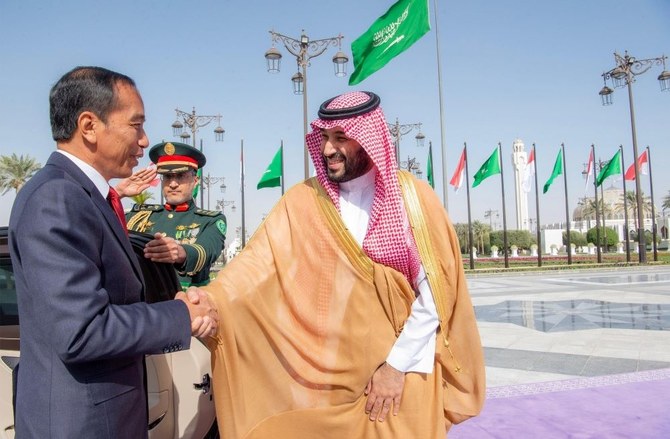
Indonesian President Joko Widodo is greeted by Crown Prince Mohammed bin Salman at Al Yamamah Palace in Riyadh. (SPA)
2 / 3
Indonesian President Joko Widodo and Crown Prince Mohammed bin Salman at Al Yamamah Palace in Riyadh. (SPA)
3 / 3
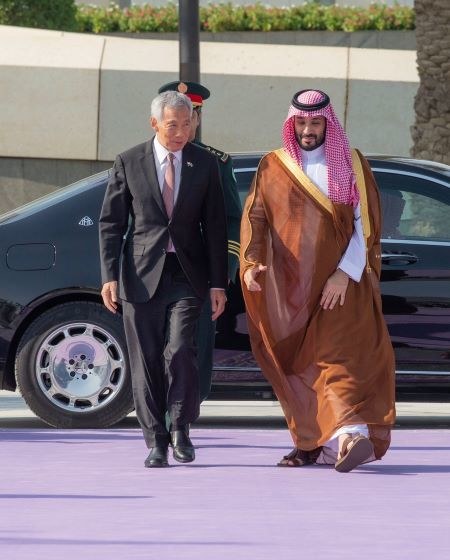
Crown Prince Mohammed bin Salman and Singapore’s Prime Minister Lee Hsien Loong at Al Yamamah Palace in Riyadh. (SPA)
Short Url
Updated 19 October 2023
Follow

Leaders from ASEAN, GCC countries arrive in Riyadh for maiden summit

  • Crown Prince Mohammed bin Salman welcomed delegates as they arrived in the Saudi capital
  • ASEAN Secretary-General Dr. Kao Kim Hourn will lead the association’s delegation to the summit

RIYADH: Leaders from Southeast Asia have been arriving in the Saudi capital for the first Association of Southeast Asian Nations-Gulf Cooperation Council Summit on Friday.

Although the two organizations established relations in 1990, the gathering will be their maiden summit with the aim of optimizing cooperation between the regional blocs.

ASEAN Secretary-General Dr. Kao Kim Hourn will lead the association’s delegation to the summit which will conclude with the issuing of a joint statement on its outcomes and cooperation plans for 2024 to 2028.

Malaysia’s Minister of Foreign Affairs Zambry Abdul Kadir on Thursday told reporters at the Malaysian Embassy in Riyadh that his country would be looking to strengthen relations with Gulf countries while attending the summit.

He said: “As the ASEAN coordinator for this historic summit, Malaysia has been entrusted to assist Saudi Arabia’s preparations in its capacity as the host.”

For Southeast Asian leaders, the meeting also offers an opportunity to seek assistance from Gulf states on issues related to energy security.

In a statement, Singapore’s Foreign Ministry said: “At the summit, the ASEAN-GCC leaders will discuss ways to strengthen relations and expand cooperation to new and emerging areas such as the green and digital economies.”

Crown Prince Mohammed bin Salman welcomed delegates as they arrived in the Saudi capital.

During a meeting with the crown prince at Al Yamamah Palace in Riyadh, Singapore’s Prime Minister Lee Hsien Loong discussed cooperation between the two countries and regional and international issues of mutual concern.

Dr. Abdulaziz Al-Uwaisheg, GCC assistant secretary-general for political affairs and negotiations, said: “The timing of this participation is crucial, especially in terms of the events and circumstances the region is going through.”

The crown prince also met Vietnam’s Prime Minister Pham Minh Chinh and Indonesian President Joko Widodo, who arrived in Riyadh on Wednesday. Filipino President Ferdinand Marcos Jr. arrived on Thursday.

The GCC comprises Saudi Arabia, Oman, Qatar, Bahrain, Kuwait, and the UAE, while the ASEAN bloc is made up of Indonesia, Malaysia, Singapore, Thailand, Vietnam, Brunei Darussalam, Cambodia, Laos, Myanmar, and the Philippines.

The value of trade between ASEAN nations currently stands at more than $110 billion.


Makkah’s urban shift enhances the city’s quality of life

Updated 08 February 2026
Follow

Makkah’s urban shift enhances the city’s quality of life

  • By harmonizing its religious heritage with modern urban development, Makkah is proving that a city can honor its past while vigorously embracing the future

MAKKAH: Islam’s holiest city is currently witnessing a qualitative urban shift, one that seamlessly blends its profound spiritual sanctity with a modern, vibrant lifestyle. By integrating cultural, educational, and entertainment initiatives, Makkah is redefining the visitor experience and significantly enhancing the quality of life for its residents, directly supporting the goals of Saudi Vision 2030.

The city’s transformation was recently highlighted by the success of the Makkah winter season. The event attracted approximately 400,000 visitors — over 60% of whom were locals — demonstrating a strong domestic demand for high-quality public spaces.

The season revitalized community interaction, driving a 35% increase in visits to recreational sites and creating more than 1,200 temporary jobs for the local workforce.

Central to this urban renaissance is the Hira Cultural District. Since opening its doors in January 2023 near the historic Mount Hira, the district has become a definitive landmark that bridges Islamic history with contemporary identity.

Makkah’s Hira Cultural District has become a definitive landmark that bridges Islamic history with contemporary identity. (SPA photo)

Far from being a static monument, the district has cultivated a thriving creative economy. Its craftsmanship program, which features over 100 artisans, has generated up to SAR 3 million in sales and attracted 130,000 visitors to live workshops. These interactive spaces allow visitors to engage directly with the region’s heritage, moving beyond passive observation to active participation.

A living legacy 

The shift extends to Makkah’s broader ecosystem of museums and cultural sites, which are now positioned as key pillars of cultural tourism. Facilities like the Revelation Exhibition use cutting-edge technology and multilingual content to narrate the story of the Holy Quran’s revelation, offering an immersive experience that complements the spiritual journey of pilgrims.

These efforts align with the “Makkah: A Living Legacy” campaign, which seeks to document the city’s historical narrative and preserve its collective memory. Recent months have seen a surge in educational workshops for university students and tour guides, ensuring that the human element of Makkah’s history is conveyed with accuracy and depth.

City’s transformation recently highlighted by the success of the Makkah winter season. (SPA photo)
 

Economic and social impact 

The results of this integrated approach are tangible. Specialized museums and restored historic sites now attract up to 1.6 million annual visitors. Crucially, this cultural enrichment is encouraging pilgrims to linger longer, increasing the average duration of stay by 18%.

By harmonizing its religious heritage with modern urban development, Makkah is proving that a city can honor its past while vigorously embracing the future, offering a holistic experience that nourishes both the soul and the community.