

Taliban say plan to formally join China’s Belt and Road Initiative 

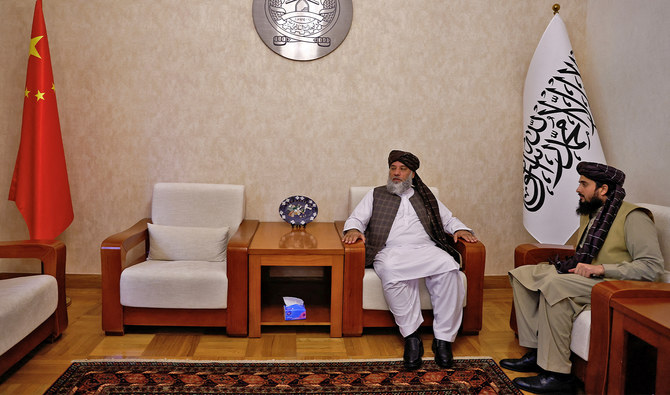
Taliban's acting commerce minister Haji Nooruddin Azizi sits next to flags of the Islamic Emirate of Afghanistan and China, during an interview with Reuters, at the Embassy of Afghanistan in Beijing, China on October 19, 2023. (REUTERS)
Short Url
Updated 19 October 2023
Follow

Taliban say plan to formally join China’s Belt and Road Initiative 

  • China has sought to develop ties with the Taliban since they took over in 2021 
  • Last month, China became the first country to appoint an ambassador to Kabul 

BEIJING: The Taliban administration wants to formally join Chinese President Xi Jinping’s huge ‘Belt and Road’ infrastructure initiative and will send a technical team to China for talks, Afghanistan’s acting commerce minister said on Thursday. 

Beijing has sought to develop its ties with the Taliban-run government since it took over in 2021, even though no other foreign government has recognized the administration. 

Last month, China became the first country to appoint an ambassador to Kabul, with other nations retaining previous ambassadors or appointed heads of mission in a charge d’affaires capacity that does not involve formally presenting credentials to the government. 

“We requested China to allow us to be a part of the China-Pakistan Economic Corridor and Belt and Road Initiative... (and) are discussing technical issues today,” acting Commerce Minister Hajji Nooruddin Azizi told Reuters in an interview a day after the Belt and Road Forum ended in Beijing. 

The Pakistan “economic corridor” refers to the huge flagship section of the Belt and Road Initiative (BRI) in Afghanistan’s neighbor. 

Azizi said the administration would also send a technical team to China to enable it to “better understand” the issues standing in the way of it joining the initiative, but did not elaborate on what was holding Afghanistan back. 

Afghanistan could offer China a wealth of coveted mineral resources. Several Chinese companies already operate there, including the Metallurgical Corp. of China Ltd. (MCC) which has held talks with the Taliban administration, as well as the previous Western-backed government, over plans for a potentially huge copper mine. 

“China, which invests all over the world, should also invest in Afghanistan... we have everything they need, such as lithium, copper and iron,” Azizi said. “Afghanistan is now, more than ever, ready for investment.” 

Asked about the MCC talks, Azizi said discussions had been delayed because the mine was near a historical site, but they were still ongoing. “The Chinese company has made a huge investment, and we support them,” he added. 

Investors have said security remains a concern. The Islamic State militant group has targeted foreign embassies and a hotel popular with Chinese investors in Kabul. 

Asked about the security challenges, Azizi said security was a priority for the Taliban-run government, adding that after 20 years of war — which ended when foreign forces withdrew and the Taliban took over — meant more parts of the country were safe. 

“It is now possible to travel to provinces where there is industry, agriculture and mines that one previously could not visit... security can be guaranteed,” Azizi added. 

Afghanistan and 34 other countries agreed to work together on the digital economy and green development on the sidelines of the Belt and Road Forum on Wednesday.


Trump to launch Board of Peace that some fear rivals UN

Updated 9 sec ago
Follow

Trump to launch Board of Peace that some fear rivals UN

  • US president sees board as going beyond Gaza to address global challenges
  • 35 countries including Israel, Saudi Arabia, Turkiye have committed; Russia considering
DAVOS, Switzerland: US President Donald Trump will on Thursday launch his Board of Peace, originally envisaged to help end the Gaza war but which he now sees having a wider role that Europe and some others fear will rival or undermine the United Nations.
Trump, who will chair the board, has invited dozens of other world leaders to join it and sees the grouping addressing other global challenges beyond Gaza, though he does not intend it as a replacement for the United Nations, he has said.
Some traditional US allies have balked at joining the board, ‌which Trump says ‌permanent members must help fund with a payment of $1 billion ‌each, ⁠either responding ‌cautiously or declining the invitation.
No other permanent member of the UN Security Council — the five nations with the most say over international law since the end of World War Two — except the US has yet committed to join.
Russia said late on Wednesday it was studying the proposal after Trump said it would join. France has declined. Britain said on Thursday it was not joining at present. China has not yet said whether it will join.
However, around 35 countries have committed to ⁠join including Saudi Arabia, the United Arab Emirates, Egypt, Turkiye and Belarus.
The signing ceremony will be held in Davos, Switzerland, where ‌the annual World Economic Forum bringing together global political and ‍business leaders is taking place.
Sputtering Gaza ceasefire
The ‍board’s charter will task it with promoting peace around the world, a copy seen ‍by Reuters showed, and Trump has already named other senior US officials to join it, as well as former British Prime Minister Tony Blair.
The ceasefire in Gaza, agreed in October, has sputtered for months with Israel and Hamas trading blame for repeated bursts of violence in which several Israeli soldiers and hundreds of Palestinians have been killed.
Both sides accuse each other of further violations, with Israel saying Hamas has procrastinated on returning a final body of a ⁠dead hostage and Hamas saying Israel has continued to curb aid into Gaza despite an ongoing humanitarian catastrophe.
Each side rejects the other’s accusations.
Israeli Prime Minister Benjamin Netanyahu has accepted an invitation by Trump to join the board, the Israeli leader’s office says. Palestinian factions have endorsed Trump’s plan and given backing to a transitional Palestinian committee meant to administer the Gaza Strip with oversight by the board.
Trump has been characteristically bold in his comments on Gaza, saying the ceasefire amounts to “peace in the Middle East.”
Even as the first phase of the truce stumbles, its next stage must address much tougher long-term issues that have bedeviled earlier negotiations, including Hamas disarmament, security control in Gaza and eventual Israeli withdrawal.
On Wednesday in Davos, Trump met Egyptian President Abdel Fattah ‌El-Sisi, whose country played a major role in Gaza truce mediation talks, and they discussed the board.