

Taliban say plan to formally join China’s Belt and Road Initiative 

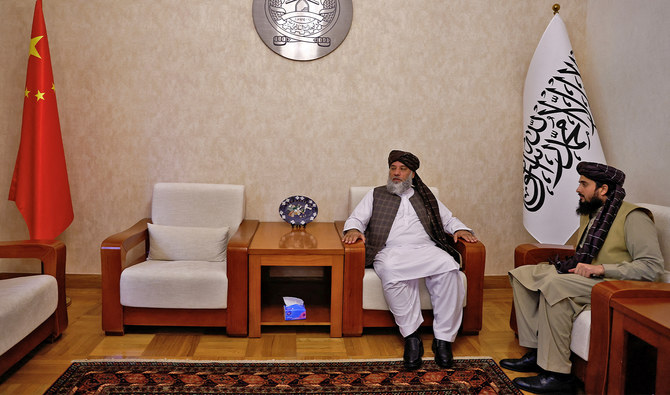
Taliban's acting commerce minister Haji Nooruddin Azizi sits next to flags of the Islamic Emirate of Afghanistan and China, during an interview with Reuters, at the Embassy of Afghanistan in Beijing, China on October 19, 2023. (REUTERS)
Short Url
Updated 19 October 2023
Follow

Taliban say plan to formally join China’s Belt and Road Initiative 

  • China has sought to develop ties with the Taliban since they took over in 2021 
  • Last month, China became the first country to appoint an ambassador to Kabul 

BEIJING: The Taliban administration wants to formally join Chinese President Xi Jinping’s huge ‘Belt and Road’ infrastructure initiative and will send a technical team to China for talks, Afghanistan’s acting commerce minister said on Thursday. 

Beijing has sought to develop its ties with the Taliban-run government since it took over in 2021, even though no other foreign government has recognized the administration. 

Last month, China became the first country to appoint an ambassador to Kabul, with other nations retaining previous ambassadors or appointed heads of mission in a charge d’affaires capacity that does not involve formally presenting credentials to the government. 

“We requested China to allow us to be a part of the China-Pakistan Economic Corridor and Belt and Road Initiative... (and) are discussing technical issues today,” acting Commerce Minister Hajji Nooruddin Azizi told Reuters in an interview a day after the Belt and Road Forum ended in Beijing. 

The Pakistan “economic corridor” refers to the huge flagship section of the Belt and Road Initiative (BRI) in Afghanistan’s neighbor. 

Azizi said the administration would also send a technical team to China to enable it to “better understand” the issues standing in the way of it joining the initiative, but did not elaborate on what was holding Afghanistan back. 

Afghanistan could offer China a wealth of coveted mineral resources. Several Chinese companies already operate there, including the Metallurgical Corp. of China Ltd. (MCC) which has held talks with the Taliban administration, as well as the previous Western-backed government, over plans for a potentially huge copper mine. 

“China, which invests all over the world, should also invest in Afghanistan... we have everything they need, such as lithium, copper and iron,” Azizi said. “Afghanistan is now, more than ever, ready for investment.” 

Asked about the MCC talks, Azizi said discussions had been delayed because the mine was near a historical site, but they were still ongoing. “The Chinese company has made a huge investment, and we support them,” he added. 

Investors have said security remains a concern. The Islamic State militant group has targeted foreign embassies and a hotel popular with Chinese investors in Kabul. 

Asked about the security challenges, Azizi said security was a priority for the Taliban-run government, adding that after 20 years of war — which ended when foreign forces withdrew and the Taliban took over — meant more parts of the country were safe. 

“It is now possible to travel to provinces where there is industry, agriculture and mines that one previously could not visit... security can be guaranteed,” Azizi added. 

Afghanistan and 34 other countries agreed to work together on the digital economy and green development on the sidelines of the Belt and Road Forum on Wednesday.


Australia’s US ambassador Rudd to step down early

Updated 5 sec ago
Follow

Australia’s US ambassador Rudd to step down early

SYDNEY: Australia’s ambassador to the United States Kevin Rudd is stepping down, Prime Minister Anthony Albanese said ​on Tuesday, a year earlier than expected following criticism from US President Donald Trump.
Rudd, a former Australian prime minister, is returning to head the Asia Society think tank and will finish his posting in March, Albanese told a news conference.
“Australia and the United States are the closest of friends and allies, and this will never change,” he said. “We will continue to take forward ‌the important ‌work that Kevin has done, some of ‌it ⁠is, ​of course, ‌ongoing work.”
Rudd had secured continued support for the AUKUS nuclear submarine program, Australia’s largest defense project, from the Trump administration, and negotiated a critical minerals agreement with the US, Albanese said.
Rudd made several comments criticizing Trump before he became ambassador, including calling him “the most destructive president in history.” He later deleted that comment from social media when he ⁠was appointed ambassador.
When asked during an October event at the White House ‌during a visit by Albanese about Rudd’s past ‍comments, Trump gestured to the ambassador ‍across the table and said “I don’t like you either, and ‍I probably never will.”
Following criticism from Australia’s opposition, who called for him to be sacked over his remarks about Trump, Albanese said in October that Rudd would serve out his four-year term.
Albanese said the decision ​to leave the role early was “entirely Kevin Rudd’s decision.” An announcement of Rudd’s replacement would be made at ⁠a later date, he said.
A White House official told Reuters when asked about Rudd’s departure: “Ambassador Rudd worked well with President Trump and the administration. We wish him well.”
Rudd wrote on social media platform X that he would remain in the United States, working on “the future of US-China relations, which I have always believed to be the core question for the future stability of our region and the world.”
He had hosted a dinner for Pentagon Under Secretary of Defense Elbridge Colby, who conducted a review of AUKUS last year, two ‌days ago, Rudd wrote in an earlier post.