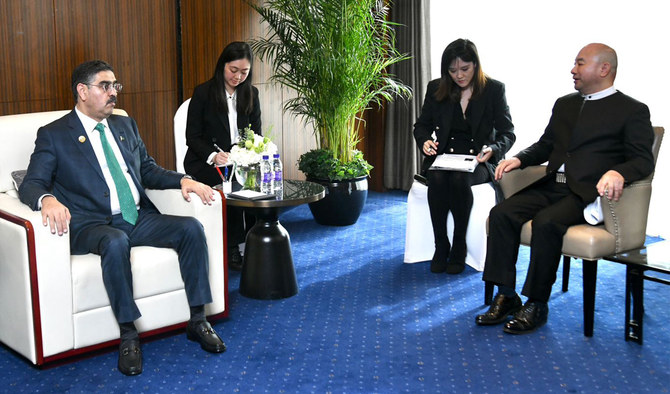

ISLAMABAD: Prime Minister Anwaar-ul-Haq Kakar on Thursday met a number of industry giants in China from the construction, steel, minerals, food, copper and other sectors, as he aims to sell Pakistan’s investment potential to firms in Beijing while on a trip to attend the Belt and Road Forum.
Since 2015, Pakistan has completed more than 50 projects worth $25 billion under the China-Pakistan Economic Corridor (CPEC), Kakar told the conference in his address on Wednesday. CPEC is a flagship project under China’s Belt and Road Initiative, with more than $65 billion pledged for road, rail and other infrastructure developments in the South Asian nation of 241 million people.
On Wednesday, Pakistan Refinery Limited (PRL) and the United Energy Group of China (UEG) signed a memorandum of understanding (MoU) for investment worth $1.5 billion in Pakistan’s petroleum sector.
On Thursday, Kakar held a slew of meetings, starting with meeting Weng Zuliang, chairman of China Minmetals Corporation, a metals and mineral trading company headquartered in Beijing, as well as the chairman of the Metallurgical Corporation of China Ltd. (MCC), a subsidiary of China Metallurgical Group Corp, a construction and property development company.
“There was a discussion regarding investment in mining and minerals sector in Pakistan,” Kakar’s office said in a statement, adding that the PM informed the firms about the government’s business-friendly policies. “Both the companies expressed deep interest in investing in Pakistan.
“The Prime Minister also informed the participants about the Special Investment Facilitation Council and said that the government is taking steps to promote investment in Pakistan under the whole-of-the-government approach.”
The SIFC is a hybrid civil-military government body Pakistan set up in June to attract foreign investment in key economic sectors, particularly from Gulf nations.
In a separate meeting, Kakar met the CEO of the China Communications Construction Company (CCCC) Wang Haihuai, and Du Fei, the chairman of the China Road and Bridge Corporation (CRBC).
CCCC is a majority state-owned, publicly traded, multinational engineering and construction company primarily engaged in the design, construction and operation of infrastructure assets, including highways, bridges, tunnels, railways (especially high-speed rail), subways, airports, oil platforms, and marine ports. CCCC has been a contractor for numerous Belt and Road Initiative projects.
China Road and Bridge Corporation, a subsidiary of Fortune Global 500 company China Communications Construction Company, focuses on global civil engineering and construction projects such as highways, railways, bridges, ports, and tunnels.
“In the meeting, the participants informed about the ongoing projects of CCCC and CRBC in Pakistan under CPEC. The participants expressed keen interest in increasing their investment in infrastructure construction, renewable energy and other sectors in Pakistan,” the PMO said in a statement.
“The Prime Minister welcomed the projects of Chinese companies in Pakistan and welcomed their interest in increasing their investment. The Prime Minister said that Pakistan is taking steps for the development of infrastructure across the country. He further said that railway and road infrastructure is very important for making Pakistan a transitional economy and for the development of tourism in the country.”
Kakar welcomed the interest of Chinese companies in increasing investment in Pakistan.
A delegation from China Oil and Foodstuffs (COFCO) also met Kakar. COFCO is a Chinese state-owned food processing holding company. COFCO Group is China’s largest food processor, manufacturer and trader. It is also one of Asia’s leading agribusiness groups alongside Wilmar International.
“In the meeting, the Prime Minister informed the participants about the agricultural sector of Pakistan [and said the] government is taking steps for the development of the agriculture sector, while the agriculture sector has also been included in the Special Investment Facilitation Council,” the PMO said.
“Pakistan is not only trying to increase the agricultural production but also taking steps to increase the processing and exports of agricultural production.”
Kakar’s office said the COFCO delegation expressed “deep interest” in investing in Pakistan.
Kakar also separately met Wang Wenyin, a Chinese businessman and chairman of Amer International Group, a Chinese giant that produces cable and copper products.
A statement from Kakar’s office said Wang “expressed deep interest in investing in the copper and steel industry in Pakistan.”
The PM also met Luo Zhaohui, chairman of the China International Development Cooperation Agency (CIDCA), and discussed ongoing CPEC projects as well as future collaboration in “socioeconomic development projects under the CPEC framework in agriculture, health, education, vocational education, water supply and poverty alleviation.”
The PM also held a meeting with Liu Jianchao, Minister of the International Department of the CPC Central Committee.
“Prime Minister Kakar and Minister Liu discussed promotion of people-to-people contacts, including exchanges between Parliaments, political parties, academia, media, youth, women and think tanks,” the PMO said.
“These exchanges would help advance the exceptional friendship between Pakistan and China that endures from generation to generation.”