PM requests Kenyen president to facilitate investigation into Pakistani journalist Arshad Sharif’s murder

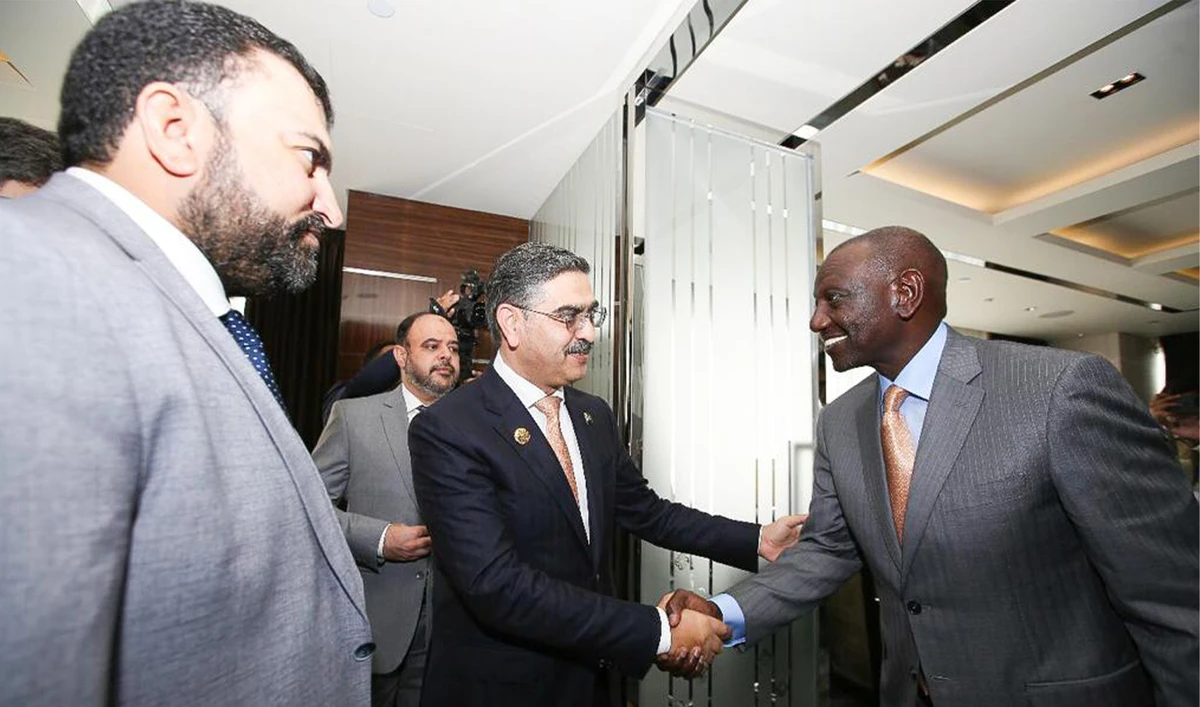
Pakistan's caretaker Prime Minister Anwaar-ul-Haq Kakar (left) meets Kenyan President Dr. William Ruto (right) in Beijing, China, on October 17, 2023. (Government of Pakistan)
Short Url
Updated 18 October 2023
Follow

PM requests Kenyen president to facilitate investigation into Pakistani journalist Arshad Sharif’s murder

  • Kenyan police have said Sharif’s killing last October was case of “mistaken identity” during a search for a similar car
  • Sharif had been on the run in Kenya, citing threats to his life, when he was killed outside Nairobi on Oct. 23 last year

ISLAMABAD: Pakistani Caretaker Prime Minister Anwaar-ul-Haq Kakar has requested Kenyan President Dr. William Ruto to help a special joint investigation finalize its probe into the murder of Pakistani journalist Arshad Sharif, allegedly shot dead by police in Nairobi last October.

Kenyan police have expressed regret over the killing of Sharif and said it was a case of “mistaken identity” during a search for a similar car involved in a child abduction case.

In a meeting with the Kenyan president on Tuesday on the sidelines of the Belt and Road Forum in Beijing, Kakar discussed the investigation into Sharif’s murder.

“The Prime Minister also requested the Kenyan President for facilitation and finalization of the report of Special Joint Investigation Team in the murder case of late Pakistani journalist Arshad Sharif,” a statement from Kakar’s office said.

Sharif was considered deeply critical of Pakistan’s powerful military, and was pro-Imran Khan, Pakistan’s now jailed former prime minister. The popular primetime anchorman left Pakistan last August after sedition charges were filed on him over an interview with an opposition politician during which comments deemed offensive to the military were made.

The ARY news channel for which he worked as an anchor for eight years cut ties with Sharif after the broadcaster was briefly taken off air following the controversial interview of Shahbaz Gill, a close aide of ex-PM Khan.

Sharif had been on the run in Kenya, citing threats to his life in Pakistan, when he was killed on the outskirts of Nairobi on Oct. 23 last year.

The killing stunned journalists in Pakistan as well as the Pakistani public among whom Sharif had a wide following.

Despite the Kenyan police findings of the ‘mistaken identity killing’, Pakistan’s then interior minister said there was evidence to suggest Sharif’s was a targeted killing based on initial findings of a team of Pakistani investigators who visited Kenya. Interior Minister Rana Sanaullah said Sharif’s body had bruises and torture marks.

Pakistan says military operation concluded in Balochistan, 216 militants killed 

Updated 8 sec ago
Follow

Pakistan says military operation concluded in Balochistan, 216 militants killed 

  • Separatist BLA militant group claimed responsibility for coordinated attacks across Balochistan last week 
  • Military says 36 civilians, 22 law enforcement and security forces personnel have been killed in attacks 

PESHAWAR: Pakistani forces have concluded a security operation in the southwestern Balochistan province and killed 216 militants after a series of coordinated attacks by separatist militants last week, the military’s media wing said on Thursday. 

Separatist militant group Baloch Liberation Army (BLA) claimed responsibility for a series of attacks in Balochistan last Friday and Saturday in multiple districts across the province, one of the deadliest flare-ups in the area in recent years. 

Pakistan military’s media wing, the Inter-Services Public Relations (ISPR), said security forces launched operations in Panjgur and Harnai district’s outskirts on Jan. 29 based on intelligence confirming the presence of “terrorist elements,” killing 41 militants. 

It said the military launched a broader series of intelligence-based operations in multiple areas of the province after that to dismantle “terrorist sleeper cells,” referring to it as “Operation Radd-ul-Fitna-1.”

“As a result of these well-coordinated engagements and subsequent clearance operations, 216 terrorists have been sent to hell, significantly degrading the leadership, command-and-control structures and operational capabilities of terrorist networks,” the ISPR said in a statement.

The military said 36 civilians, including women and children, were killed by militants while 22 security forces and law enforcement personnel also lost their lives. 

The ISPR said a substantial cache of foreign-origin weapons, ammunition, explosives and equipment were also recovered during the counteroffensive operations. 

“Preliminary analysis indicates systematic external facilitation and logistical support to these extremist proxies,” the statement said. 

The military said Pakistan’s armed forces remain steadfast in their resolve to combat “terrorism,” vowing that counterterror operations will continue until militants are completely eliminated. 

“Operation Radd-ul-Fitna-1 stands as a testament to Pakistan’s and particularly Balochistan’s proud peoples’ unwavering commitment to always prefer peace over violence, unity over division and development over violence,” the ISPR said. 

Pakistan’s government has accused India of being behind the militant attacks in Balochistan, charges that New Delhi has rejected as “baseless.”

Balochistan, Pakistan’s largest province by land area, has long faced a separatist insurgency that has intensified in recent years. Militants frequently target security forces, government officials, infrastructure projects, foreigners and non-local workers.

The province holds vast reserves of minerals and hydrocarbons and is central to the multibillion-dollar China-Pakistan Economic Corridor (CPEC), a flagship component of China’s Belt and Road Initiative.

Separatist groups such as the BLA accuse Islamabad of exploiting Balochistan’s natural resources while denying locals a fair share. Pakistan’s civilian and military leadership reject the claim and say they are investing in the province’s development.